Buy for the size it packs to, not for the wind speed on the box. An umbrella is the only piece of travel gear whose entire value depends on a decision made hours earlier, in a hotel room, about whether to bother carrying it. Get the packed size wrong and the best-built umbrella in the world stays on the luggage rack while its owner gets soaked. Everything else in this category — ribs, vents, coatings, wind claims — is a negotiation with that one fact.
Packed length is the whole decision
The six picks on this page span from a micro-mini that lives in a handbag to a 25-inch carbon stick that straps to the outside of a backpack. That is not a range of quality. It is a range of where the umbrella lives, and it is the first thing to settle.
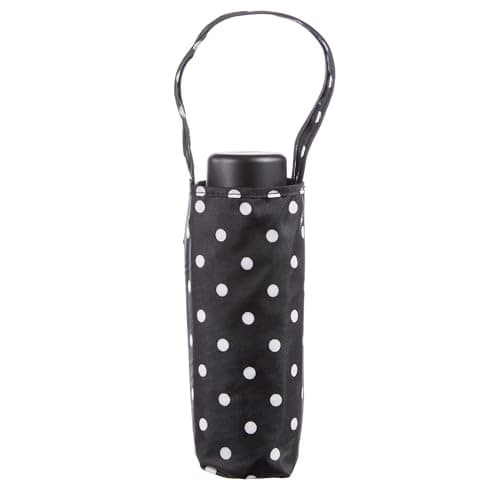
Under about 8 inches is handbag and laptop-sleeve territory. An umbrella this small is carried every day rather than on days when rain is forecast, which means it is present for the shower nobody predicted. The cost is coverage: a very short shaft under a modest canopy keeps a head dry and lets shoulders and a backpack take the rest.
Eleven to twelve inches is the standard three-fold compact, and it is where most of this category lives. It slides into the water-bottle pocket of a packable daypack, the outside pocket of a carry-on, or a tote. This is the default size for a traveler and the right answer unless something specific pushes you off it.
Fifteen inches and up stops being luggage and starts being an object you carry. It buys real canopy depth and real wind survival, and it is the correct choice for someone who walks in genuine weather — but it will not disappear into a day bag, and anyone who promises themselves it will is about to leave it in a hotel room.
There is a version of this decision for every bag on the site, and it is the same one we work through in how to pack a carry-on: the item that gets used is the item that is reachable, not the item that is best.
Wind ratings are marketing, and here is the proof
No agency certifies an umbrella’s wind rating. There is no test standard behind the numbers on these listings, and the clearest evidence is that the same product carries two different numbers depending on where you read it.
Our top pick is sold on Amazon under a title claiming it withstands winds up to 100 mph. Repel’s own product page for the same umbrella says it is designed to withstand gusts of 50 mph. Both are published by parties with an interest in the sale. Neither is a measurement you can check.
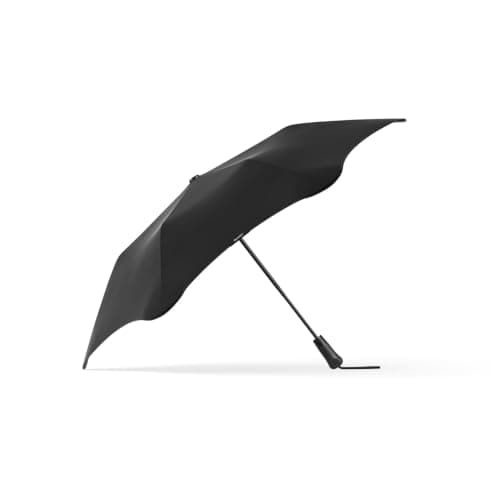
Independent testing is far less flattering than any of it. GearLab drives umbrellas out of a moving vehicle and runs them in a wind tunnel; across their comparison, compact umbrellas started inverting in the 15 to 25 mph range. Our top pick buckled at 20 mph and inverted at 15 mph when deliberately angled into the wind, recovering both times without damage. The Blunt Metro inverted around 22 mph and began collapsing at 35. The cheap automatic on this page collapsed at “relatively low speeds”, though nothing on it broke.
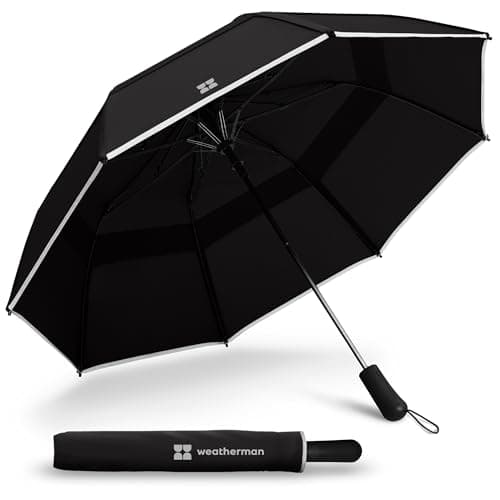
One model in that comparison reached its own claim: the Weatherman Collapsible, which the manufacturer wind-tunnel tests to 55 mph and which testers pushed to 55 mph before collapse. That is the exception that makes the rule useful. If a wind number matters to you, buy the product whose number somebody else has checked — and accept that it weighs and packs like an umbrella that can do that.
The practical translation for a gift buyer: treat every wind figure as a marketing claim, and buy the frame instead. Fiberglass or fiberglass-composite ribs, more of them rather than fewer, and a vented double canopy are the things that correlate with survival. A number is not.
Inverting is not the same as breaking
Most people treat an umbrella turning inside out as the moment it died. Usually it is the moment it saved itself.
A canopy that inverts has dumped the load. Fiberglass ribs are chosen precisely because they bend a long way and spring back, where steel ribs take a set and stay bent. The umbrellas that genuinely fail are the ones that resisted until something snapped — and in GearLab’s testing, even a well-regarded compact snapped several ribs on its first high-wind run before a warranty replacement performed normally.
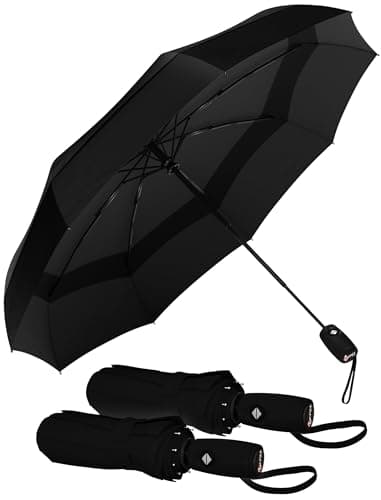
The other half of the design is the vent. A double canopy is two overlapping layers with a gap between them, and the gap lets air escape upward instead of building pressure under the dome. It does not make an umbrella windproof. It raises the speed at which it flips, and it makes the flip recoverable. That is the honest ceiling of the technology, and it is worth knowing before spending a hundred dollars chasing more.
Automatic, manual, or the awkward middle
Three mechanisms exist, and the marketing does not distinguish them clearly.
Manual open and close. A runner you push up and pull down. Nothing to jam, nothing to break, the lightest and cheapest option — and the reason the micro-mini on this page outlives compacts that cost twice as much. The cost is doing it by hand in the rain with luggage in the other arm.
Auto-open, manual close. A button fires the canopy open; closing is done by hand. This is the combination we would choose deliberately rather than treat as a compromise, because opening is the action that has to happen fast and closing is the action that breaks mechanisms. The Weatherman is built this way on purpose.
Auto-open, auto-close. The button does both. It is the genuinely useful feature getting into a car door one-handed, and it is also the most common failure point in the category. Note what it actually does: it retracts the canopy, not the shaft. You still collapse the shaft by hand against a strong spring, and testers found that on our top pick this takes a surprising amount of muscle. Two-way mechanisms are worth having. They are not worth assuming.
Arc, diameter and depth are three different numbers
Umbrella listings quote canopy size in whatever way flatters the product, and the three figures are not interchangeable.
Arcis measured over the curve of the open canopy, from rim to rim across the top. It is always the biggest number, which is why listings prefer it. A “38-inch arc” umbrella covers less ground than a 38-inch diameter one.
Diameteris the flat width of the circle the canopy throws on the ground. This is the number worth comparing, and it is often several inches smaller than the advertised arc. Independent measurement is the only reliable way to get it: our top pick’s tested diameter is 36.5 inches, which is ordinary.
Depthis how far the canopy curves down around you, and it is the number nobody publishes and everybody feels. Rain in any wind arrives at an angle, and a deep canopy is the difference between dry shoulders and a wet coat. The Weatherman’s 11-inch tested depth is why it protects so much better than the budget pick’s 6.5 inches, despite the two having similar widths on paper.
One more shape note, because it is the reason the most expensive umbrella here is not ranked first: a scalloped or asymmetric canopy looks striking and measures well at its widest point, but the short points are where the rain gets in. Testers measured roughly a six-inch difference between the long and short points of the Blunt Metro and concluded it lets through more rain than its headline diameter suggests.
Half of this category is about sun, not rain
Search demand for travel umbrellas splits in two, and the sun half is badly served by American gear writing. In much of East and Southeast Asia a carried parasol is completely ordinary, and any traveler heading to Japan, Vietnam or Thailand in summer will see them everywhere. The same is true of desert hiking, where an umbrella is shade you brought with you.
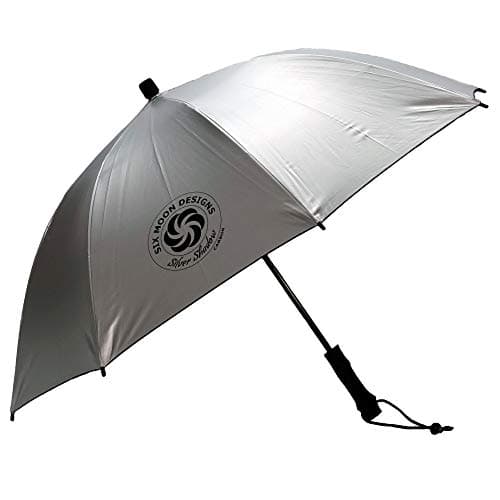
What to look for is a published UPF rating, and a canopy designed to reflect rather than absorb. A UPF 50+ rating means the fabric blocks the large majority of ultraviolet radiation; a silver reflective outer layer additionally bounces heat, which is the difference between standing in shade and standing under a warm dark cloth. Two picks here publish a UPF 50+ rating: the carbon hiking umbrella and the Weatherman. Blunt publishes UPF 50+ on its separate UV-specific models rather than on the standard Metro we link, which is worth knowing if sun is the reason for the purchase.
A plain black rain umbrella does provide meaningful shade — it is not useless in the sun. It simply has not been rated for it, and it holds heat. If the trip in question is somewhere hot and bright, the UPF line on the spec sheet is worth paying for; if it is a rainy city, it is a nice extra and nothing more.
What actually breaks, and why the warranty is the spec
Umbrellas fail in three places, in this order: the mechanism, the rib joints, and the canopy at the tips. Fabric almost never fails first. This is why the interesting difference between a twelve-dollar umbrella and a forty-dollar one is not the cloth — it is whether anyone stands behind the frame.
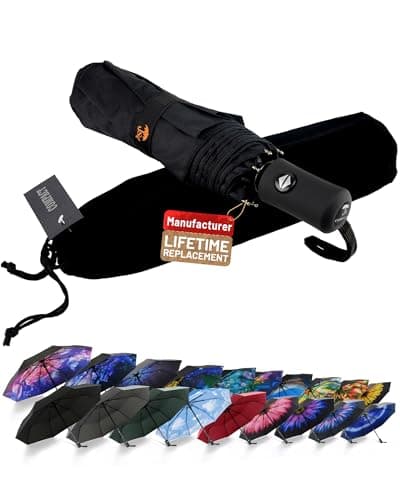
The branded picks here publish real terms. Repel offers a lifetime replacement guarantee. Weatherman advertises a lifetime warranty. Blunt ships a two-year global warranty and sells replaceable canopy loops so a damaged one can be repaired rather than thrown out. The budget automatic has no comparable story, which is the honest explanation for most of the price gap and the reason to think of it as a consumable.
That framing helps with the gift decision too. A cheap umbrella is not a bad object; it is a different purchase. Two of them, one left in a car and one in a suitcase, is a genuinely sensible strategy — it just is not a present. The same logic runs through how much to spend on a travel gift: the upgrade a gift buys should be one the recipient would never buy for themselves.
Airport and airline rules, in one paragraph
TSA allows umbrellas in carry-on bags and in checked bags, and advises checking with your airline for size or weight restrictions. In practice the only umbrella on this page that raises a question is the 25-inch hiking stick, and the question is about fitting a personal-item sizer rather than about security. A folding umbrella in a bag has never been a checkpoint problem. The same cannot be said of everything else people pack, which is what the liquids rules and the power bank rules exist to sort out.
Buying an umbrella as a gift
Umbrellas are a strange present because everyone already owns one and nobody likes the one they own. That is the opening: the gift is not the umbrella, it is the upgrade from the eight-dollar bodega umbrella with two bent ribs that they have been meaning to replace for three years.
Four things make the difference between a good version of this gift and a forgettable one.
First, buy the brand. In most categories that is lazy advice; here it is the whole point. An unbranded umbrella and a branded one look identical in a photograph, and the visible difference on the day it is unwrapped is a name, a warranty card and a canopy that does not feel like a bin liner.
Second, match the size class to their bag, not to your idea of good coverage. Someone who carries a small crossbody and a phone will never carry a 14-inch folder, however good it is. Someone who walks two miles to work in Seattle rain will be annoyed by a micro-mini. The person’s bag is the spec.
Third, consider where they are going. A trip to Japan in August wants UPF. A city break in Edinburgh wants wind survival. A thru-hike wants weight. If the trip is European and rain is the concern, the rest of that packing problem is covered in gifts for someone going to Europe.
Fourth, an umbrella alone is a thin present. It is a perfect component of a larger gift and a slightly grim standalone one. Beside a good packable daypack, in a stocking with a travel wallet, or as part of a rainy-city kit, it lands. On its own, in a box, it reads as practical rather than thoughtful — which is fine if that is the relationship, and worth knowing if it is not.
How we ranked these
Scored against our published rubric from published specifications, manufacturer documentation, independent published testing and aggregated owner feedback. We do not run a lab and we do not claim measurements we have not taken; where a figure comes from someone else’s test bench we say so and link it below.
Usefulness is weighted toward coverage that survives wind rather than coverage on a still day, because still rain is the easy case. Portability counts packed length first and weight second — length is what decides whether a bag will take it. Durability leans on published warranty terms and on frame construction rather than on unverifiable wind claims. Value rewards the cheap picks honestly: the least expensive umbrella here scores a perfect ten on value and still finishes last, because it is a spare rather than a gift.