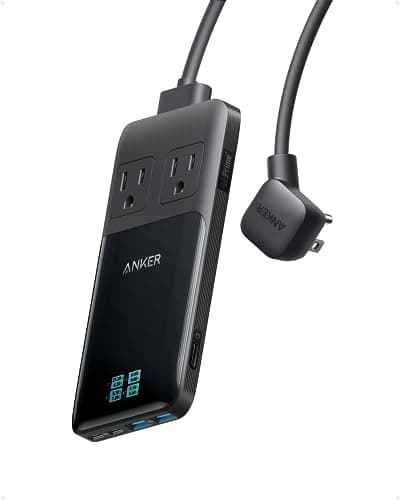
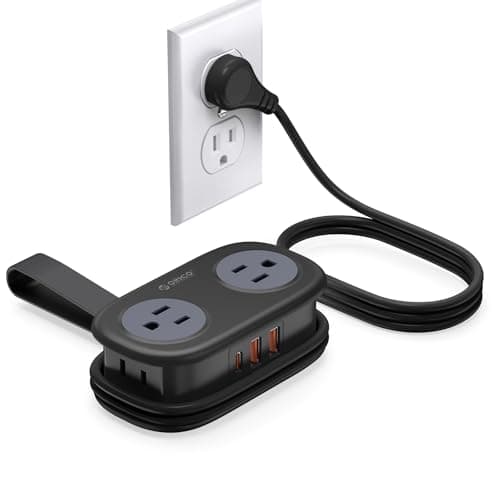
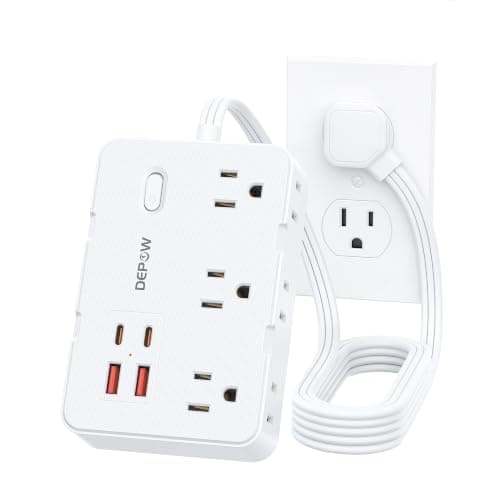
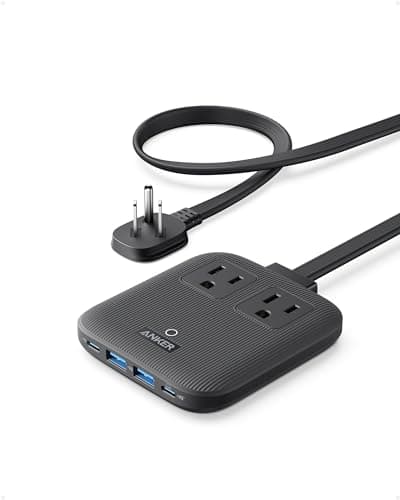
Count the plugs, not the outlets.Almost everyone shops this category by asking how many sockets they get. That is the wrong number. The traveler arrives in a room with one reachable outlet and between four and seven things that need power overnight - phone, watch, earbuds, power bank, laptop, camera battery, somebody else’s phone - and most of those things charge over USB, not over AC. A strip with six AC sockets and no USB solves a problem nobody has; a slim box with two AC and four USB solves the actual one and takes a third of the space. That is the axis this page is ranked on.
Everything else follows from it. The strip has to be thin enough to live flat in a bag rather than wedged in a corner, it has to have a plug shape that works on a wall plate with furniture in front of it, and it has to be the kind of object that gets packed a second time after the first trip. Outlet count is close to last.
What a travel strip is actually solving
Three specific, boring failures, which is why this is such an effective and such an unglamorous gift.
The one-outlet room. Older hotels put a single socket on the wall plate by the door, one behind the television, and one in the bathroom marked for shavers. Newer hotels put a USB port in the headboard that charges at a speed best described as decorative. A strip converts whichever socket exists into enough outputs for a whole trip, and it does it from the nightstand instead of from the floor across the room.
The charger bag. Every traveler with more than one device is carrying a pouch of bricks. A 6-in-1 station with real USB-C output replaces the laptop brick, the phone brick and the watch puck with one object - which is a weight and volume saving, not just a tidiness one. The bag and the method for the rest of it are in best travel tech organizers and how to organize cables for travel.
The shared room. Two people and one outlet is the oldest argument in travel. Four AC outlets settles it for the price of a sandwich.
The surge-protection catch
This is the part of the category that surprises people, so it goes before the picks rather than after them.
The two best objects on this page - both Anker charging stations - do not have surge protection. Anker’s own product notes for the Prime 140W station say so in plain words: “This power strip does not have surge protection.” The Nano 67W publishes no joule rating either; what it lists instead is ActiveShield 2.0, covering over-voltage and short-circuit protection. Those are real safety features and they are not the same thing as a surge protector, which is a sacrificial component rated in joules that absorbs a spike and dies so your laptop does not.
Meanwhile the cheapest pick here, a plain flat-plug desk strip, publishes 1050 joules. That inversion is worth understanding before you spend: the premium travel strips are charging stations that happen to have AC outlets, and the cheap ones are surge protectors that happen to have USB ports. Which you want depends entirely on the trip. A week in a business hotel on a modern grid: the charging station, every time. A month in a rental with two-pin adapters hanging out of the wall, or a storm season anywhere: take the joules.
The one mistake that actually damages things
Taking a US power strip abroad and plugging it into 230V through a plug adapter.
A plug adapter changes the shapeof the pins. It does not change the voltage behind them. Most of Europe, the UK, Australia and much of Asia and Africa run roughly 220-240V; the US runs roughly 120V. Modern laptop and phone chargers handle both - look for “100-240V” printed on the brick - which is why a bare plug adapter is all most travelers need, and that is the subject of best universal travel adapters and travel adapter vs voltage converter.
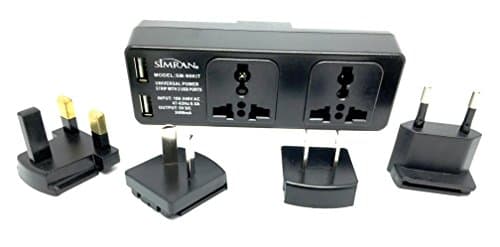
A US power strip is a different case, because the strip itself is a device. Its own body, its switch and especially its surge-protection components are specified for a 120V supply. Run it on 240V and the failure mode is not “it works a bit worse” - the varistor that does the surge protecting is the component most likely to fail, and it fails hot. This is why a US-market surge strip is the one piece of travel gear we would flatly tell you not to carry overseas, and why the international pick on this page is a strip rated 100V-250V with interchangeable plug heads rather than a US strip with an adapter in front of it.
The exception is the two Anker stations: both publish an input range of 100-240V, so the unit itself is rated for a foreign wall. Put the right plug adapter in front of either one and it is fine. Everything plugged into their AC outlets, however, is still receiving the local voltage untouched - so the dual-voltage rule still applies to the hair dryer.
Cruise ships, and why we did not rank one
Cruise lines are the one travel context where a power strip gets confiscated at the gangway, and the rules are stricter than most people expect. Royal Caribbean’s published policy prohibits electrical extension cords and, in the wording of its 2024 clarification, “power strips/surge protected strips and multi-plug outlets.” The reasoning the lines give is overload and fire risk in a cabin, not surge protection as such - which is why the ban covers the plain strips too.
What Royal Caribbean does allow is narrow and specific: a “consumer type power conversion device USB charger (multi-plug blocks on which the outputs are for USB cables)”, and only if the charger is “stamped with US/Europe recognized Conformance Marking.” A block that mixes USB ports with AC sockets is still prohibited. Other lines are less strict than Royal Caribbean and the rules change, so read the specific line’s own prohibited-items page before packing rather than trusting a blog - including this one.
So nothing on this page is the right gift for a cruise passenger. The cruise answer is a USB-only multi-port wall charger with a visible safety mark, and if the passenger needs mains power for a CPAP or similar they should arrange it with the line in advance rather than pack a strip. The rest of that kit is on gifts for cruise lovers.
Two companion pieces to this section. The airline question - which is the opposite answer to the cruise one - is in can you bring a power strip on a plane, and the rest of what a cruise cabin needs instead is in how to pack for a cruise.
Plug shape beats outlet count
Three physical details decide whether a strip is pleasant to use in a hotel room, and none of them appear in the headline specs.
A flat plug, not a block. Hotel sockets are frequently behind the bed, behind the desk or behind the television. A plug that projects three inches straight out of the wall cannot be used with furniture in front of it; a flat plug lets the bed go back against the wall. Every pick on this page except the universal one has a flat or low-profile plug, and it is the single most underrated feature in the category.
Thickness, not footprint. A strip packs flat against the back panel of a bag or inside a laptop sleeve. Anker publishes both stations here at 0.7 to 0.75 inches thick, which is why they travel well despite being the heaviest things on the page. A chunky six-outlet bar is the same volume as a pair of shoes.
Cord length, and the right amount of it. Five feet reaches from the one working socket to the nightstand. Three feet does not, usually. Fifteen feet is a tangle and, on a cruise or in some rentals, counts as a prohibited extension cord. Five feet is the number to look for.
How we ranked these
In order: how many of the outputs are the kind the recipient actually uses (USB-C first), published charging wattage, physical thickness and plug shape, whether a surge rating exists at all, and how much of the spec sheet the seller is willing to publish. That last one matters more in this category than in most, because half the listings here publish an outlet count and nothing else - no weight, no dimensions, no joules. Where a figure is missing we say so in the pick rather than estimating it. Our full method is on how we choose.
Prices move constantly in this category and the strips go on deep promotion in Q4, so every price on this page is pulled live rather than typed in. If you are buying as a gift and can wait, the discount history for the site’s winners is tracked on Black Friday travel gear deals.
Match the strip to the trip, not to the person
This is the rare gift where the right answer changes with the trip rather than the recipient. A frequent flyer doing three nights at a time wants the thin 6-in-1 station. The same person spending a month in a rental wants the cheap surge strip. Someone moving abroad wants the universal one. If you only know that the recipient travels, the 6-in-1 station is the safest guess: it is the one that is useful at home on a desk too, so it never becomes dead weight.
How many outlets is enough?
Count AC and USB separately. Two AC outlets covers almost every solo trip, because the only things that genuinely need a wall socket now are a laptop brick (if you have one) and whatever appliance came along. Four AC is for couples, families and long stays. On the USB side, four is the number: phone, watch, earbuds and power bank is a completely ordinary overnight load, and that is before a second person.
Watts, and what they are for
A USB-C port’s published wattage tells you what it can charge, not how fast it charges a phone. Roughly: 20W is a fast phone charge, 30-45W covers a tablet or a small laptop, 65W covers most 13-inch laptops, and 100W-plus is for 15- and 16-inch machines. Buying 140W for a laptop that ships with a 65W brick buys nothing. And every one of these figures is a single-port maximum - plug four things in and the total gets divided, as Anker’s own multi-port tables show.
What a strip cannot do
It cannot convert voltage, it cannot ground an ungrounded socket, and it cannot make a two-pin wall socket safe for a three-pin appliance. If the recipient is traveling with a hair dryer, a curling iron, a travel kettle or an electric shaver, the thing to check is the label on that appliance - “100-240V” means it travels, a single voltage means it needs a converter or it needs to stay home. Our adapter versus converter guide covers that decision properly.
Lithium, luggage and where it rides
A power strip has no battery, so unlike a power bank it is not subject to the cabin-only lithium rule and can legally travel in checked luggage. Pack it in the carry-on anyway: a strip in the hold is a strip you cannot use on the plane-side of a delay, and it is the object most likely to be pulled for a closer look at security, which is faster to resolve when it is accessible rather than buried.
Price brackets, honestly
The bottom of the category buys a competent flat-plug desk strip with a real joule rating and slow USB. The mid bracket is where the travel-specific designs live: fewer AC outlets, much better USB, far thinner. Above that you are paying for laptop-class wattage and a display, which is money well spent for someone working from a 16-inch laptop in hotel rooms and wasted on anyone else. Nothing in this category needs to cost three figures.
Who it is a good gift for
Business travelers, digital nomads, anyone doing a long stay, students heading abroad, and the specific person who always arrives with four devices and one cable. It is also one of the better gifts under $50precisely because almost nobody buys it for themselves - it is invisible until the night it is needed. It is a poor gift for someone who travels with a phone and nothing else, and a bad one for a cruise passenger unless you have read that line’s rules first.