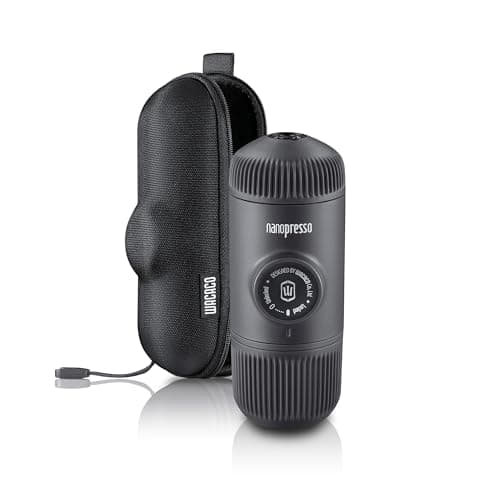
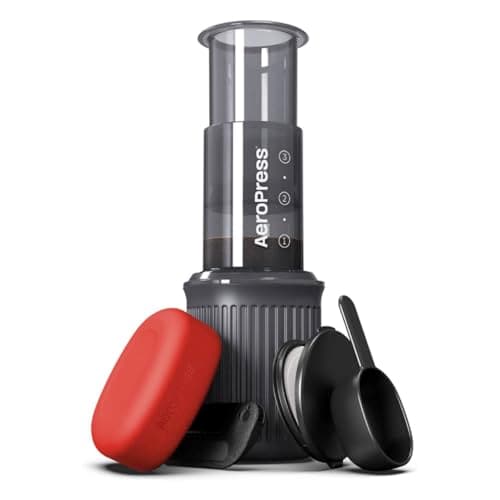
Buy the AeroPress Go for anyone who drinks mugs of coffee; buy the WACACO Nanopresso only for someone who genuinely drinks espresso. This is not a close comparison once you ask what the recipient orders at a cafe. The AeroPress Go brews about 8 ounces in two minutes and the whole kit nests inside its own cup. The Nanopresso reaches a maximum of 18 bar by hand pump from an 80 ml tank and an 8 gram basket — a real espresso, and about two ounces of it. Give a drip drinker a Nanopresso and they will find it a curiosity; give an espresso drinker an AeroPress and they will notice in one sip.
Side by side
| | AeroPress Go | WACACO Nanopresso |
|---|
| What it makes | About 8 oz of concentrated filter coffee | One small espresso |
| Water per brew | Up to the 8 oz chamber | 80 ml tank |
| Coffee dose | Scoop included, forgiving of dose | 8 g basket |
| Pressure | Hand pressure only | Up to 18 bar, hand pumped |
| Weight / size | 11.4 oz packed, 4.5 x 3.6 in | 11.9 oz / 336 g, about 6 in tall |
| Grind it needs | Medium-fine, forgiving | Fine and even, unforgiving |
| Consumables | Paper micro-filters (25 in the travel holder) | None required |
| Cleanup | Compressed puck ejects into a bin | Unscrew and rinse three parts |
| Heats water | No | No |
Every figure above is published by AeroPress or WACACO on their own product pages, linked in Sources. Nothing here is an estimate.
Neither one heats water, and that decides more than the brewer does
This is the single most important thing about the whole category and it is never on the box. No manual travel brewer heats water. Something else has to produce near-boiling water: a hotel kettle, a pod machine's hot water spout, a camp stove, a cafe willing to hand over a cup of hot water. US hotel rooms very often supply a pod machine rather than a kettle, which works but runs cooler and slower than a kettle does.
So before choosing between these two, answer where the recipient will be standing. A campsite with a stove suits either. A business hotel in Europe or Asia with an in-room kettle suits either. A US chain hotel with only a pod machine favours the AeroPress, which is more forgiving of water that is slightly below boiling — espresso extraction punishes cool water far more obviously. We go through all of this on the travel coffee maker roundup.
The AeroPress Go argument
It is the safest coffee gift there is, for three reasons. First, it packs as a single object: press, filters, stirrer and scoop all nest inside the included cup, so nothing arrives as a handful of parts to lose. Second, the short steep plus hand pressure is forgiving of an imperfect grind, which matters when the beans came from a supermarket or a hotel gift shop rather than a roaster. Third, the spent grounds eject as a compressed dry puck straight into a bin — the cleanest disposal of anything in this category, and the reason it works in a hotel room with no sink to spare.
It is also polypropylene and silicone, so it bounces. Nothing on it cracks when the bag goes into an overhead bin, which cannot be said for glass or ceramic brewers.
The costs are honest ones. 8 ounces at a time means two coffee drinkers brew twice. Paper micro-filters are consumables, and the travel filter holder carries 25 of them before it needs a refill. And as a present it looks like what it is — a plastic plunger — so it wants a bag of good beans next to it in the box.
The Nanopresso argument
Eighteen bar from a hand pump is genuinely remarkable, and it is the number that makes this real espresso rather than strong coffee. There is no electricity, no battery and no voltage question, which means it works identically at a campsite, in a car and in a hotel in any country — relevant because electric travel coffee makers are the wrong gift abroad for exactly that reason, as our adapter versus voltage converter guide explains. At about six inches and 336 grams it rides in a daypack rather than in luggage, and the listing we link includes the hard protective case that keeps the pump and basket together in a bag.
Its limits are structural. An 80 ml tank and an 8 gram basket produce one small espresso per fill, so a mug-sized drink means brewing twice or topping up with hot water. Espresso needs a fine, even grind, and supermarket pre-ground pushes through fast and thin — which is why a hand grinder tends to follow a Nanopresso into the bag. And pumping, then unscrewing and rinsing three parts, is more ritual than most people want before a 7 am flight.
The third option nobody considers
The ESPRO Go P0 is the pick for a different problem entirely: it is the brewer that is also the cup. Brew in it, press, screw the lid on and walk out the door with 16 ounces of insulated coffee. The double micro-filter and the AirLock stop extraction at the plunge, so the last mouthful does not taste like the bitter end of a French press, and vacuum stainless keeps a 6 am brew drinkable at the gate.
Its trade-off is the messiest cleanup here — wet grounds sit in the bottom until there is somewhere to dump and rinse them. In a rental car or on a plane that is a problem; in a hotel room with a sink it is thirty seconds. Choose it when the goal is coffee in hand on the way out rather than coffee as a sit-down ritual.
Can you take any of these on a plane?
Yes. TSA lists coffee and espresso makers as allowed in both carry-on and checked baggage, and ground coffee and beans are allowed as well — though a large quantity of grounds may get a secondary look at the X-ray because dense organic material shows up oddly. The only real constraint is liquid: a thermal brewer travels empty through security like any other bottle.
So which one
AeroPress Go for almost everyone, and certainly for anyone you are not sure about. Nanopresso for the confirmed espresso drinker who has complained about hotel coffee out loud. ESPRO Go P0 for the person who drinks their coffee moving. And if you are buying for someone who camps, add a way to boil water to whichever you choose — that, not the brewer, is the part they are missing.
Quick answers
Is the Nanopresso real espresso?
By pressure, yes — up to 18 bar by hand, which is in espresso territory rather than an approximation of it. By volume it is a single small shot per fill of the 80 ml tank.
Does the AeroPress Go make a full mug?
It brews about 8 ounces of concentrated coffee, which is a mug as brewed or two shorter cups diluted. Two coffee drinkers means brewing twice.
Which needs a grinder?
Both are better with one; only the Nanopresso really requires it. Espresso needs a fine even grind that supermarket pre-ground does not supply, which is why a hand grinder usually joins it.
Which is easier to clean in a hotel room?
The AeroPress, clearly. The dry puck goes into a bin. The Nanopresso needs three parts rinsed, and the ESPRO needs wet grounds emptied.
What you should spend
The AeroPress Go is normally the cheapest of the three and the Nanopresso the most expensive once the protective case is included. Every button on this page shows a live price, and where we have no verified price we show none rather than a stale number.