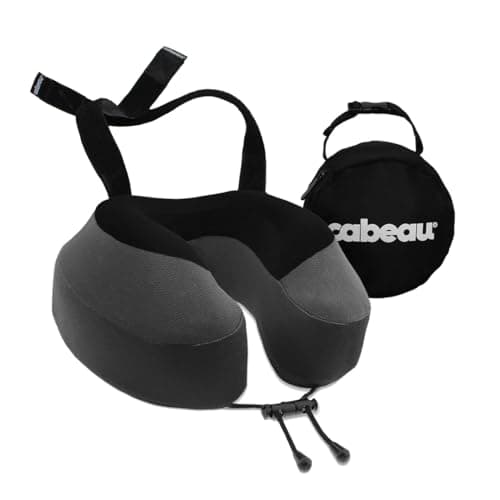
The Cabeau is the safe answer when you don't know how someone sleeps. It's a firm, structured memory-foam pillow with a raised rear panel, and unlike a soft horseshoe it actually resists the head-nod that wakes people every twenty minutes on a flight. If you're buying one neck pillow for someone whose sleeping habits you can't confirm, this has the highest hit rate.
Why most travel pillows disappoint
The classic U-shaped pillow is a soft cushion that fills the space between the neck and the seat. That's fine as padding. It is not support. When someone genuinely falls asleep upright their head goes in one of three directions — backwards into the headrest, forwards onto the chest, or sideways onto a shoulder — and a soft horseshoe barely resists any of them.
The Cabeau's design attacks the first two. The foam is firm rather than squishy, so it holds shape under load, and the raised rear panel stops the head tipping backwards into an awkward angle. The result is that the head stays roughly where it started instead of nodding, jerking awake, and repeating for six hours.
It also gives usable lateral support — more than a soft pillow, less than a purpose-built wrap. That middle position is exactly why it's the safe gift: decent in every direction rather than excellent in one.
The strap is not a gimmick
A detail that sounds trivial and isn't: the Cabeau has a strap that clips it to the seat. The most common failure of a travel pillow is that it slides down and forward as the wearer relaxes, at which point it's a cushion in their lap. Anchoring it to the headrest keeps it doing its job through an actual sleep cycle rather than for the first ten minutes.
What you give up: packed size
This is the honest trade. A structured foam pillow takes real space. It compresses into its bag to roughly half its size, better than most horseshoes, but it is still a physical object in a bag that probably has none to spare — and for a lot of travelers it ends up clipped to the outside of a backpack.
If packed size is the binding constraint, a wrap-style pillow with an internal support rolls down far smaller. It's also the better answer for a committed side sleeper, which we work through in the best travel pillow for side sleepers.
Sleep is three problems, not one
A pillow that holds the head still doesn't help much if light and noise keep someone at a shallow sleep depth. Realistically a traveler who wants to sleep on a plane needs all three:
- Support — this pillow, or the wrap version if they lean sideways.
- Darkness — a contoured mask with eye cups, which blocks light without pressing on the eyes over several hours.
- Quiet — noise canceling, and earbuds rather than over-ears if their head rests against something. Our noise-canceling headphone roundup covers that trade directly.
Buying only one of the three produces a disappointingly small improvement, which is why the sleep kit is a better gift than the pillow alone. Our gifts for frequent flyers list assembles the whole thing.
Who should buy something else
Committed side sleepers. A wrap with a rigid internal rib supports the head sideways in a way no horseshoe does.
Ultralight packers. Anyone counting liters will resent this; the wrap style rolls to a fraction of the volume.
Children. Adult pillows sit wrong on a small frame. A chin-supporting design in a children's size is the right product — see travel gifts for kids.
Occasional short-haul flyers. On a two-hour hop an inexpensive pillow is genuinely enough. This is built for people who sleep on red-eyes.
Who this is the right gift for
The long-haul flyer, the person who complains about arriving wrecked, and anyone whose sleeping direction you can't confirm. It's also one of the better gifts in the under $50 band, where problem-solvers beat upgrades.
Is the Cabeau the right pillow for them?
Buy it if
They fly long-haul, they sleep in transit, and you don't know which way their head falls. It's the highest-hit-rate pillow for an unknown sleeper.
Buy a wrap instead if
They lean hard to one side, or packed size is the binding constraint. Both point to a wrap-style pillow with an internal support.
Buy the cheap one instead if
Their flying is a couple of short hops a year. Structured support is wasted on someone who isn't really sleeping.
Don't buy it alone
Support without darkness and quiet produces a small improvement. A mask and something for the noise turn it into an actual night's sleep.