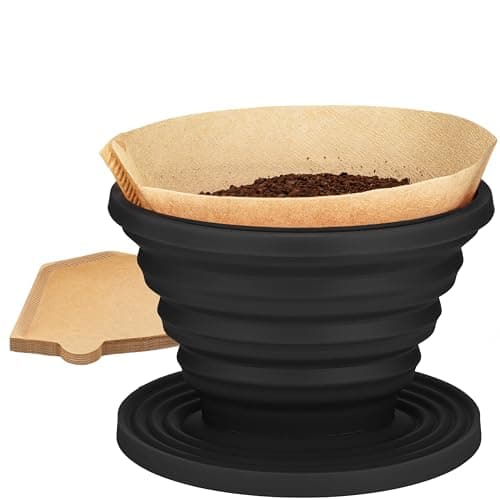
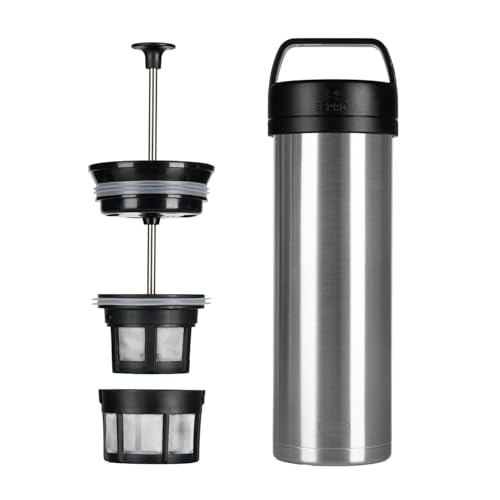
The ESPRO Go P0 is the alternative to buy for most people who went looking for one, because it answers the two most common objections at once — it is insulated stainless steel rather than plastic, and its double micro-filter means there is no paper to run out of. The budget pick is the COLETTI Sierra, a collapsible pour-over cone that costs a fraction of an AeroPress and packs flatter than anything else here. Every price below is read live from our price layer and stamped with an as-of date in the table.
What the AeroPress is genuinely good at
Worth setting out properly, because an alternatives page that opens by knocking the original is both unfair and useless. We sell the AeroPress, we rank it first in our travel coffee maker roundup, and it is still the safest coffee gift in the category. Three reasons:
- It is forgiving. A short steep plus hand pressure produces a drinkable cup from a grind that would ruin a pour-over. That matters enormously on the road, where the coffee came from a supermarket, a hotel gift shop, or whatever was in the cupboard of the rental.
- Cleanup is one motion. The used grounds eject as a compressed dry puck straight into a trash can. Nothing else in this category disposes of grounds that cleanly, and cleanup is the single biggest predictor of whether a travel brewer gets used a second time.
- It bounces. The thing people object to — the plastic — is also why it survives a bag going into an overhead bin. Glass and ceramic brewers do not travel like that.
On the Go model specifically, the whole kit nests inside its own cup, so it travels as one object rather than a handful of loose parts. That is a real design achievement and none of the alternatives below match it exactly.
So why do people look for an alternative?
Because of one of four things. This is the useful part, and it is why this page is sorted by objection rather than by a single ranking: the right alternative depends entirely on which of these is yours.
- The plastic.By far the most common. The AeroPress chamber is a polymer, it meets hot water every morning, and some people simply do not want that. “No plastic” and “metal” are both among the most common phrases people attach to this search.
- The paper filters. They are consumables. The travel filter holder carries a finite number, and running out somewhere with no coffee store turns a brewer into a paperweight. Some people also dislike what paper does to the cup — it strips oils, which is a preference, not a fault.
- It is not espresso. The AeroPress makes a smooth, concentrated immersion coffee. It is very good. It is not espresso, and an espresso drinker notices in one sip.
- It still takes up room. Packed, an AeroPress Go is roughly mug-sized. For someone counting every cubic inch in a 40-liter bag, that is a real cost.
What is not usually the reason: coffee quality. The AeroPress brews well, and nothing below makes an obviously better cup from the same beans. These are trades, not upgrades.
The objection-to-brewer map
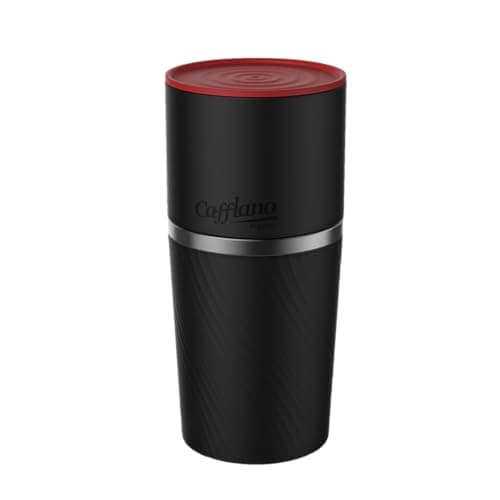
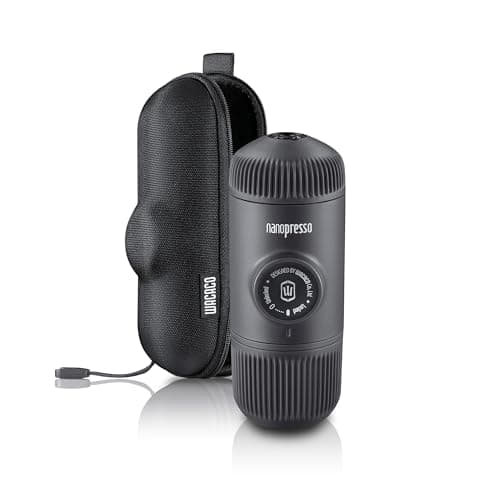
If the objection is the plastic, the answer is the ESPRO Go P0: a vacuum double-wall stainless body that brews the coffee and then is the cup you drink it from. If the objection is the paper filters, there are two answers — the ESPRO again, whose double micro-filter needs no paper, and the Cafflano Klassic, whose etched stainless permanent filter means there is nothing to run out of, ever. If the objection is that it is not espresso, only the WACACO Nanopresso answers it, because only a hand pump reaches espresso pressure. And if the objection is packed size, the COLETTI Sierra collapses flat and weighs under an ounce.
Those are four genuinely different objects, which is the whole point. “The AeroPress alternative” does not exist as a single product, and a page that pretends otherwise is picking for you without asking the question that decides it.
What every alternative still does not solve
None of these heat water. Not one. The AeroPress does not either, and it is the defining constraint of the whole category — a travel brewer is always half a system, and the other half is a hotel kettle, a camp stove, a cafe that will fill a cup, or an in-room machine run with no pod in it. We cover the ways to solve that in the main travel coffee maker roundup, and it is worth reading before buying any of these as a gift, because a brewer given to someone with no hot water source is a brewer that stays in the box.
Nor does swapping brewers fix stale coffee. Ground coffee goes flat within days of the bag being opened, and that does more damage to a hotel-room cup than the choice between immersion and pour-over. If the person already grinds at home, a hand grinder — we rank the 1Zpresso Q Air in the main roundup, and it is small enough that 1Zpresso states it fits inside an AeroPress plunger — changes the cup more than any brewer on this page will.
Glass, and why there is none here
“AeroPress alternative glass” is a real and frequent search, and we are not going to pretend to answer it. Glass brewers make excellent coffee and there are good ones. None of them belong in a bag that gets handled by someone else, and we are not going to rank a glass carafe as travel gear so the page can claim to have covered the query. If the brewing happens at home and only the method is in question, a glass pour-over is a legitimate choice — it is just not a travel recommendation, and this is a travel site.
The closest honest answer to the glass search is the ESPRO: it is the pick here that feels like a proper object rather than a plastic tool, and stainless gets you that without the part that shatters.
When the right answer is still an AeroPress
Three cases, stated plainly, because sending someone away from the right product is a worse outcome than losing the sale.
- If the objection was packing, not plastic. The AeroPress Original costs less than the Go and brews more; the premium on the Go buys the nesting cup, not better coffee. If the brewer is going in a checked bag or staying in one place for a week, the Original is cheaper and larger and the objection dissolves.
- If the complaint was that the coffee goes cold. The AeroPress Go Plus swaps the plastic cup for a vacuum-insulated stainless tumbler. That is the same fix the ESPRO applies, inside the brand the person already knows.
- If it is a gift and the recipient has no routine yet. Forgiveness of a bad grind is worth more to a beginner than any material upgrade. Our AeroPress Go review goes through who that is and who it is not.
How we ranked these
Every pick here is a product we already sell and have already written up, scored on the same five-point rubric as everything else on the site — usefulness, portability, durability, value and giftability — against published specifications and manufacturer documentation, not lab tests we did not run. You can read the method on how we choose. The ordering here is additionally weighted by how directly a product answers the most common objection: the ESPRO is first because it is the only pick that resolves two of the four at once.
No price is typed into this page. Our product records have no price field at all; every number renders from our live price layer with the date it was collected, and where we have no verified live price we show a check-price link instead of a stale number.
Decide the objection before the product
The four reasons above are not equally common and they are not compatible. A brewer that fixes the plastic does not fix the espresso problem, and the one that fixes packed size fixes nothing else. Pick the objection first, and there is usually only one sensible answer left.
Permanent filter or paper, and what each does to the cup
A metal filter passes coffee oils and a little fine sediment, which gives a heavier-bodied cup. Paper strips both, which gives a cleaner one. Neither is better. What matters for travel is that paper is a consumable you can run out of and metal is not — and that a permanent filter needs rinsing properly, which is harder in a hotel bathroom than it sounds.
Where do the wet grounds go?
This is the question that decides whether a travel brewer survives its second trip. The AeroPress wins it outright with a dry puck. A press leaves wet grounds in the bottom until there is a bin and a tap; a pour-over leaves a soaked paper filter. In a rental car or on a train that is a genuine problem, and it is worth thinking about before the material question.
Check the grind they actually buy
Espresso needs a fine, even grind; a press wants a coarse one; pour-over sits in between. Supermarket pre-ground is a medium compromise that suits none of them perfectly and the AeroPress most. If the person buys pre-ground and intends to carry on doing so, that is an argument for staying with immersion brewing rather than moving to the Nanopresso.
One object, or one more object?
The AeroPress Go packs into its own cup. Of the alternatives, only the ESPRO and the Cafflano are self-contained; the COLETTI needs a mug it does not include, and the Nanopresso produces a couple of ounces that have to go somewhere. For a one-bag traveler that is the deciding detail, not the brewing method.
What to spend
In qualitative terms: the collapsible dripper is pocket money, the insulated press sits in the same bracket as an AeroPress Go itself, and the all-in-one and the espresso maker are both clear step-ups that read as a significant gift. Live prices are in the table above; we do not quote figures in prose because they move.
Buy the beans too
Every brewer on this page is a better present with a bag of coffee next to it, and the cheapest of them is barely a present on its own. If the budget is tight, the dripper plus good beans beats a mid-priced brewer with nothing to put in it.