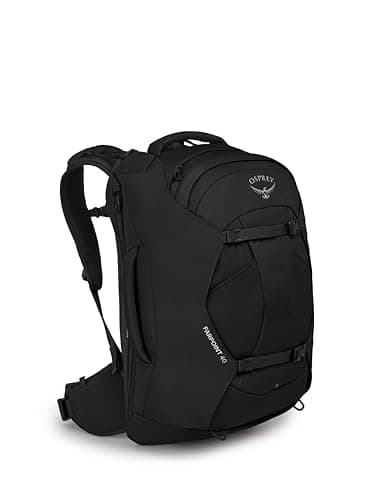
The Farpoint 40 is the default recommendation for one-bag travel, and it is the gift most likely to need a conversation first. Not because it's a bad bag — it's the standard for good reason — but because a pack has to fit a specific body, and 40 liters is a large enough purchase that getting the size wrong matters.
The design decision that makes it a travel pack
Most large backpacks are top-loaders: one opening at the top, everything stacked vertically, and finding the thing at the bottom means unpacking the things above it. That works for hiking, where you pack once in the morning and don't touch it until camp.
It is miserable for travel, where you're living out of the bag in a different room every few days. The Farpoint opens like a suitcase — a full clamshell zip that lays the interior flat. You see everything at once, and with packing cubes inside it the bag becomes a set of drawers rather than a sack. That single choice is most of why this bag has the reputation it has.
The second choice that matters: the harness zips away behind a panel. A loose hipbelt and shoulder straps are what get caught and torn on airport baggage systems, so being able to hide them turns the pack into a duffel for the flight and back into a backpack for the walk to the hostel.
The carry-on question, answered honestly
The Farpoint 40 is widely treated as a carry-on bag, and for most full-service airlines it is. But 40 liters is at the top of the range, and the honest position is this: packed loosely it goes in the overhead bin without anyone looking twice; packed to bursting it becomes a rounded, over-thick shape a strict sizer will reject.
Budget carriers are the real risk, and their limits are both smaller and more actively enforced. If the recipient flies low-cost European or Asian carriers regularly, the smaller version is the safer gift. Check the specific airlines they use rather than assuming — our guide to carry-on size rules covers how much the limits actually vary.
Torso length, and why it matters more than height
This is the part that catches gift buyers. A pack this size carries its load on the hips, and that only works if the hipbelt sits on the hips and the shoulder straps meet the shoulders. That geometry is set by torso length — the distance from the base of the neck to the top of the hip bones — not by overall height. Two people the same height can need different sizes.
The Farpoint is sold in more than one back length, and there is a women's-specific version with a different harness and hipbelt shape. Getting this wrong doesn't produce a slightly less comfortable bag; it produces a bag that puts all the weight on the shoulders and becomes genuinely unpleasant after twenty minutes.
Practical advice for a gift: measure discreetly, buy it with them, or buy something from the same trip that doesn't need to fit — cubes, a packable daypack, a tracker. Our gifts for backpackers list is full of the second category for exactly this reason.
Its closest rival is the clamshell Cotopaxi, which trades five litres for a suitcase-style opening and a weatherproof shell — the head-to-head is here.
What it gives up
Wheels. On smooth airport floors a rolling bag is easier, full stop. The backpack wins on stairs, cobbles, unpaved stretches and crowded transit, and loses on a long polished terminal. If their travel is business hotels and airport transfers, our carry-on luggage roundup is the more useful page.
Structure. It's a soft bag. Nothing inside is protected from a crush, which matters for anything fragile.
Laptop access. There's a sleeve, but not the quick-open airport-security arrangement a dedicated work bag has. A commuter carrying a laptop daily will prefer a proper work pack.
Who this is the right gift for
The person about to take their first long trip, the backpacker moving up from a hiking bag they've been suffering with, and anyone whose travel involves stairs, cobbles or public transport. For all three it's close to the perfect bag, provided the size is right.
Before you buy one as a gift
1. Find out their torso length
Not their height. Back length decides whether the hipbelt carries the weight, and a mis-sized pack is uncomfortable in a way no adjustment fixes.
2. Check whether the women's version fits better
The women's-specific model has a differently shaped harness and hipbelt. For many people it's simply the better-fitting bag, and it isn't a cosmetic distinction.
3. Check which airlines they fly
Full-service carriers rarely question a 40-liter pack. Budget carriers frequently do. If they fly low-cost regularly, size down.
4. Decide whether they want wheels instead
Airport-to-hotel travelers are usually better served by a wheeled carry-on. Backpacks win where the ground is bad and the stairs are many.
5. If in doubt, buy what goes inside it
Packing cubes, a packable daypack, a tracker and TSA locks all avoid the fit problem entirely and are used just as often.