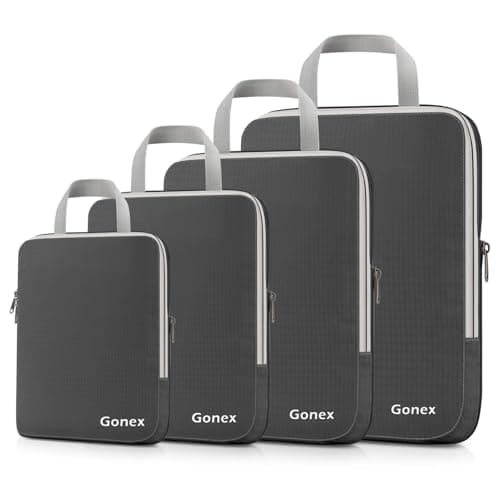
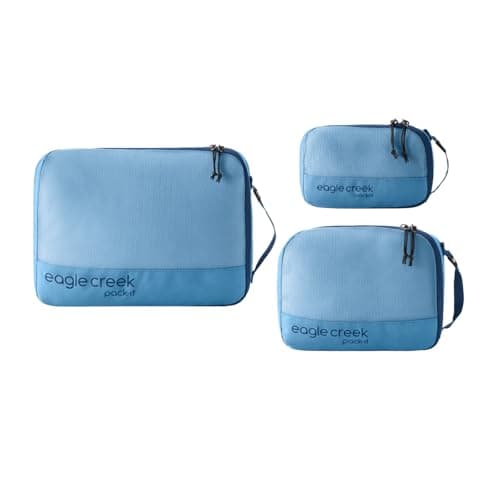
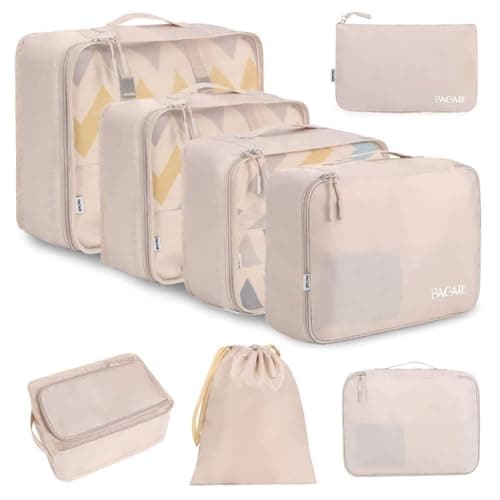
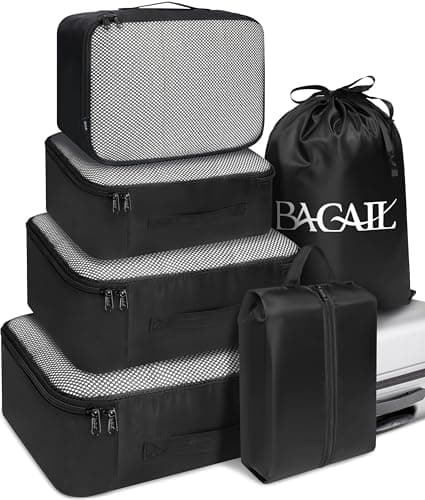
Four to six cubes, for one person, on almost any trip. The counter-intuitive part is that the number barely changes with trip length. Cubes sort clothing into categories, and one person has roughly the same number of categories on a weekend as on a fortnight — the cubes just get fuller. A three-week trip needs bigger cubes, not more of them.
Why the count scales with categories, not nights
Think about what actually goes into a cube. Tops in one. Trousers and layers in another. Underwear and socks in a third. A bulky item — a sweater, a jacket, workout clothes — in a fourth. Something for the things that migrate: chargers, swimwear, a growing laundry pile.
That's five, and it doesn't change between a two-night trip and a two-week one. On the weekend the cubes are half empty; on the fortnight they're full. Adding cubes seven and eight doesn't create a new category — it splits an existing one, which produces more objects to keep track of and no more order.
This is why the eight-piece set is the most commonly mis-bought item in the category. It looks like more value and it's more than one person's suitcase can use.
The sizes that actually matter
A good set arrives in assorted sizes, and the assortment matters more than the count. What to look for:
- One large. The workhorse. Takes tops, or a full outfit rotation. Nearly every set includes at least one.
- One medium. Trousers, layers, a second category.
- One slim. Underwear and socks. The slim shape matters — it slides into the gap the two big cubes leave, rather than demanding its own block of space.
- One or two small. Chargers, swimwear, laundry.
A set of five identical medium cubes is worse than a set of four assorted ones, because a suitcase is not a grid and identical boxes waste the corners. If a listing shows all the same size, skip it.
When eight is genuinely right
Three cases, and they're real:
Two people sharing a bag. Now there are two sets of categories, and color-coded cubes are the standard solution — two colors, one person each, no arguments about whose socks those are.
A family. One cube per child per category is the way this is done, and it's the difference between a functional family suitcase and a nightly excavation.
A month or more on the road. Long trips genuinely add categories — a formal outfit, cold-weather layers for one leg, a separate dirty-laundry cube that's permanently in use.
Outside those three, six is the ceiling and four is often enough. Our packing cubes roundup ranks the six- and eight-piece sets against each other with this in mind.
Do they fit the bag?
The question nobody asks before buying, and it's the second most common way this goes wrong. Cube sets are sized for a mid-size checked suitcase by default. A 40-liter carry-on backpack takes the medium and small cubes comfortably and often can't fit the large one flat, which turns the best cube in the set into wasted material.
If the recipient travels carry-on only, check the cube dimensions against their bag, or buy a set specifically sized for carry-on. Clamshell bags — those that open flat into two halves — are the shape cubes were designed around, which is why they pair so well with a clamshell travel backpack and a soft-side carry-on.
What goes in which cube
The system that survives contact with a real trip, rather than the one that looks tidy in a photograph. Three rules do most of the work.
One category per cube, and never mix. The whole value is that "where is it" has a one-word answer. A cube containing tops and also the charger and also swimwear is a small suitcase, and you're back to excavating.
Keep one cube empty on the way out. This is the trick experienced packers use and nobody writes down. The empty cube becomes the dirty-laundry cube on day two, which keeps worn clothes away from clean ones and means the repack on the last morning is sorting rather than deciding. It costs nothing on the outbound because an empty cube compresses flat.
Put the day-one cube on top. Whatever they need in the first twelve hours — a change of clothes, something warm for the arrival, swimwear if the hotel has a pool — goes in the cube that comes out first. Most first-night suitcase chaos is caused by the right cube being at the bottom.
Color-coding, and when it's worth it
For one person, color-coding is a solution looking for a problem — five cubes in one bag are distinguishable by size and position, and you'll learn them by day two.
For two or more people sharing a bag it stops being decoration and becomes the point. One color per person, and the question of whose clothes are in which cube never gets asked. It's the single reason to care what color a cube set is, and it's why the eight-piece sets are so often sold in two colors — that's a family configuration, not a bonus.
The same logic runs the other way for a solo traveler: buy whatever color is cheapest, and spend the attention on whether the sizes are assorted. If a set only comes in one color and the recipient shares a bag with a partner, buy two small sets in different colors instead of one large set.
Compression changes the math
If the set is compression rather than plain, buy fewer. Compression cubes have a second zipper that squeezes the air out, so each cube holds more and the pile they create is smaller. Four compression cubes routinely do the work of six plain ones.
They're also more work to pack — the second zip has to be closed, which takes a moment per cube — so a large set of compression cubes turns packing into a chore. Four is the number. Our cubes vs compression bags guide covers whether compression is right for the person at all.
The practical answer, by trip
- Weekend, one person: 3–4 cubes, and they'll be half empty. Plenty.
- One to two weeks, one person: 4–6. The standard six-set is bought for exactly this.
- A month, one person: 5–6 in larger sizes, plus a dedicated laundry cube.
- Couple sharing a bag: 6–8, color-coded by person.
- Family: 8 or more, one per person per category.
- Carry-on only, compression: 4, sized to the bag.
As a gift, the six-piece assorted set is the safe answer for a solo traveler and the eight-piece for a family — and the BAGAIL six-set review covers why the cheap version is usually the right one.
Once the count is settled, the set itself is the next decision, and the two that come up most are compared in BAGAIL vs Veken packing cubes — six plain cubes against a compression set with laundry and shoe bags.