Buy the INIU 45W 10,000mAh if you want the most charging per dollar; buy an Anker if the bank needs a cable or connector built into it, or if the box has to carry a name the recipient already trusts. Both brands make reliable 10,000mAh banks at similar sizes, and at this capacity neither is going to let anybody down on a travel day. The real difference is not reliability — it is that INIU competes on output per dollar and Anker competes on convenience features and range. For a gift, those are two genuinely different arguments.
Side by side
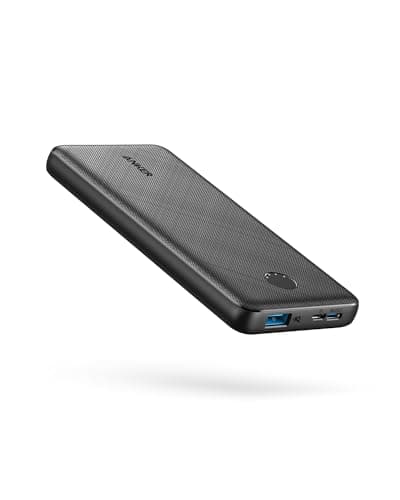
| | INIU 45W 10K | Anker Nano 10K | Anker Zolo 20K | Anker PowerCore 10K |
|---|
| Capacity | 10,000mAh | 10,000mAh | 20,000mAh | 10,000mAh |
| Stated output | 45W USB-C | Not published as a single figure | 30W | Not published as a single figure |
| Cable needed? | Yes — bring your own | No — fold-out USB-C plug | No — cable built in | Yes — bring your own |
| Charges a phone about | Twice | Twice | Roughly twice what the 10K banks manage | Twice |
| Tops up a tablet or small laptop | Meaningfully, at 45W | Slowly | Slowly | Slowly |
| Pocketable | Slim for the capacity | Yes | No — noticeably heavier | Yes |
| Reads as a brand gift | No — plain packaging | Yes | Yes | Yes |
The figures above are the ones the two brands publish on their current retail listings, linked in Sources. Where a bank's maximum output is not published as a single comparable number we say so rather than estimate it — watt ratings get quoted loosely in this category and a guessed figure is worse than no figure.
The question that actually decides it: what do they forget?
A power bank only works if it is charged and if there is a cable. Nearly every power-bank failure on a travel day is one of those two things, not a capacity shortfall — and that is the difference between these brands in practice.
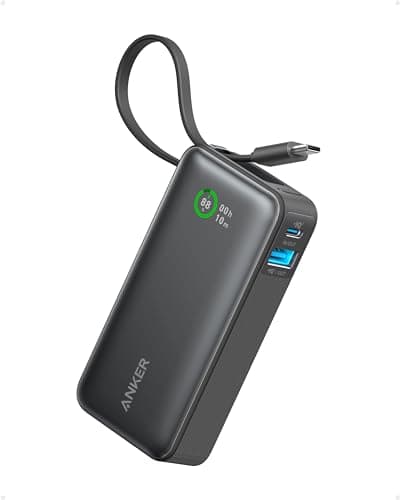
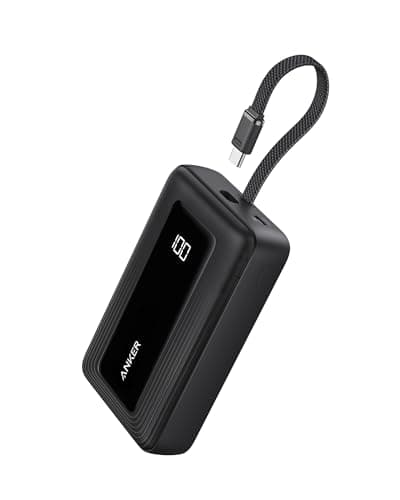
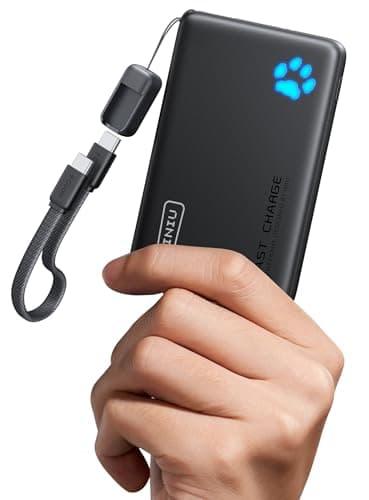
If the recipient is the kind of person who has a cable in every bag, buy on output and price, and the INIU wins: 45W is enough to fast-charge a phone and put a real dent in a tablet or a small laptop, which is unusual at this size and price. If they are the kind of person who arrives at the gate with a bank and no cable, buy the convenience instead — the Anker Nano's fold-out USB-C plug and the Zolo's attached cable remove the failure mode entirely, and that is worth more than any watt figure.
Where INIU wins outright
Watts per dollar. The 45W output is the headline, and it is genuine: it is the difference between a bank that trickles into a tablet and one that actually gains charge while the device is in use. The slim profile matters too, because a bank that is pleasant to pocket is a bank that gets carried rather than left in a hotel drawer.
The honest costs are packaging and recognition. INIU arrives plainly, with none of the unboxing of a name-brand gift, and some recipients care about that more than they will admit. And 10,000mAh is still 10,000mAh — 45W does not change how much energy is in the cell, so it will not fully recharge a laptop whatever the output says.
Where Anker wins outright
Range and built-in connectors. Anker makes the two shapes that solve the cable problem — the Nano, with a plug that folds out of the body, and the Zolo, with a USB-C cable permanently attached that doubles as the carry strap — and no amount of value engineering substitutes for that if the recipient loses cables. Anker also covers the capacity ladder properly, which matters when the real requirement is a laptop rather than a phone: for that, see the full power bank roundup, where the 24,000mAh option lives.
The costs: a built-in cable is a single point of failure, and the Zolo is twice the weight of the job if the job is topping up one phone on a short flight. A magnetic bank — the MagGo — is the other Anker shape worth knowing about, and it is excellent on a compatible iPhone and dead weight on anything else.
Capacity is not the spec most buyers should shop on
10,000mAh is roughly two phone charges and fits a pocket. 20,000mAh is roughly four and does not. Beyond that you are buying a brick for a laptop, and the decision changes category. Most gift buyers over-buy capacity and under-buy output, then wonder why the bank takes all evening to refill itself.
Two constraints override all of this. Lithium batteries fly in the cabin, never in checked luggage, and there is a capacity ceiling above which airlines want prior approval — our guide on taking a power bank on a plane covers the rules and where to find the current limits. And a bank is useless without the right cable, which is the argument for keeping the charging kit in one case rather than loose in a bag.
As a gift, they land differently
Anker is the safer present. It is a recognized name doing a thing people understand, and the Nano's fold-out plug is the rare feature that gets an audible reaction when it is unwrapped. INIU is the better buy for someone who will read the spec sheet — a tech-literate traveler, a digital nomad, anyone who has complained about charging speed rather than charging capacity.
If you genuinely cannot decide: a 10,000mAh bank with a built-in USB-C plug is the single hardest-to-get-wrong tech gift on this site, which is why it shows up on the frequent flyer list and in almost every gift basket we would build.
Quick answers
Is INIU as reliable as Anker?
At this capacity we have no evidence of a reliability gap between them, and we would not claim one without it. What Anker buys you is a bigger range and name recognition, not a different class of component.
Does 45W matter for a phone?
Only up to a point — a phone draws what it can take, and most phones take far less than 45W. The output matters when there is a tablet, a handheld console or a small laptop in the bag.
10,000mAh or 20,000mAh?
10,000 for a phone and a pocket. 20,000 for a long delay, two devices or two people. The step up is paid for in weight, and most travelers notice that more than they notice the extra charge.
Can it go in checked luggage?
No. Lithium power banks belong in the cabin with the passenger. See the power bank flying rules before gifting one to someone about to fly.
What you should spend
This is a category where paying more mostly buys convenience features rather than more energy. Every button here carries a live price with the date it was checked, and where we have no verified price we show none rather than a stale number.