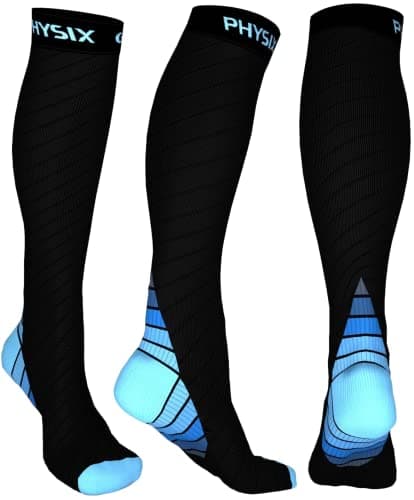
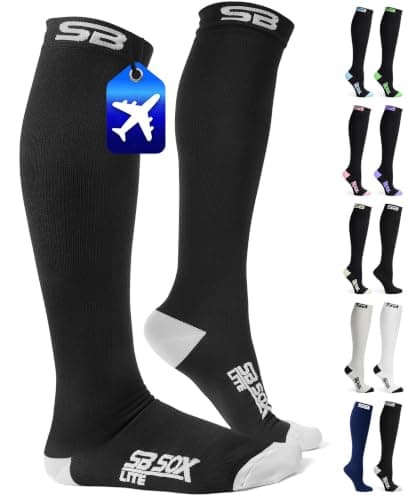
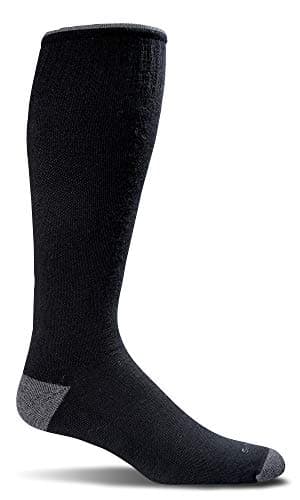
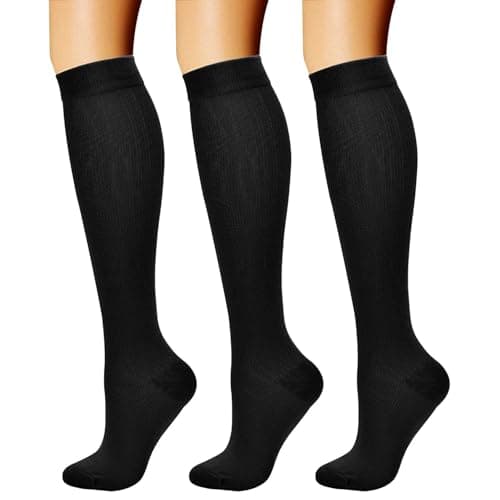
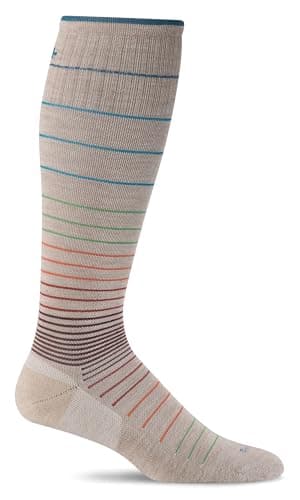
Buy 15–20 mmHg unless a clinician has told them otherwise. That's the over-the-counter grade that flight socks are generally sold in, it's printed on the packaging of everything on this page, and it's the band most travel advice points at for long flights. Higher grades exist, are harder to put on, and belong in a conversation with a doctor rather than in a gift guide.
A note before anything else: we're a gift site, not a medical one. Compression socks are widely used by travelers for comfort on long flights, and everything below is about buying a comfortable, well-made pair. If the recipient has a circulatory condition, is pregnant, has had recent surgery, or has been advised about clot risk, the grade and the fit are a clinician's decision. Nothing here replaces that conversation, and we'd rather say so plainly than write around it.
What "graduated compression" means
The knit is tightest at the ankle and gets progressively looser up the calf. That gradient is the entire design — a sock that squeezes evenly all the way up isn't a compression sock, it's a tight sock, and a couple of cheap listings blur that line.
The pressure is measured in millimeters of mercury (mmHg) and quoted as a range. The ranges you'll meet:
- 8–15 mmHg — very light. Sold as "energizing" socks. Comfortable, barely a compression sock.
- 15–20 mmHg — the standard over-the-counter travel grade. This is what to buy as a gift.
- 20–30 mmHg and above — firm and medical-adjacent. Genuinely difficult to pull on, and prescribed for reasons. Not a gift purchase.
Every product on this page states its grade on the packaging. Anything that doesn't state a grade at all should be treated as a tight sock rather than a compression sock.
The sizing problem, which is where gifts fail
This is the reason compression socks are a riskier gift than they look. They're sized by shoe size and calf circumference, and calf circumference is the one nobody knows. A sock that's too tight at the top rolls down and forms a band, which is the opposite of what a graduated knit is trying to do — and it's the single most common complaint in this entire category.
Three practical ways round it when you can't measure someone:
- Buy the multi-pack. Three pairs at a low price makes a wrong guess survivable, and it's the sensible way to find out whether they like compression at all before spending merino money.
- Buy unisex sizing. Unisex socks tend to size by shoe size alone with a wider calf tolerance, which removes one of the two unknowns.
- Include the receipt. Unglamorous, and by far the most useful thing you can do. A compression sock in the wrong size is useless; in the right size it's one of the most-used gifts on this site.
If any of that makes the gift feel fragile, it's a good candidate for pairing rather than standing alone — it sits naturally inside a long-flight kit alongside a mask and a pillow, where a sizing near-miss doesn't sink the whole present.
Merino versus nylon: the fourteen-hour question
On a three-hour flight, fabric barely matters. On a fourteen-hour one it decides whether the socks stay on.
Nylon-and-spandex socks are cheap, they compress correctly, and they get warm and damp over a long day. Merino blends cost several times as much and manage temperature and odor far better — the same reason merino dominates hiking socks. For someone who does regular long-haul, the merino pair is the one that gets worn for the entire journey rather than peeled off somewhere over the Atlantic.
There's a presentation argument too. Compression socks are, bluntly, not an exciting unwrap. The merino ones come in patterns and colors that look like good socks rather than medical supply, and that changes whether they get used. It's the same logic as our travel gifts to avoid guide: the useful gift that looks clinical often loses to the useful gift that looks like a gift.
How to actually wear them
Before any of that, it is worth settling whether this flight warrants them at all - the published threshold is shorter than most advice implies, and we go through it in do you need compression socks on a flight. The rest of the long-haul wardrobe is in what to wear on a long flight.
Worth passing on with the gift, because most first-timers get this wrong. Put them on before the flight rather than at the gate — ankles are smallest first thing in the morning, and a sock that goes on easily at 6am is a fight at 6pm. Pull them all the way up so the graduated knit sits where it's designed to. Don't fold the top over: that creates exactly the tight band the design exists to avoid.
And they're not a substitute for moving. Standard long-flight advice is to walk the cabin periodically and flex the ankles while seated; the socks are a complement to that, not a replacement for it.
How we ranked these
Scored against our published rubric from published specifications, manufacturer documentation and aggregated owner feedback — we compile, we don't test, and we say so. Stated compression grade and published sizing clarity carry the most weight, because an unsized guess is the way this gift fails. Fabric decides the ranking above that line: merino leads because on the flights these are bought for, comfort is what determines whether they're worn at all.
How to choose compression socks for a flight
1. Grade: 15–20 mmHg
The standard over-the-counter travel band, and what every pick here uses. Firmer grades are harder to put on and are a medical conversation, not a gift decision.
2. Size by shoe size and calf
Both matter. If you only know one, buy unisex sizing or a multi-pack, and include the receipt. A too-tight top band rolls down and undoes the whole design.
3. How long is the flight?
Under six hours, any well-made pair. Over ten, merino earns its price because the socks stay comfortable for the whole journey rather than being removed halfway.
4. One pair or three?
Three for a multi-leg trip or a first try. One good pair for someone who already knows they like compression and washes as they go.
5. Will they actually wear them?
Patterned socks that look like socks get worn. Beige medical-looking ones often don't. This is a genuine factor, not a superficial one.