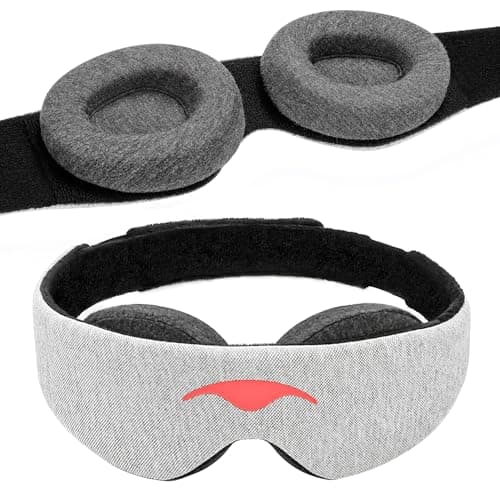
The whole product is the gap. Every flat sleep mask presses cloth against closed eyelids. The Manta does not: two C-shaped cups sit on the bone around each eye socket and hold the fabric away from the lids, so there is an air pocket in front of the eye. Everything people like about this mask and everything they complain about comes out of that one design decision. If the gap matters to the person you are buying for, nothing cheap substitutes. If it does not, you are paying three to four times the going rate for an eye mask.
What you actually get
Manta publishes the construction in more detail than most of this category bothers with. The eye cups are Modal fabric over a molded shell and they are detachable— they attach along the head strap and can be placed anywhere on it, which is how the mask adapts to the distance between somebody’s eyes rather than assuming an average face. The strap is a 73 cm loop, breathable polycotton on the outside and polyester velour against the skin, with elastic sections so it tightens without clamping. The whole thing weighs about 142 grams and is machine washable cold in a mesh bag, air dried flat.
Manta sells it with a 60-day money-back guarantee and a six-month manufacturer warranty against defects. Hold onto both of those numbers — we come back to the second one.
Note also what it is not. This is the Original. Manta sells a whole line — silk versions, cooling versions, a weighted version, one with built-in audio — and the review sites that call the Original “the best of the eye-cup designs” are comparing it against those as well as against rivals. For travel, the Original is the right one in the line: the others add weight, bulk or electronics to a thing whose job is to be packable.
Does the 100% blackout claim hold up?
Mostly, and for a structural reason rather than a marketing one.
Flat masks fail in exactly one place: the nose. The bridge of the nose is a ridge, the mask is a flat sheet, and the two meet at a triangle of daylight on each side. That is why almost every cheap mask leaks at the bottom, and why a cabin window two rows up is still visible at 6 a.m. The cupped designs attack it by sealing on the orbital bone instead — a continuous ring of contact on the hard rim around the eye, below the brow and above the cheekbone, with a nose piece that only has to bridge rather than seal.
In practice that gets the Manta far closer to true darkness than a flat mask gets, which is the honest version of the claim. It is not unconditional. Owner reviews do report light leakage, and when they do it is almost always a fit problem — the cups are in the wrong position on the strap for that face, or the strap is loose, or the mask has been put on in the dark and seated crooked. The adjustability that makes this mask work for unusual faces is the same adjustability that lets you set it up wrong. It needs five minutes in daylight, once, to be positioned properly, and anyone gifting it should say so.
Zero eye pressure is the real feature
Blackout gets the marketing. The gap is what people actually keep it for.
With a flat mask, the eyelid is loaded for the whole night and the eye cannot move freely under the cloth. With cups, you can open your eyes inside the mask and blink normally into the dark. That sounds like a gimmick until you are one of the people for whom it is not: contact lens wearers, anyone with dry eye, anyone with eyelash extensions that a flat mask flattens overnight, people prone to migraine who cannot tolerate pressure around the orbit, and anyone recovering from eye surgery who has been told to keep weight off the lid. For those recipients this mask is not a nicer mask — it is the only format that works, and the price argument evaporates.
We are not a medical site and nothing here is advice about an eye condition; anyone in the last two categories should be guided by their clinician rather than by a gift guide. But as a purchasing fact, “no pressure on the lid” is the feature that makes this a considered buy rather than an indulgence.
The side-sleeper question, honestly
This is the most searched objection to the Manta and it deserves a straight answer, because Manta’s own listings do not entirely agree with each other.
The product page on mantasleep.com describes the mask as “great for back, belly and side sleep.” The Amazon listing for the same product is titled, in part, Zero Eye Pressure for Back & Belly Sleepers — side sleeping is simply absent from it. Owner reviews split along the same line: some side sleepers are perfectly happy, others report the cup rim pressing into the temple and the eye socket once the side of the face is loaded against a pillow.
Our read: treat it as a back-and-belly mask that a lot of side sleepers get along with anyway. The variable is face shape and how hard the recipient presses into a pillow, and there is no way to know that from the outside. If you are buying for a committed side sleeper, two things help — the 60-day money-back guarantee makes it a low-risk experiment, and a lower-profile contoured mask like the MZOO is a cheaper hedge. The full comparison across cupped and flat designs is on our best travel sleep masks page.
On a plane the question is slightly different, because an economy seat rarely lets anyone sleep fully on their side anyway. In a seat, the pressure the mask has to survive comes from the headrest wings and from a neck pillow, not from a mattress — which is why this mask tends to do better in flight than its side-sleeping reputation suggests.
How it behaves as a travel object
Three practical notes that reviews of the mask-as-a-mask tend to skip.
It is bulkier than a flat mask, and that is fine. Cups have volume; a silk mask folds to nothing. At 142 grams the weight is irrelevant, and the cups are soft enough to squash into a corner of a bag, but it will not live in a pocket the way a flat mask does. In practice it travels in a pouch with the earbuds and the charger rather than loose.
It competes with headphones for head space. The strap runs around the back of the skull where an over-ear headband also wants to sit, so a mask plus big headphones is a negotiation. Earbuds are the easier pairing for sleep in a seat — the same conclusion we reach for different reasons in headphones vs earbuds for flying.
It is washable, which matters more on the road. A mask that spends a week absorbing sunscreen, airline air and a hotel pillow is a mask that needs a machine at some point. Cold wash in a mesh bag, air dry flat. Plenty of premium masks are hand-wash-only and quietly become disposable because of it.
Durability and the warranty
The recurring long-term complaint is the fastening: owners report the hook-and-loop closure losing grip over time, which on an adjustable mask is the component doing the most work. It is not universal and it is not quick, but it is the failure mode to expect.
Against that, Manta backs the mask for six months against defects and offers 60 days to simply send it back. The 60 days is genuinely useful — it is what makes the side-sleeper gamble reasonable. Six months of warranty is short for the money, and it is the single weakest number on the spec sheet; a thirty-dollar flat mask comes with nothing at all, but a thirty-dollar flat mask is also something you expect to replace.
When to buy something cheaper instead
We would rather send you to the right product than the expensive one, so: there are two clear cases for not buying this.
If they nap occasionally — a flight a year, an afternoon on a sofa — a silk flat mask costs a fraction of this, weighs nothing, and is pleasant against the skin. It will leak light at the nose. For occasional use nobody cares.
If they want the cup geometry on a budget, a contoured molded mask gets a long way toward the same thing for roughly a third of the price. It is a fixed shape rather than an adjustable one, so it works beautifully on some faces and not at all on others — but at that price it is a sensible first experiment, and if it works you have saved real money.
Buy the Manta when the recipient sleeps badly in light, travels enough for it to matter, and either has a specific reason to keep pressure off the eye or has already tried a cheap mask and been annoyed by it. That is a narrower recommendation than most reviews of this product give, and it is the honest one.
Is it a good gift?
Unusually good, for three reasons. It is the right size of present — enough to feel considered without being an occasion. It is something almost nobody buys for themselves, because thirty-odd dollars for an eye mask feels absurd right up until the first night it works. And it is impossible to get wrong on sizing, which is rare in this price band.
It also pairs well rather than standing alone. A mask plus a neck pillow is the standard long-haul kit, and a mask plus a travel white noise machine covers light and sound together, which is the combination that actually gets somebody through a hotel room next to a corridor. If you are assembling the whole thing, we rank it as a set on best travel accessories for long flights.
One gifting note: include the fitting instruction. The single most common disappointed review of this mask is somebody who put it on, found a sliver of light, and concluded it does not work. Five minutes adjusting the cup positions in daylight is the difference between a mask that gets used for years and one that ends up in a drawer.