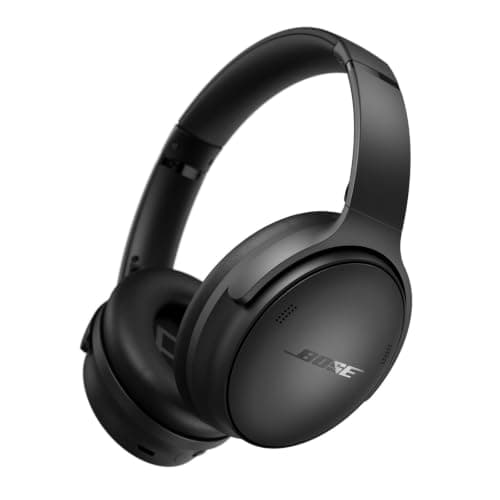
The reason to buy these is the clamping force, not the cancellation. Every flagship over-ear in 2026 cancels engine drone well enough that the differences are audible in a review and nearly irrelevant at 36,000 feet. What is not irrelevant is hour seven, when a headband that was fine at takeoff has become the most noticeable object in your life. Bose has spent two decades optimizing for that hour, and the QuietComfort Headphones are the current, non-flagship, sensibly-priced expression of it. If you are buying a gift for someone who flies long-haul, that is a more useful thing to optimize for than a decibel figure.
What Bose publishes
The numbers that matter to a traveler, taken from Bose’s own product page rather than from a retailer listing:
- 24 hours of battery life with a 2.5-hour charge time, over USB-C. Twenty-four hours is the figure to care about, and it is the one that makes these a travel product rather than a commute product.
- Bluetooth 5.1, with a stated range of up to 30 feet (9 metres) from the source device.
- 7.68 x 6.18 x 3.15 inches and 0.520 lb— about 236 grams. Note that retailer listings for this model disagree on weight, with figures from 238 g up to 1 lb floating around; the heavier numbers almost certainly include packaging. We are quoting Bose’s own figure and flagging the disagreement rather than picking whichever number reads better.
- Quiet and Aware modes, adjustable, plus a microphone for calls.
- They fold, and ship with a case and a wired audio cable.
One thing worth naming because it shapes everything below: this is the 2023 QuietComfort model, and it sits deliberately below the QuietComfort Ultra in Bose’s own line. It is not last year’s flagship quietly discounted — it is the mid-tier product, designed to be the sensible one, which is exactly why it is the pick we recommend most often to gift buyers.
The 24-hour number is the travel spec
Battery life is the specification that looks boring on a comparison table and decides whether a gift is actually pleasant to own. Twenty-four hours with cancellation on means a Los Angeles to Sydney flight, the airport before it, and the connection after it, on one charge — and more importantly it means the recipient does not have to think about charging them on a trip at all. Plug them in once at the hotel on arrival and the return leg is covered.
The practical test for a gift is not peak endurance but how often the recipient has to care. At 24 hours, the answer is roughly once per trip. That is the threshold where a device stops being a thing you manage. It is also, for what it is worth, enough that a forgotten charge is a non-event rather than a ruined flight.
The 2.5-hour charge time is unremarkable and fine. If the recipient is the kind of person who charges things in the taxi to the airport, note that over-ears like these are usable wired via the included cable while they top up — which the earbud alternatives are not.
Quiet and Aware, and why two modes is the right number
Bose publishes two named modes plus adjustability between them, and the restraint is a feature. Quiet is full cancellation: what you use for the cruise portion of a flight, the one that turns engine noise into distant weather. Aware passes outside sound through, which exists for the three moments on a flight when you need it — the crew asking about a drink, a gate announcement, and ordering coffee without taking the headphones off.
That third one is the underrated case. A traveler who has to remove headphones to interact with the world removes them ten times a journey and sets them down in ten places. A pass-through mode is, in a very literal sense, a way of not losing your headphones.
What you give up against the step-up models is per-situation customization and spatial-audio processing. Our honest read: those are features you notice in a review and do not reach for on a plane, where the only two states anyone actually wants are “off, let me sleep” and “let me hear the person talking to me.”
The comfort claim, examined honestly
We do not run a testing lab and we are not going to tell you we wore these for nine hours. What we can do is say where the comfort reputation comes from and what, structurally, supports it.
At Bose’s published 0.520 lb, these are light for a full over-ear with active cancellation — and weight is the part of comfort that is measurable. The rest is clamping force and earcup geometry, which Bose has historically set looser than its rivals, and it is a real design choice with a real trade: a looser clamp is more comfortable over hours and seals slightly less aggressively, which is part of why these do not quite match the very best measured cancellation. That is the trade, and it is the right one for a long flight.
The one comfort factor nobody’s spec sheet covers is heat. All over-ears are warm, these included, and in a warm cabin that is the thing that eventually makes someone take them off. If the recipient runs hot, or sleeps pressed against a window, the honest answer may be earbuds — see below.
Where the Sony WH-1000XM5 actually beats them
We rank the Sony WH-1000XM5 first in our noise-canceling headphones roundup and these second, so it is worth being specific about why rather than hiding behind a score.
The Sony wins on feature count and app control: more adaptive processing, more granular settings, stronger call handling in wind, and a more capable companion app. It is the better product for someone who wants to tune things.
The Bose wins on the specific axis this page is about. If you had to wear one pair for a fourteen-hour flight and could not take them off, most people would pick these. It is a narrow win on a single axis, and that axis happens to be the one that decides whether a traveler loves a gift or tolerates it.
There is also a practical difference in the box: the Bose folds at the hinges, which the XM5 famously does not — the Sony swivels flat instead. For a traveler whose personal item is permanently full, a folding hinge is a genuine advantage, and it is the kind of thing that only becomes obvious after the purchase. Our Sony XM5 vs Bose QuietComfort comparison takes that head-to-head further.
Should you pay more for the QuietComfort Ultra instead?
This is the question every buyer of these actually faces, because Bose sells both and the Ultra sits visibly above them.
The framing we would use: the Ultra is a different purchase, not a better version of the same one. It adds Bose’s immersive spatial audio and more sophisticated cancellation processing, and it costs meaningfully more. Neither of those additions changes the two things a traveler does with headphones — block the cabin, and sleep. Spatial audio is a listening feature for someone enjoying music attentively, which is not what happens at hour six of a red-eye.
So: buy the Ultra if the recipient is an attentive listener who also flies. Buy these if the recipient is a traveler who also listens to things. For most people on most gift lists, the second description is the accurate one, and the difference in price is better spent on something else in their bag.
The two honest reasons to buy something else
Bag space. Even folded, an over-ear case is a substantial object, and a traveler who walks onto a plane with one tote has a real problem with it. Noise-canceling earbuds now cancel nearly as well in a case that disappears into a pocket, and the headphones vs earbuds question is the one to settle before buying either.
How they sleep. Over-ears and a window seat are a bad combination — the earcup presses against the window or the headrest and the headband gets in the way of a neck pillow. Someone who sleeps leaning against the side of the aircraft is better served by earbuds and a proper neck pillow. Someone who sleeps upright, or who mostly uses headphones awake, is the right recipient for these.
Who these are the right gift for
A long-haul flyer who wears headphones for hours rather than minutes, does not want to manage settings, and would rather have the pair that disappears on their head than the pair that scores highest. Also, more specifically, anyone upgrading from cheap over-ears or from the airline’s own: the jump in both comfort and quiet is the single most dramatic improvement available in travel gear, and it is why this category leads our gifts for frequent flyers list.
They are the wrong gift for a spec-obsessed listener (buy the Sony or the Ultra), a light packer (buy earbuds), or someone who flies four short hops a year — at that frequency the difference between these and a competent mid-price pair is genuinely hard to justify, and our travel gifts under $100 list has better uses for the money - starting, unglamorously, with a luggage scale, which costs a fraction of these and prevents a fee they will otherwise pay again.
One last practical note for gift buyers: these are a mainstream, heavily-discounted product in late November. Our Black Friday travel gear page documents what the Bose QuietComfort line did in last year’s sales with dated sources. If the occasion is Christmas and you are shopping in October, waiting is a reasonable strategy for this specific product.