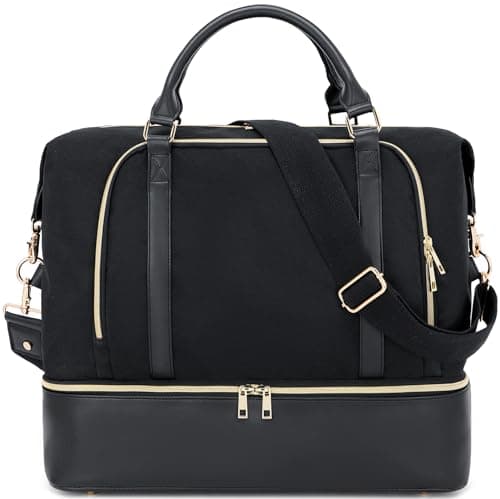
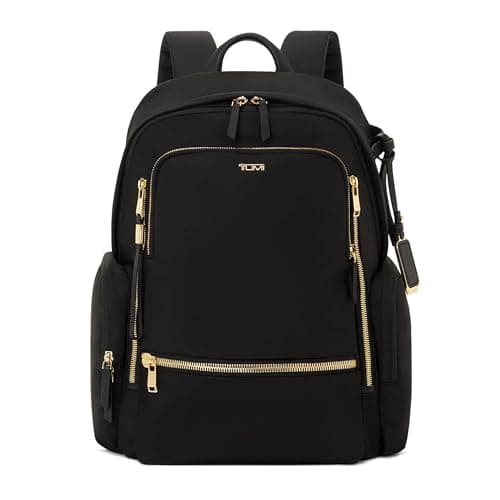
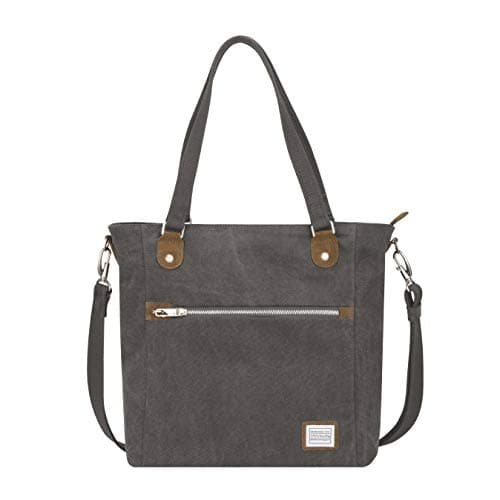
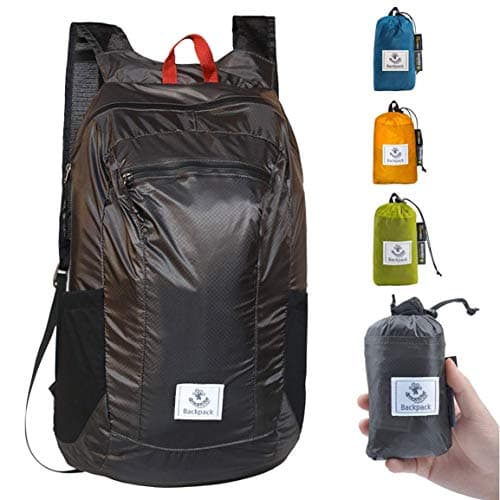
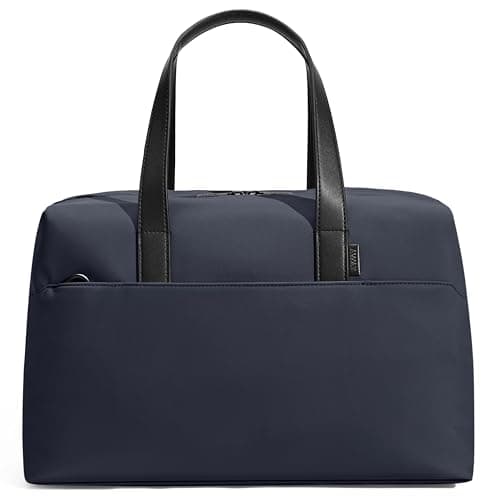
The Away Everywhere Bag is the pick for most people: it is built to the personal-item slot rather than squeezed into it, the trolley sleeve is standard, and the padded laptop pocket is on the outside so the machine comes out at security without unpacking the bag. A personal item is the bag that goes under the seat in front, and it is the only free bag left on most fares. That makes it the highest-leverage bag a traveler owns — and the one most people buy wrong, because they shop it as a handbag or a weekender rather than as a container with a fixed ceiling on its dimensions.
What a personal item actually has to do
Three things, in this order. It has to fit the under-seat space on the airlines the recipient flies. It has to be reachable in flight, because anything in the overhead bin is gone for the duration. And it has to not be miserable to carry through an airport alongside a rolling bag — which is a strap-and-sleeve problem, not a volume problem.
On sizing we are going to be blunt: we do not print a table of per-airline personal-item dimensions, because carriers change them and the published figures differ between a US legacy airline, a European budget carrier and a regional jet with a shallower seat box. The honest instruction is to look up the current personal-item dimensions on the airline the recipient actually flies, then compare them to the bag's published measurements — not to its marketing claim of being "carry-on friendly," which means nothing. Our carry-on size rules guide explains why the numbers vary and where to find each airline's.
Two of the picks here publish real external dimensions, which is why they rank where they do: the Away Everywhere Bag at 16.3 by 10.2 by 7.3 inches, and the TUMI Voyageur Celina at 16.0 by 10.6 by 6.5 inches. A bag that tells you its size is a bag you can actually check against a rule. Most bags in this category do not.
The five picks, side by side
| | Published size | Trolley sleeve | Laptop pocket | Structure |
|---|
| Away Everywhere Bag | 20L — 16.3 x 10.2 x 7.3 in | Yes, built in | Padded, outside, up to 16 in | Structured |
| CAMTOP weekender tote | Not published | Yes | No dedicated pocket | Soft — slumps when heavy |
| TUMI Voyageur Celina | 16.0 x 10.6 x 6.5 in | Yes | Up to 16 in | Structured, slim |
| Travelon Heritage Tote | Not published | No | No dedicated pocket | Soft, slash-resistant body |
| 4Monster packable daypack | Around 20L, packs into its own pocket | No | No | None — it is a stuff sack with straps |
Every figure in that table is one the listing publishes; the blanks are blank because the brand does not state a comparable measurement, and we would rather print "not published" than a number we measured off a photograph. All five listings are linked in Sources.
The trolley sleeve is the feature that decides it
This is the detail that separates a good personal item from a bag you resent. A trolley sleeve is a fabric channel on the back panel that slides over a rolling suitcase handle, so the second bag rides the first one instead of sliding off a shoulder every nine steps. Three of the five picks here have one, and it is the single most requested feature in this category for a reason.
If the recipient never travels with a rolling bag — a one-bag backpacker, say — the sleeve is irrelevant and a comfortable strap matters more. If they always do, a bag without a sleeve is the wrong buy at any price.
Laptop access, and why the pocket should be on the outside
The laptop comes out at security, and in most lanes it comes out of the bag entirely. A padded laptop pocket that opens from the outside turns that into a two-second action; a laptop buried in the main compartment under a sweater and a water bottle turns it into unpacking on a metal table with a line behind you. The Away and the TUMI both do this properly. It is worth more than an extra liter of capacity.
Soft bag or structured bag
A soft bag squashes into the under-seat space and will take an extra jumper; a structured bag stands up, protects what is inside and does not slump into a shapeless lump by hour four. Soft wins on flexibility, structured wins on dignity and on anything fragile. The CAMTOP is the soft answer and the cheapest way into this category; the Away and TUMI are the structured ones.
One honest note on the soft bags: packed heavy, they sag, and the shoe compartment that makes the CAMTOP so useful on a weekend trip is also the thing that makes it bulge. That is the trade at the price.
The city-theft version, and the free second bag
If the trip is three European cities and the real risk is a crowded metro rather than an airline sizer, the Travelon anti-theft tote is the answer in this list: locking zips, a slash-resistant body and RFID pockets built in, at a fraction of designer money. It looks like what it is, and for some buyers that is the point. We go through the whole don't-get-robbed question in how to keep valuables safe while traveling.
And if the recipient already has a bag they like, the cheapest useful gift in this category is a packable daypack that stuffs into its own pocket — the 4Monster. It is not a great personal item on a travel day, because it has no structure and no sleeve. It is a brilliant second bag once they arrive, and the whole category is ranked separately on our packable daypack roundup.
What this bag is not
It is not a weekender, and it is not a carry-on. A personal item that holds a weekend of clothes is a bag that will be gate-checked on a full flight, and a personal item bought to replace a suitcase is the most expensive way to learn what a sizer is. If the real brief is the rolling bag, that is carry-on luggage; if it is a backpack to live out of, that is the travel backpack roundup; and if a soft bag for a two-night trip is what is wanted, the duffel roundup is the right page. This page is about the free bag that goes under the seat.
How to choose a personal item bag
Start with the airline, not the bag
Look up the personal-item dimensions published by the carrier the recipient flies most, then shop for a bag whose own published dimensions fit inside them. Budget carriers are the strict ones, and they are also the ones that charge for being wrong.
Then decide: rolling bag or no rolling bag
With a rolling bag, insist on a trolley sleeve. Without one, prioritize a wide, padded, ideally detachable shoulder strap — the thing you will be carrying for forty minutes of connection.
Check how the laptop comes out
Outside pocket, padded, top-opening. If the laptop lives in the main compartment, every security lane becomes an unpacking exercise.
Count the openings, not the pockets
A wraparound zip that opens the whole bag beats a slot at the top with six internal pockets. Under a seat, in the dark, with the bag at an angle, access is everything.
Be realistic about weight
Many international and budget carriers weigh cabin baggage, and an empty bag's weight is deducted from what the traveler can put in it. A heavy structured bag is a real cost on those fares — the same argument we make about suitcases in Travelpro vs Samsonite.
What to spend
There is a genuinely good bag in this category at every price point from a single-figure packable to designer money, and the expensive ones buy structure, materials and warranty rather than capacity. Every price here is live and date-stamped; where we have no verified price we show none rather than a stale number.