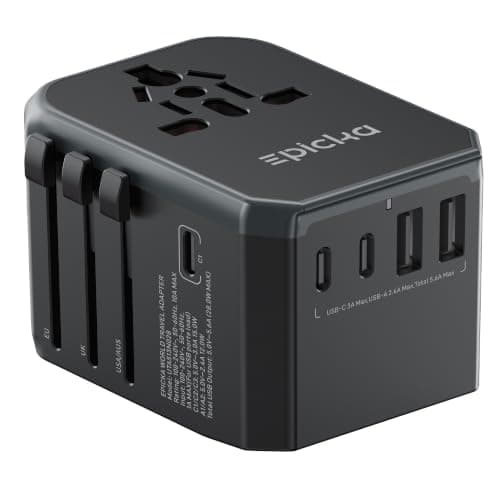
This is the safe answer when you don't know where they're going. One block with slide-out pins covers the US, UK, European and Australian plug shapes, and the USB ports on the side mean it replaces the wall charger as well as the plug. If you're buying one thing for someone heading abroad and you want a near-zero chance of getting it wrong, this is it.
What it is
A single plastic block, roughly the size of a deck of cards, with four sets of pins that slide out of the housing one at a time. Slide out the UK pins and it plugs into a British socket; retract them, slide out the European pins, and it plugs into a French one. On the face is a universal socket that accepts almost any plug from anywhere, and on the side is a row of USB-A and USB-C ports.
That's the whole product. Its virtue is that it's one object rather than a pouch of loose pieces, which is why it survives contact with real travel — nothing to lose in a hotel drawer.
The one thing it does not do
It does not change voltage. This is the single most important sentence on this page and it's the reason we've put it above the praise.
An adapter is a mechanical shim: it makes a plug fit a hole. Much of the world runs at roughly 220–240 volts; the US runs at about 110–120. If a device is dual voltage — labeled "INPUT: 100–240V" in the small print — it handles both perfectly happily, and an adapter is all it ever needs. Phone chargers, laptop bricks, tablets, e-readers and camera chargers are almost universally dual voltage.
The exception is high-wattage heating tools. Many hair dryers, straighteners, curling irons and travel kettles are single voltage, and pushing 240 volts into one through a plain adapter can destroy it or trip the room's breaker. Those need a genuine voltage converter, which this is not and does not claim to be. We work through the whole distinction in travel adapter vs voltage converter, and it's worth a two-minute read before you buy this for someone who travels with a straightener.
The USB ports are the real feature
The wall socket on the front gets used less than you'd think. What actually happens on a trip is that the traveler plugs the adapter into the wall once, then charges a phone, a watch and a set of earbuds directly from the USB ports on the side and never touches the AC outlet.
That changes what's in the bag. Without it, an international traveler carries an adapter and a multi-port wall charger. With it, they carry one thing. For anyone trying to travel light — see gifts for minimalist travelers — that consolidation is worth more than any spec on the box.
The caveat worth knowing: USB output on universal adapters is shared across the ports, so charging four devices at once is slower than charging one. It's fine overnight, which is when most charging happens. It is not a substitute for a high-wattage laptop charger, and anyone traveling with a power-hungry laptop should keep the manufacturer's brick and use the AC socket.
Where it doesn't reach
"150+ countries" is a broad claim and the honest reading of it is that the four pin types cover the overwhelming majority of the world. The gaps are the unusual ones — Switzerland's Type J and Italy's Type L sockets both accept the standard European pins in most modern installations but not universally, and South Africa's older Type M sockets are a genuine exception.
For the traveler heading to Zurich or Johannesburg specifically, a country-specific plug alongside this is cheap insurance. For everyone else, this covers it. Our travel adapter roundup includes a plug kit for exactly the traveler who'd rather carry separate, sturdier pieces.
Build, and the honest complaints
Two things come up repeatedly from owners and both are fair.
It's bulky. A single-country plug is a quarter of the size. If the recipient only ever goes to one place, the universal block is more object than they need.
It hangs heavy in a loose socket. Older European sockets, particularly in budget hotels, hold plugs loosely, and a block of this weight can sag out. Nothing dangerous, but worth knowing — a short extension lead is the standard workaround for anyone who travels with a lot of gear.
Set against those, it has a built-in fuse and a spare, which is genuine basic surge protection and is not universal at this price. For a product that mostly sits in a bag pocket, this is a reasonable set of trade-offs.
Who should buy it, and who shouldn't
Buy it for anyone taking their first international trip, for the frequent flyer whose adapter is a tangle of separate pieces, and for anyone you're buying for whose itinerary you don't know. It's small, cheap, universally applicable and almost impossible to already own two of.
Don't buy it as the answer to a hair-dryer problem, and don't buy it for someone who exclusively visits one country — a single well-made country-specific plug is smaller and does that job better. And if it's the entire gift for someone close, it's under-scaled; it works far better as the practical component of something larger, which is how our gifts for first-time travelers list uses it.
How we assess
Scored against our published rubric — usefulness, portability, durability, value, giftability — from published specifications, manufacturer documentation and aggregated owner feedback. We compile and reason; we don't run a lab and we don't claim tests we haven't done. Where a limitation is inherent to the product category rather than this product, we say which is which.