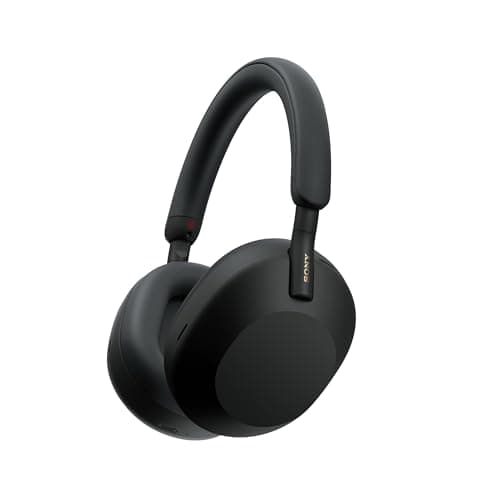
Buy these if the person you're buying for flies long-haul more than a couple of times a year. That's the whole recommendation. The XM5 is one of the most complete pairs of travel headphones you can buy — and since Sony replaced it with the pricier WH-1000XM6, it is also the sensible way to buy in — but it is still considerably more money than most people need to spend, so the honest question isn't whether they're good. It's whether the trips justify them.
What the noise canceling actually does
On a plane the dominant sound is a continuous low-frequency roar from the engines and the airflow over the fuselage. That is precisely the kind of noise active cancellation handles best, and the XM5 handles it about as well as anything on the market. Put them on at cruising altitude and the roar drops to something like distant weather.
What it does not do, and no pair does, is erase sudden high-frequency sound. A crying baby, a cabin announcement, the laugh from two rows back: those still get through, softened rather than removed. Anyone promising silence is overselling. What you're buying is a much lower noise floor, which means music and dialogue play at a lower volume and the traveler steps off the plane noticeably less frayed.
The second-order effect is the one people underrate. Constant loud noise is tiring in itself, independent of whether you're listening to anything. Frequent long-haul flyers tend to describe the real benefit as arriving able to think rather than as an audio upgrade, and that framing is what makes the price make sense.
Where the money goes
Against the genuinely good sub-$100 pairs, the XM5 buys four things:
- The last stretch of cancellation. Smaller than the price gap suggests, but real, and most obvious on the longest flights.
- Comfort over many hours. Light clamping force, deep earcups and a well-distributed headband are what make hour seven bearable. This is the difference that matters most and gets discussed least.
- Call microphones. If they take meetings from airports and hotel rooms, the microphone array is a genuine professional advantage over cheaper pairs.
- Multipoint pairing. Connected to a laptop and a phone at once, switching automatically. On a working travel day this gets used constantly.
What about the newer WH-1000XM6?
Sony replaced the XM5 with the WH-1000XM6 in May 2025, at $449.99 list. The XM6 cancels a little more (a faster processor and twelve microphones against the XM5's eight), and it folds again, which the XM5 does not. It is the better pair. It is not, for most gift buyers, the better purchase: the XM5 is still sold new, typically sits well over $100 below it, and gives up very little of what a traveler actually notices at cruising altitude — the drone still drops to distant weather, the comfort and battery are the same. If the recipient is a weekly flyer whose personal item is always full, the folding hinge alone can justify the XM6. For everyone else, the XM5 is where the money goes furthest, which is why it stays our pick.
The two honest reasons to buy something else
Bag space. The XM5 swivels flat rather than folding at the hinges, and an over-ear case is roughly the size of a small melon. For a traveler whose personal item is already full, or who habitually walks onto a plane with nothing but a tote, that's a real problem, and noise-canceling earbuds now cancel almost as well in a case that fits a coin pocket.
How often they actually fly. On four short flights a year the difference between these and a good $90 pair is genuinely hard to justify, and the money is better spread across two or three gifts. We work through that trade in our noise-canceling headphone roundup and in travel gifts under $100.
Practical things to check before gifting these
Seat-back entertainment. Many aircraft still use a wired socket for the in-flight screen. Wireless headphones need either a small Bluetooth transmitter or a cable to use it, though newer aircraft increasingly offer direct Bluetooth pairing. If the recipient watches seat-back films rather than downloads, check the airline rather than assuming the gift covers it.
Glasses. Over-ear clamping pressing the arms of glasses into the side of the head is an under-discussed problem on long flights. The XM5's clamping force is on the gentle side, which helps, but it's worth knowing if they wear frames for the whole flight.
Battery. Comfortably covers a long-haul and the return leg. It is not the thing that will let them down.
Who this is the right gift for
The frequent flyer, the business traveler doing same-day returns across time zones, and the person who has said out loud that flying exhausts them. For those three this is one of very few travel gifts where the premium tier is felt on every single trip rather than admired occasionally. For everyone else, buy down and spread the budget — our gifts for frequent flyers list puts headphones in context with the rest of the kit, and the XM5 versus the Bose QuietComfort settles the other question people ask at this price.
Should you buy the XM5 as a gift?
Buy it if
They fly long-haul regularly, they have bag space for an over-ear case, and they take calls on the road. Those three together make this the correct purchase rather than an indulgent one.
Buy earbuds instead if
They travel light, take mostly short flights, or sleep leaning against a window. A headband is in the way in all three situations, and flagship earbuds now cancel nearly as well.
Buy the value tier instead if
They fly a handful of times a year. The sub-$100 pairs deliver most of the benefit and the difference funds two more gifts.
Check first
Whether they wear glasses for whole flights, whether their personal item has room for the case, and whether they rely on seat-back entertainment. Any of the three can change the answer.