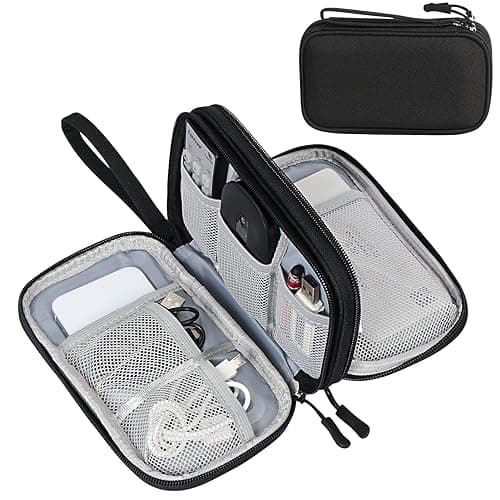
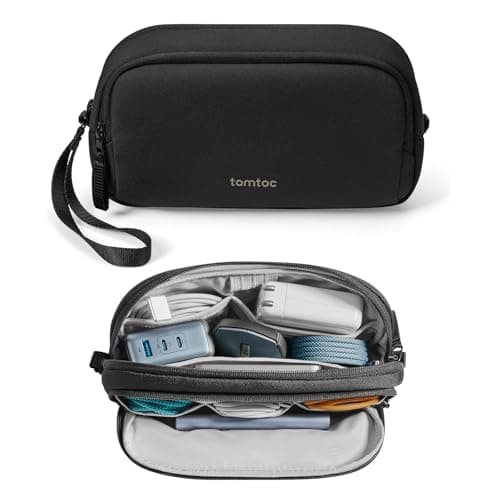
Buy the shape that fits the biggest thing they carry, and buy it in the smallest size that still does. Tech organizers all look interchangeable in a listing photo — a zip case full of neat elastic loops — and they are not. A flat clamshell and a deep dual-compartment case hold completely different kits, and the case that is wrong for the kit ends up in a drawer no matter how good it is. This page is about matching the two.
The brick test
Start here, because it eliminates most of the market in one question: does the person travel with a laptop charger?
A laptop charging brick is by far the largest, heaviest, most awkwardly shaped thing in anyone's tech kit. It is rigid, it does not compress, and it is roughly two to three inches thick once the cable is wrapped around it. A flat single-layer organizer — the shape that dominates the cheap end of the category — is under an inch thick by design. The brick either does not go in, or it goes in and turns the case into a lumpy wedge that no longer slides anywhere.
So: if there is a laptop, buy a case with real depth or a dedicated compartment for the brick. If there is no laptop — a phone charger, a couple of cables, earbuds, a power bank, maybe an adapter — buy the flat one and do not spend more. The flat case is genuinely better for that kit, because it lies against a laptop or a tablet instead of stealing depth from the middle of the bag.
Almost every one-star review in this category is a version of this mismatch. Very few are about build quality.
The three shapes, and who each one is for
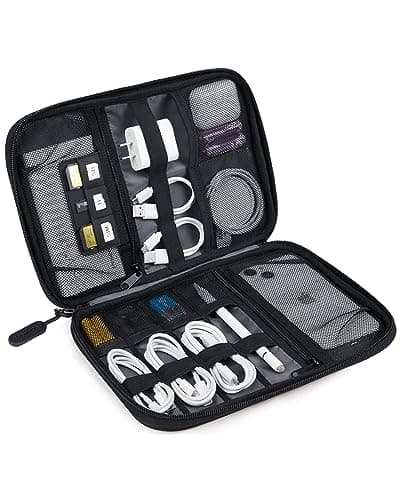
1. The flat clamshell.One layer, under an inch thick, zips open like a book so everything is visible at once. Elastic loops along one panel, mesh pockets along the other. This is the BAGSMART shape and it is what most people picture when they hear “cable organizer”. It excels at cables, small chargers, SD cards and adapters, and it has one genuinely valuable property: it fits in a laptop sleeve alongside a laptop, so it costs almost nothing in packed volume. It fails at anything with bulk.
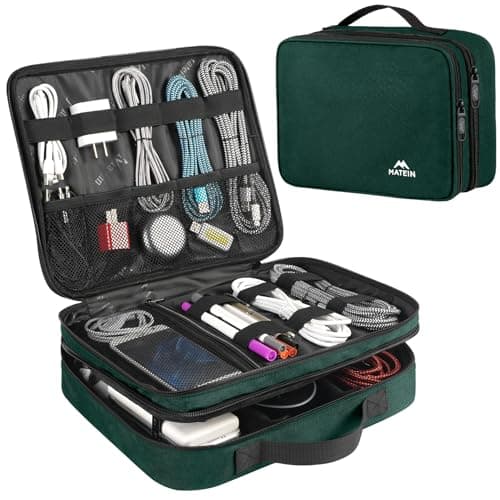
2. The structured block. Two to four inches deep, holds its own shape, often with two separate compartments or removable dividers. The tomtoc and the MATEIN are both this shape at different sizes. It houses the brick, keeps the heavy items from crushing the small ones, and stands upright on a desk so the contents are visible rather than excavated. The trade is real: it is a solid object that takes up the same space whether it is full or half empty.
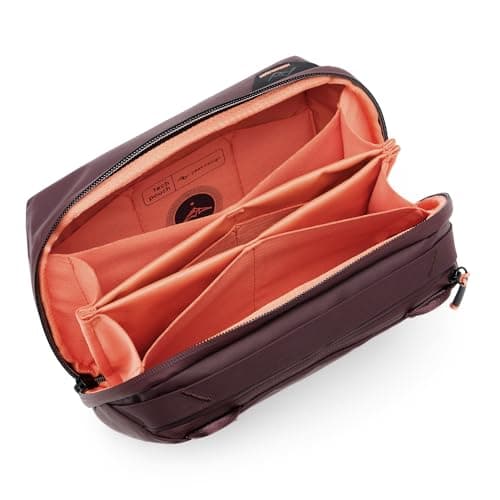
3. The expanding pouch. The premium answer, and the Peak Design is the clearest example — internal dividers that fold flat and open out as they fill, so capacity grows without the outside changing shape. It holds a startling amount for its footprint. The catch, and reviewers are consistent about this, is that it needs to be reasonably full to work. Under-packed, the structure has nothing to press against and the whole thing slumps.
There is no fourth shape worth chasing. Hanging organizers, rolls and multi-pocket panels all exist; none of them solve a problem these three do not, and most of them are harder to close.
What the specs on the listing actually mean
Liters. The only capacity number that means anything, and only about half of these cases publish it. Around 1L is a phone charger and cables. Around 1.8 to 2L is a laptop charger plus the rest of the kit — the size most travelers actually need. Anything above that is a small bag with a handle, and should be judged as one.
Denier. The 200D or 600D on a shell spec is thread thickness, not toughness in any absolute sense. A 600D polyester is a heavier, more abrasion-resistant weave than a 200D nylon of the same construction, but nylon is stronger than polyester per thread, which is why a 200D nylon canvas shell and a 600D polyester one can end up in the same place. Denier tells you about weight and feel. It does not tell you the case will survive a decade.
RPET. Recycled polyester, made from post-consumer bottles. It is a materials-sourcing claim, not a performance claim — an RPET shell is not stronger or weaker for being recycled. Worth knowing so it does not read as a durability spec.
Water-resistant, not waterproof. Every case on this page uses a coated shell or a DWR finish. That buys you time against a spilled drink and a wet bag floor; none of it survives immersion, and none of these cases have sealed seams. If the concern is genuinely wet conditions, that is a dry bag, and it is a different purchase.
Elastic loops versus zipped pockets — where things get lost
The single most useful feature in this category is the one buyers skim past: at least one zipped interior pocket. Elastic loops are excellent for cables, which are long and want to be held at one point. They are useless for the small flat things — SD cards, dongles, USB drives, spare tips — which slide out the moment the case is turned over. A case with a dozen loops and no zip pocket loses exactly the items that are most annoying to lose.
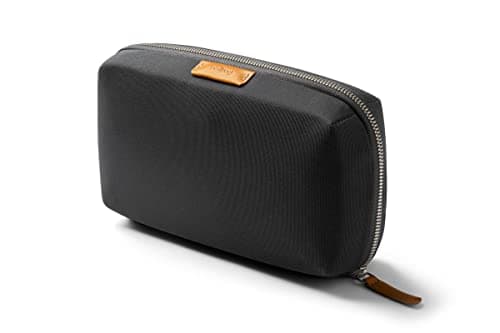
This is the honest knock on the Bellroy, which is otherwise the nicest object here: its interior is elastic only. It is also the quiet advantage of the cheap BAGSMART, which includes a zip mesh pocket. Price does not predict this feature at all, which is why it is worth checking on any case you are considering, including ones not on this page.
The second thing worth checking is whether the loops come in more than one size. A row of identical loops sized for a charging cable will not hold a mouse or a power bank, and a row sized for a power bank lets thin cables fall straight through.
Where the organizer actually rides
A tech organizer is not stored, it is carried, and the three places it can ride are not equivalent.
In the laptop sleeve, against the laptop. Only the flat clamshell fits here, and it is the best outcome in the category: the case costs you essentially no packing volume and is reachable without opening the main compartment.
In the main compartment of a personal item.Where the structured cases go. Fine, but a three-inch block in a bag that is already full is a real cost — it is roughly a pair of shoes worth of space. Worth checking the recipient's bag has the room before buying the biggest version.
Out on the tray table, or on a hotel desk. The reason the standing cases and the flat-opening clamshells earn their premium. A case that stands up or lies open flat turns into a work surface and the kit stops disappearing into the seat pocket — which is where chargers get left behind.
One security note, since it comes up: an organizer full of cables does not need to come out at a US checkpoint, but a densely packed one is a classic trigger for a bag check because it reads as an unresolvable blob on the X-ray. Loosely packed and flat scans cleaner. The rules that actually bind at the checkpoint are the liquids rules and the lithium battery rules — and the battery rules mean the power bank in that case has to be in a carry-on, never a checked bag.
Does an organizer save space? No — and that is fine
Worth being straight about this, because the marketing implies otherwise. A tech organizer costs you volume. The case itself is fabric, padding and zips, and loose cables stuffed into a corner of a bag will always take less room than the same cables in a structured box.
What it buys is time and attrition. Everything is in one place, so packing is one motion instead of a sweep of the room, and the count is obvious at a glance — the reason people stop leaving chargers in hotels is that an empty loop is visible. It is the same logic as packing cubes, which also do not save space and are also worth carrying. Anyone who tells you a tech pouch makes your bag smaller is selling something.
Buying one as a gift
Tech organizers are one of the best-converting gifts in travel gear, for a specific reason: almost nobody buys one for themselves. It is a solution to a low-grade, repeated annoyance that never quite rises to the level of a purchase, which is exactly the gap a good gift fills. There is also no sizing to get wrong and no compatibility to check, which puts it in the same safe-bet category as a toiletry bag.
Four notes that separate a good version of this gift from a great one.
First, watch them pack once, or picture their desk. If there is a laptop in the picture, buy depth. If it is a phone-and-tablet traveler, buy flat. This is the whole decision and you can usually make it from memory.
Second, buy one size up from the visible kit, not two. Kits grow — a second cable, a dongle, a spare battery — and a case that is exactly full on day one is full forever. But an oversized case is worse than a tight one, because empty structured space is dead weight that gets carried anyway.
Third, an organizer is a superb bundle anchor. Empty, it is a slightly abstract present. Filled with a power bank, a short charging cable and a universal adapter, it becomes a complete, obviously-useful kit and presents far better than any of those items alone. That is the version to give to a digital nomad or a business traveler.
Fourth, colors matter more here than usual. A black case inside a black bag is genuinely hard to find, and a black case inside a dark seat-back pocket is how it gets left on a plane. A visible color is a practical choice, not a stylistic one.
How we ranked these
Scored against our published rubric from published specifications, manufacturer documentation and aggregated owner feedback. We do not run a lab and we do not claim measurements we have not taken. Whether the case houses a laptop brick carries the most weight under usefulness, because it is the failure that sends these things to a drawer. Portability is scored on what the case costs you in packed volume rather than on its own weight. Value rewards the cheap picks honestly — the lowest-priced case here scores highest on that axis and still does not win overall, because it cannot do the one thing the winner does.
How to choose a travel tech organizer
1. Is there a laptop charger to house?
Yes means depth: a dual-compartment case or an expanding pouch. No means a flat clamshell, which is cheaper, better for that kit, and takes almost no space. Answer this first and half the market disappears.
2. How much is there, really?
Around 1L covers a phone charger and cables. Around 1.8 to 2L covers a laptop charger plus the rest. Beyond that you are buying a small bag, which is the right answer only if a tablet or a hard drive is going in with everything else.
3. Where will it live in the bag?
A flat case rides in the laptop sleeve and costs nothing. A structured block goes in the main compartment and costs about a pair of shoes worth of room. Check the bag has that room before buying the deep one.
4. Is there at least one zipped interior pocket?
Elastic loops hold cables. Nothing holds SD cards, dongles and USB drives except a zipped pocket, and plenty of expensive cases skip one. This is the feature most worth checking and the one most often missed.
5. Does it open flat, or stand up?
Both work; a case that does neither means digging. Flat-opening suits a tray table, standing suits a hotel desk. It sounds like a detail and it is the difference between a case that gets used and one that gets emptied onto the bed.
6. Will it be found in a dark bag?
Black in black is how gear gets left behind. A gray, blue or bright interior lining does most of the work here even if the outside is black.
What you should spend
The budget tier — the flat clamshells and small double-layer pouches — is a legitimate buy rather than a compromise, and for a cable-only kit it is the right buy. The mid tier is where the dual compartments and the real shell specs appear, and it is where most travelers with a laptop should land. The premium tier buys expanding capacity, better materials and multi-year warranties, and it is worth it for someone who carries a lot or for a gift that has to present well. We publish a live price on every pick rather than a number that goes stale — the buttons above show what each one costs today.