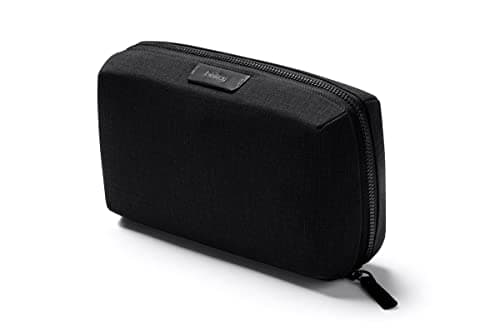
The Bellroy Tech Kit is the Tech Pouch alternative for most people, and it is for the traveler who wants the same finish and the same openable-on-a-table presentation in a case that is roughly half as deep, for the same money or less — 9.05 by 5.11 by 2.83 inches at 7.3 ounces, in recycled woven fabric behind a three-year warranty. The budget pick is the FYY Electronic Organizer, the cheapest case here and a genuinely good flat clamshell for someone who only ever needs the price objection answered. Every price below is read live from our price layer and stamped with an as-of date in the table.
First, what the Tech Pouch is genuinely good at
We rank the Peak Design Tech Pouch on our own travel tech organizer roundup and we are not here to talk anyone out of it. It has four real strengths, and three of them are unmatched by anything else on this page.
- Origami pockets that expand as they fill. Two litres of stated capacity that swallows an unreasonable amount without the outside footprint changing. No flat clamshell does this.
- A cable pass-through port. A power bank can charge a phone while the pouch stays zipped. At an airport seat with one outlet this is the sort of detail you notice every single trip.
- 200D nylon canvas, a DWR coating and weatherproof zips, plus an outer quick-access pocket for the one thing you need at security.
- A lifetime warranty — by a wide margin the longest-running promise of any case we rank.
If none of the three objections below is yours, buy the Tech Pouch. The people who should read on are the ones who have already looked at it and flinched at something specific.
The three objections, and what each one points at
Peak Design’s own reviewers are unusually consistent about where this pouch does not suit, and the complaints sort cleanly into three.
- The price. It is several times what a competent clamshell costs, and most of that premium is capacity and warranty rather than organization.
- The depth.Four inches is a great deal of depth to give up inside a personal item that is already tight. This is the objection behind the “small tech pouch alternative” search.
- It needs to be full. Reviewers are consistent that it does not work well unless it is fairly full — under-packed, the structure collapses in on itself. A soft expanding pouch is the wrong shape for someone carrying three cables and nothing else.
If the objection is the depth or the finish
The Bellroy Tech Kit, and it is the top pick here because it is the only case that answers two objections at once. At 2.83 inches deep it is roughly two-thirds of the Tech Pouch’s depth, which is the dimension that actually fights a packed personal item, and at 7.3 ounces it is light. It is also, at the time of writing, no more expensive — check the live numbers in the table, because that one moves. It also keeps the thing people buy Peak Design for in the first place: it is a pouch you can open on a conference table or a café table without it looking like a cable drawer. Recycled woven fabric, three-year warranty.
It is not the capacity answer. The Tech Pouch holds more and expands to hold more still; the Bellroy is a fixed, flatter volume and it will not swallow a growing kit the same way. We put the two directly against each other in Peak Design Tech Pouch vs Bellroy Tech Kit, which is the page to read if these are the only two on your list.
If the objection is the price
Two answers at very different sizes, and both are a fraction of the Tech Pouch.
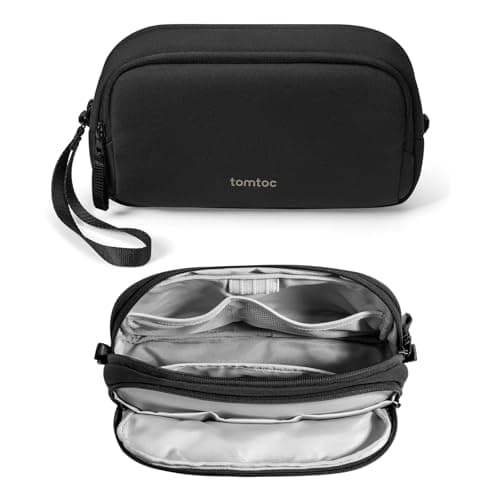
The tomtoc Electronic Organizeris the one to buy if the kit includes a laptop charging brick. Its dual-compartment layout is built around exactly that — the heavy, awkward object that defeats most pouches — and tomtoc’s zippers and padding are the part of that range people consistently rate. It is a flat clamshell rather than an expanding pouch, which means it behaves perfectly well half empty, which is the third objection answered as a side effect.
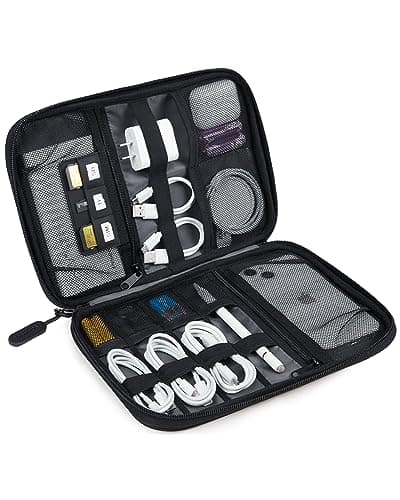
The FYY Electronic Organizer is our budget pick: a medium flat clamshell for less than the cost of a single premium cable. It is the right call for someone who is not yet sure they need a tech case at all, for a second case that lives permanently in a different bag, or as a stocking filler that will genuinely get used. It has no pass-through, no weatherproofing and no meaningful warranty; at this money that is a reasonable trade rather than a failure.
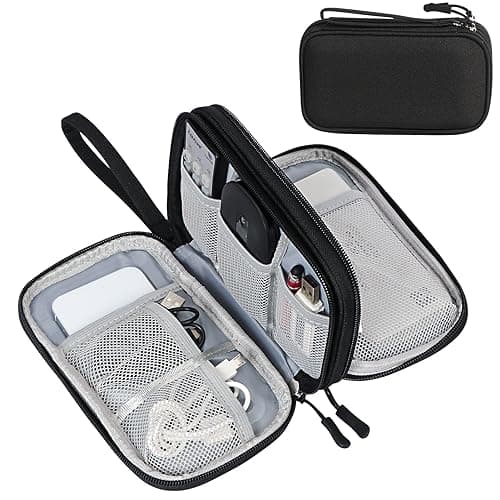
The BAGSMART Large Electronic Organizer sits between the two: more room than the FYY, still well under premium money, and the most common first tech case people buy. It is a flat case with elastic loops rather than a structured system, and it does the job.
If the objection is that you carry more than a pouch should hold
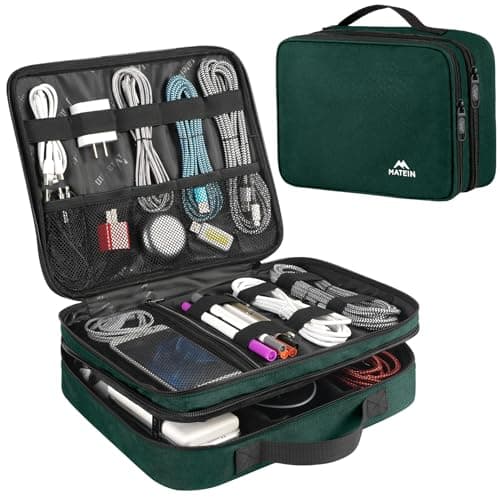
The MATEIN Tech Organizer (Large), and it is the opposite answer to everything above. This is closer to a small camera bag than a pouch: it fits a tablet up to 12.9 inches, it has three removable padded dividers so the layout is yours rather than the manufacturer’s, and its real padding and water-repellent shell make it the only case here that meaningfully protects a portable hard drive. A grab handle lets it move from suitcase to seat-back as a small bag in its own right.
The honest caveat is in the dimensions: at roughly 12.4 by 10 by 3.9 inches, this is luggage, not an accessory. It needs a bag with room to spare, and anyone buying it to solve a depth problem has misread the page.
Three cases where the answer is still the Tech Pouch
- The kit keeps growing. Expanding origami pockets are genuinely unmatched here. If the number of small objects you carry has gone up every year for five years, buy the pouch and stop shopping.
- You charge from the bag. The cable pass-through is the single feature on this page that nothing else replicates, and if you have ever run a power bank to a phone through a half-open zip you already know why.
- You want the warranty. Lifetime coverage on a soft goods item is rare and it is a real part of the price. The Bellroy gives you three years, the budget cases give you nothing.
How to choose in one question
Hold the heaviest object you carry — usually the laptop brick — and ask where it goes. If the answer is “in its own padded compartment,” buy the tomtoc. If it is “in with everything else, and there is a lot of everything else,” buy the Tech Pouch or the MATEIN depending on whether a tablet is involved. If it is “I do not carry one,” you are in flat-clamshell territory and the only remaining question is how much finish you want, which is the Bellroy at one end and the FYY at the other.
The full category, with the Tech Pouch ranked among six cases, is on our travel tech organizer roundup. If the real problem is the cables rather than the case, how to organize cables for travel is the better starting point — a good method beats a good pouch, and it is free.
Depth is the dimension that fights your bag
Length and width sit flat against a laptop sleeve. Depth is what makes a personal item bulge. Measure the case you are replacing before you shop.
Expanding pouches need to be full
A soft origami pouch under-packed collapses and rattles. If your kit is small and stable, a flat clamshell holds its shape and costs a fraction as much.
Find the laptop brick a home first
The charging brick is the object that defeats most organizers. A case with a dedicated compartment for it solves eighty percent of the problem on its own.
A pass-through is worth more than it sounds
Charging from a zipped bag at an airport seat with one outlet is a daily-use feature, and almost no budget case has it.
Padding only matters if something is fragile
Cables do not need protecting. A portable hard drive does. Buy padding for the drive, not for the cables.
Warranty length scales with price, not with quality
Lifetime, three years, nothing. All three can be the right purchase — just know which one you are buying.