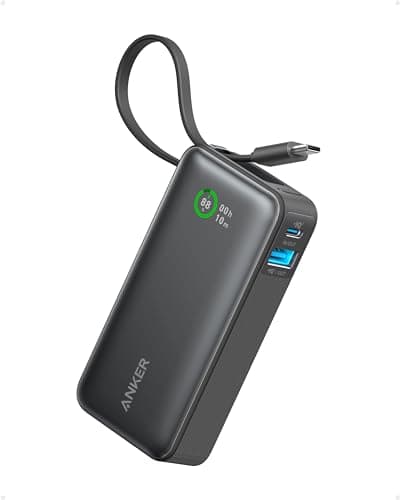
The thing that goes wrong on a travel day is never the capacity. It is the cable. Nobody has stood in an airport at 15% battery thinking their power bank was too small; they have stood there with a fully charged power bank and no cable, because the cable is the item that stays plugged into the wall at home. The Anker Nano Power Bank’s answer is to attach one permanently. That single design decision is most of what you are paying for, and for a gift buyer it is the right thing to pay for — though Anker’s own specification sheet contains two numbers worth understanding before you do.
First: make sure you are buying the right Nano
Anker uses “Nano” across a genuinely confusing range of products. There are Nano power banks with a fold-out plug that pushes straight into the phone. There are Nano wall chargers that are not power banks at all. There is a Nano 6-in-1 charging station, which we rank on our travel power strip page and which is a completely different object. And there is this one: the Anker Nano Power Bank, 10,000mAh, 30W, with a built-in USB-C cable — Anker’s model A1259.
If the listing you are looking at says 5,000mAh, or shows a plug rather than a short attached cable, it is a different product with a different use case. This is the one with a cable, and the cable is the reason to buy it. Mis-buying inside a brand’s own naming scheme is the most common way a well-chosen gift arrives wrong, and it is the same trap we flagged on the Bose QuietComfort range.
What Anker actually publishes
All of the following comes from Anker’s own specification page for the A1259. We have not tested this bank and we do not publish measured figures.
- Capacity: 10,000mAh. Anker publishes no watt-hour rating for this model, which matters for flying — more on that below.
- Built-in USB-C cable: 30W max, across published profiles from 5V/3A up to 20V/1.5A.
- USB-C port: 30W max, the same profiles.
- USB-A port: 22.5W max.
- Total output: 24W max.
- Input: 30W max over USB-C, and the built-in cable doubles as the input, so the bank recharges itself with its own cable. Anker states it will “recharge the power bank to 50% in just 45 minutes.”
- Size and weight: 4.09 x 2.06 x 1.02 in (104 x 52.3 x 26 mm), 7.58 oz (215 g).
The number almost nobody reads: total output is 24W
Look at that list again. The built-in cable is rated 30W. The USB-C port is rated 30W. The USB-A port is rated 22.5W. And the total output is 24W.
That is not a contradiction and it is not Anker hiding anything — the figure is published plainly on their own page. It is simply how multi-port banks work: the headline wattage is what one output can deliver on its own, and the total is what the bank can push out across everything at once. The practical consequence is worth knowing before you gift it: plug in a phone and a pair of earbuds together and each gets less than the phone alone would, and the combined draw is capped below the single-port headline. Charge one device at a time if you are in a hurry, which on a travel day you usually are.
We mention this because it is the kind of detail a spec sheet states honestly and marketing never repeats, and because “30W” is the number printed on the box.
The attached cable: why it is worth it, and what it costs
The case for this bank is almost embarrassingly simple. A power bank is only useful in combination with a cable, and the cable is the half of the pair that gets forgotten, frayed, borrowed, or left in a hotel. Attaching one removes the failure entirely. It also removes a small daily friction — no fishing a cable out of a bag, no choosing which pocket it lives in — and small daily frictions are exactly what decides whether a gift gets used or drawered.
Two honest costs.
The cable cannot be replaced. It is part of the body. A cable that is used every day, flexed at the same point every day, is a wear item, and when this one eventually goes the headline feature goes with it. The saving grace, and it is a real one: there is a separate USB-C port on the body, so the bank does not become scrap — it becomes an ordinary power bank that needs a cable, which is what every other power bank is.
It is USB-C only. Fine for every current iPhone, every modern Android, iPads, most earbuds cases, a Kindle, a travel router. Useless for an older Lightning iPhone, which is the single most likely way this gift lands wrong. Check the recipient’s phone before buying, because there is no adapter story that makes an attached cable fit a different port.
215 grams, and whether that is the right weight
Anker publishes 7.58 oz / 215 g. That is roughly a deck and a half of cards and it is a genuine presence in a jacket pocket — heavier than the 5,000mAh pocket banks, lighter by a wide margin than the laptop-capable bricks.
For this site’s purposes that is the correct place to be. 10,000mAh is the capacity that covers a long travel day for a phone with room spare, and 215 g is the weight at which the bank still goes in the bag that is already packed rather than being left behind. If the recipient wants something that disappears into a pocket, the smaller 5,000mAh format is a different and legitimate choice. If they need to keep a laptop alive, that is the Anker 737 territory and about three times the weight.
One widely held expectation worth correcting: 10,000mAh does not mean two full charges of a modern phone. Cell capacity is rated at the cells’ own low voltage, and delivering it to a phone at 5V or above involves conversion losses, so the energy that reaches the phone is less than the label implies — for every bank, from every brand. Treat 10,000mAh as comfortably more than one full phone charge rather than as a guaranteed two, and you will not be disappointed.
Flying with it
Two rules, and the first is the one people get wrong. A power bank is a lithium battery and it belongs in the cabin, never in a checked bag. Our power bank flying guide covers the detail, including what airlines do when they find one in the hold.
Second, capacity. Airline limits are written in watt-hours, not milliamp-hours, and Anker publishes no Wh figure for this model — so rather than quote one as if it were a spec, here is the arithmetic every airline desk uses: milliamp-hours multiplied by the nominal cell voltage of about 3.7V, divided by 1,000. For 10,000mAh that is roughly 37 Wh, far below the 100 Wh threshold at which airlines begin asking questions. In other words this bank is uncontroversial on any normal flight, and that is true of every 10,000mAh bank. It is the 20,000mAh and larger ones where the number starts to matter.
Where it sits against the alternatives
We rank this as the best power bank on the site for most travelers, and the reasons someone should buy a different one are specific rather than vague.
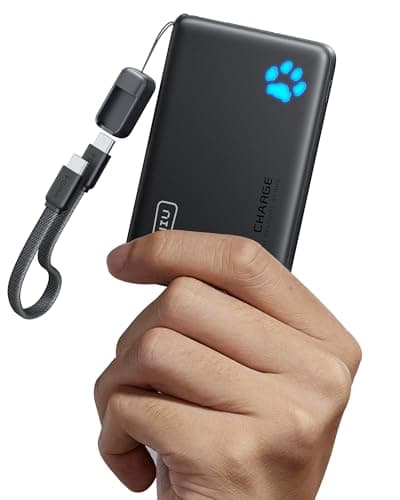
If the priority is watts per dollar, the INIU 45W 10,000mAh is the better buy and it is not close — more output, less money, and a cable in the box rather than attached to the body. We put the two head to head in Anker vs INIU, and the short version is that INIU wins on the spec sheet and Anker wins on the thing the spec sheet cannot show, which is whether the cable is present when you need it.
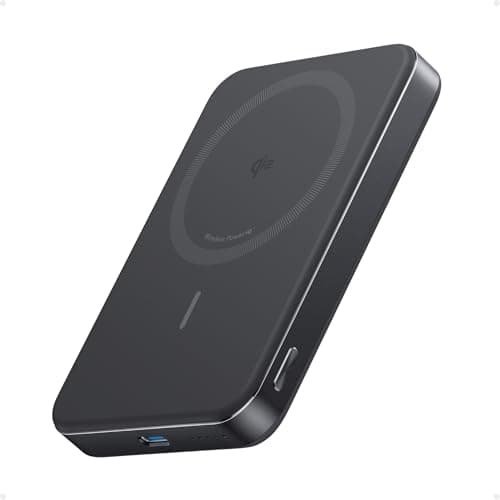
If the recipient has a MagSafe iPhone and hates cables generally, the Anker MagGo 10K sticks to the back of the phone and charges without any cable at all. It is slower and heavier for the same capacity — wireless charging always is — and for some people that is an easy trade.
If they travel with a laptop, neither this nor any 10,000mAh bank is the answer. 30W will slow a laptop’s battery drain and will not meaningfully charge one.
As a gift
This is one of the easiest gifts on this site to get right, for three reasons: almost every traveler needs one, almost nobody buys themselves a good one, and the feature that makes it good is explainable in one sentence to someone who does not care about electronics. It lands well for a digital nomad, a business traveler, a commuting teenager, or anyone who has ever asked to borrow a charger.
It also bundles unusually well, because it is a device rather than an accessory. A bank plus a tech organizer is the complete version of this gift — the organizer being the thing that stops the bank living loose at the bottom of a bag with the keys. If you want the reasoning behind that pairing, our cable organization guide makes the case.
The one honest reason not to buy it: if the recipient already owns a power bank they like, this is not enough of an upgrade to justify a second one. In that case a set of proper travel bottles or a pair of luggage locks is the smaller, better-aimed present.
Check the port on their phone first
The attached cable is USB-C and cannot be changed. Every current iPhone and essentially every modern Android is USB-C; an older Lightning iPhone is not. This is the one check that decides whether this is the right gift at all.
Buy 10,000mAh, not 20,000
10,000mAh covers a long travel day for a phone with room to spare at a weight that still gets carried. 20,000mAh doubles the weight to solve a problem most travelers do not have, and starts to approach the watt-hour figures airlines care about.
Expect one generous phone charge, not two
Rated capacity is measured at the cells’ own voltage and delivered at a higher one, so conversion losses mean less energy reaches the phone than the label suggests. That is true of every bank from every brand, and a bank that claims otherwise is the one to distrust.
Charge one thing at a time
Anker’s published total output is 24W across all ports at once, below the 30W a single output can deliver. Two devices simultaneously is slower per device than either alone.
It flies in the cabin, always
Lithium batteries belong in carry-on baggage, never in the hold. At roughly 37 Wh by the standard arithmetic, a 10,000mAh bank is far below the point where any airline needs to be asked.
Pair it with somewhere to put it
A power bank rolling loose in a bag gets scratched, buried and forgotten. A tech pouch turns it from an object you own into an object you find, and the two together make a coherent gift rather than a gadget in a box.