Yes. A travel power strip flies in carry-on or in checked baggage, and the thing worth knowing is that the US rule and the cruise rule disagree completely: a strip that is fine in an overhead bin is confiscated at a cruise gangway. Here is what each published policy actually says, and the one honest gap in it.
What TSA publishes — and what it doesn't
We went to the source. TSA's “What Can I Bring?” tool does not have an entry for “power strip”, “surge protector” or “power board” at all. The nearest published ruling is Extension Cord, which TSA lists as permitted in both carry-on and checked bags, with the note: “Please carefully pack your electronics items, making sure all cords are wrapped and any DVDs, CDs, or cassettes are removed from their devices.”
That is the honest state of the information, and we are stating it as a gap rather than papering over it. A travel power strip is an extension cord with extra sockets on the end. There is nothing on the prohibited list that covers it, there is a published ruling permitting its nearest relative in both bags, and in practice these go through screening constantly without comment. What there is not is a line on tsa.gov with the words “power strip” in it.
The practical version. Put it in the carry-on with the cord wrapped. Not because checked is forbidden — it is not — but because a bundle of cord in a checked bag is one of the shapes most likely to trigger a hand search, and because the thing you want a power strip for is the airport layover and the hotel room, both of which happen before you see a checked bag again.
The confusion worth clearing up: a strip is not a battery
Most of the anxiety in this question is borrowed from a different rule. Lithium batteries — power banks, spare camera batteries, anything that stores energy — are restricted to carry-on only, because a lithium fire in an inaccessible hold is the specific hazard the rule exists for. That rule is real, it has watt-hour limits, and we cover it in can you take a power bank on a plane.
A power strip contains no battery. It is a passive object, or at most a charger with a transformer in it. The battery rules simply do not reach it — which is why the answer here is “either bag” and the answer there is “carry-on only”. If the thing in your hand has a capacity printed on it in mAh or Wh, it is a battery and the other page applies.
The cruise rule is the opposite, and it is enforced
This is the part that genuinely catches people, including people who have flown with the same object a dozen times.
Royal Caribbean's published prohibited-items policy lists clothing irons and garment steamers outright, and puts extension cords and power strips in its prohibited electrical items. The one exception the policy names is “Device and USB chargers marked with a recognized U.S. or European conformity certification” — which is a USB charging block with a safety mark on it, and nothing more.
The reason is a fire-safety one rather than a security one: a cabin circuit on a ship is not a hotel circuit, and a strip that overloads is a fire in a corridor nobody can drive away from. Security screens bags at the terminal and these come out of them. So for a cruise, the honest conclusion is blunt: none of the picks on this page is a cruise gift. What travels is a certified USB-only block. Our how to pack for a cruise guide has the rest of that list, and best travel power strips goes through the same policy in the context of the products.
Two rules for taking one abroad
Both of these matter more than the airline question, because both can destroy the object and the thing plugged into it.
Do not put a US power strip behind a plug adapter. A plug adapter changes pin shape. It does not change voltage. A US-market strip is built for a roughly 120 V wall, and a European or Asian socket supplies 230 V — and the component that fails first is the surge varistor, which fails hot. Check the strip's own input rating before it leaves the country.
Buy one rated 100–240V if it is going overseas. Both Anker picks on this page publish that range, which is what makes them usable on a European wall with a plain adapter in front. Which adapter, and which plug shapes you actually need, is on best travel adapter for Europe and in travel adapter vs voltage converter.
What to actually pack
The picks on this page are ranked for the real problem, which is not the security line — it is that a hotel room has one reachable outlet and a traveler has five things to charge overnight.
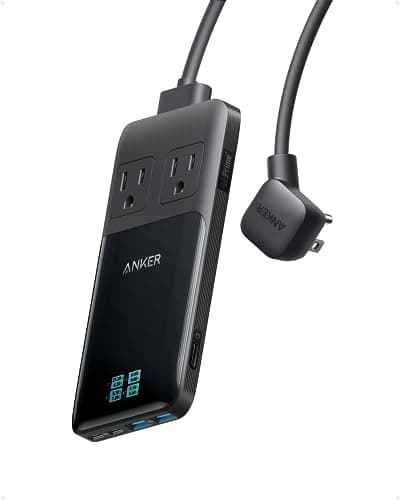
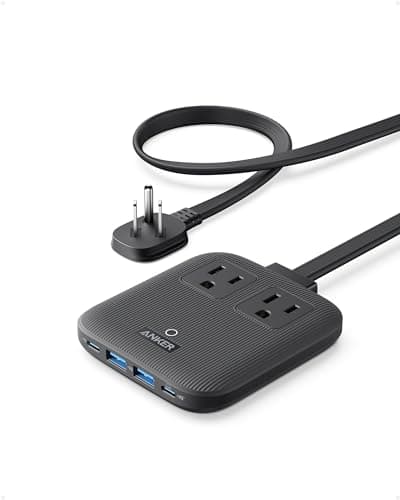
For most flyers: the Anker Nano 67W. Anker publishes it at 3.94 x 3.66 x 0.75 inches and 13.7 ounces with a five-foot flat cord and 100–240V input — two AC outlets plus four USB ports in something three-quarters of an inch thick, which is the dimension that decides whether it actually gets packed.
For someone working on the road: the Anker Prime 140W, same format with more power for a large laptop.
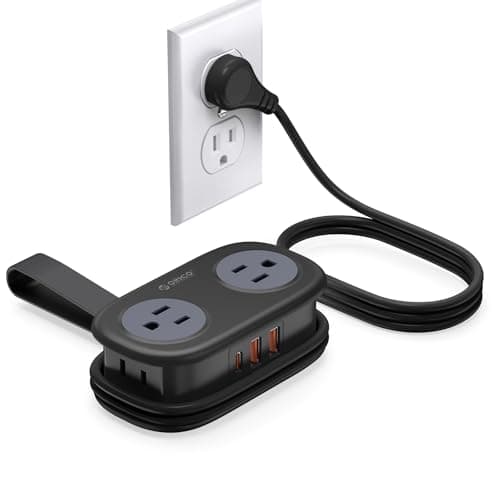
For a family sharing one socket: the ORICO strip, which is the cheapest way to turn one outlet into enough.
One honest note carried over from our power strip ranking: the two best objects here are charging stations rather than surge protectors. Anker's own product notes for the Prime 140W state that it does not have surge protection, and the Nano publishes ActiveShield 2.0 — over-voltage and short-circuit protection — with no joule rating. If surge protection is the point, that is a different purchase, and it belongs in a house rather than a carry-on.
The one-line answers
- Plane, carry-on: yes. Wrap the cord.
- Plane, checked: yes. TSA's nearest published ruling permits extension cords in both bags; carry-on is still the better choice.
- Cruise ship: no. Power strips and extension cords are prohibited; a certified USB charging block is the allowed substitute.
- Abroad: only if the strip itself is rated 100–240V. A plug adapter does not make a 120V strip safe at 230V.
- Power bank: different rule. Carry-on only, with watt-hour limits.
And if the person you are buying for is the one who always arrives with four chargers and nowhere to plug them in, this is a genuinely good present — see gifts for digital nomads and how to organize cables for travel.