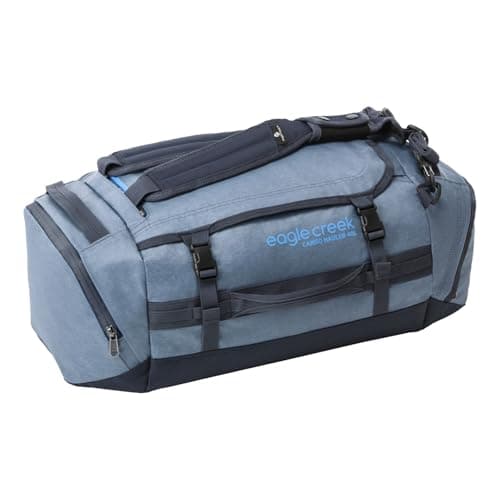
Buy the duffel that converts to a backpack if the bag will ever be carried further than a parking lot. A duffel is a bag with no wheels, no frame and no rules about how you pack it. That freedom is exactly why people love them, and exactly why the bad ones get abandoned after one trip: a soft bag on a single shoulder strap is fine from a car to a hotel desk and miserable across twenty minutes of train station. Every other decision — fabric, size, shoe compartment, price — comes after that one.
What a duffel is actually for
A duffel sits between a suitcase and a travel backpack. A suitcase wins on smooth floors and loses on stairs, cobbles and gravel. A backpack wins on anything rough and loses when you want to lay a bag flat and see everything at once. A duffel is the compromise: it opens wide like a suitcase, it carries like a backpack when it has the straps for it, and it collapses when empty in a way neither of the others can.
That last point is the underrated one for a gift. A hard suitcase takes up closet space whether or not anyone is traveling. A duffel folds, and the best of them fold into their own pocket. If the person you're buying for lives somewhere small, that difference is worth more than any number on the spec sheet.
The trade you accept is protection. Nothing in a duffel is safe from being sat on, and there is no shell between a laptop and a baggage conveyor. If what they carry is fragile — camera bodies, a work laptop, anything with a screen — a duffel has to be packed thoughtfully or paired with something rigid, and hard-shell carry-on luggage may simply be the better gift.
The four things that separate a good duffel from a cheap one
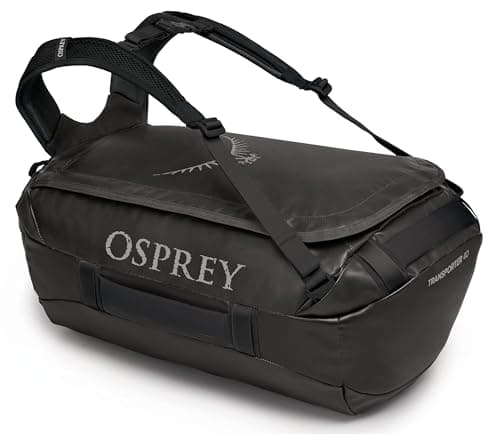
1. The carry system. This is the whole game. Grab handles are universal and therefore irrelevant — every duffel has them. What matters is whether there's a second way to carry it: a padded, removable backpack harness. Eagle Creek and Osprey both do this and stow the straps out of the way when they aren't needed; most fashion-led duffels give you one padded shoulder strap and nothing else. A single strap under load pulls the bag into your hip and your spine into a curve, which is fine for ten minutes and unpleasant for an hour.
2. The opening. A U-shaped zip that opens most of the top lets you see the whole bag at once and pack it like a suitcase. A narrow slot down the middle means digging by feel. Check the zippers while you're there: the difference between a duffel that lasts five years and one that dies in eighteen months is almost always a zipper, not a fabric.
3. The fabric and its coating. Denier — the 600D, 840D or 900D number in the specs — describes thread thickness, not waterproofing. What keeps rain out is the coating or laminate on the back of the cloth. Eagle Creek's Cargo Hauler coats recycled polyester in TPU over a ballistic polyester base, and Osprey coats its recycled nylon in TPU as well. An uncoated 600D polyester bag is perfectly durable and will still let water through in a sustained downpour — and a coated bag with ordinary zippers and unsealed seams will too, just later. Neither is wrong — but a weekender for city breaks and a duffel for a gravel road are different purchases.
4. Whether it holds a shape. Structured duffels stand up when you set them down and stay rectangular when half full. Unstructured ones slump. Slumping isn't a defect — it's the reason a packable duffel packs — but a bag that slumps is harder to load into an overhead bin and harder to keep organized. This is where packing cubes earn their keep more than in any suitcase: cubes give a soft bag the internal structure it doesn't have on its own.
Sizes, and the carry-on question
Duffel capacity is quoted in liters, and the useful bands are narrow. Around 18 to 25 liters is an overnight bag: one change of clothes, a laptop, a toiletry kit. Roughly 30 to 45 liters is the weekend and carry-on band, and it's where most travel duffels live. Anything from 55 liters up is a checked bag or a gear hauler — useful for ski trips and month-long moves, oversized for a long weekend.
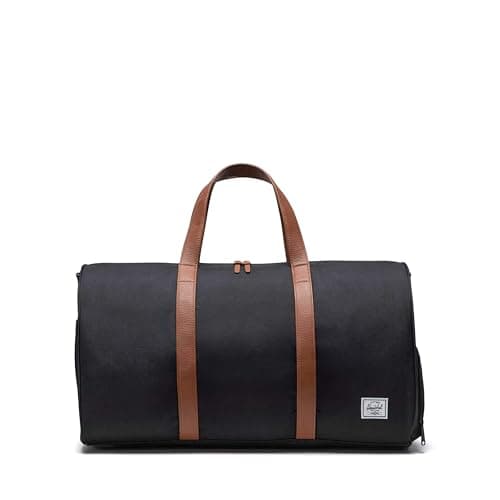
The carry-on part deserves a warning. Most US airlines print a 22 x 14 x 9-inch cabin allowance, and plenty of well-known travel duffels are deeper than nine inches — the Osprey Transporter 40 measures roughly 21 by 12 by 10.5 inches, and the Herschel Novel is over 20 inches wide. Soft bags usually squash into the sizer, which is why these get carried on every day without incident, but "usually" is the operative word on a full flight with a strict gate agent. If a guaranteed cabin fit is the point of the gift, our carry-on size rules guide explains why the same bag passes on one airline and fails on the next, and a measured hard-side carry-on is the safer buy.
Shoe compartments, handle sleeves and the features worth paying for
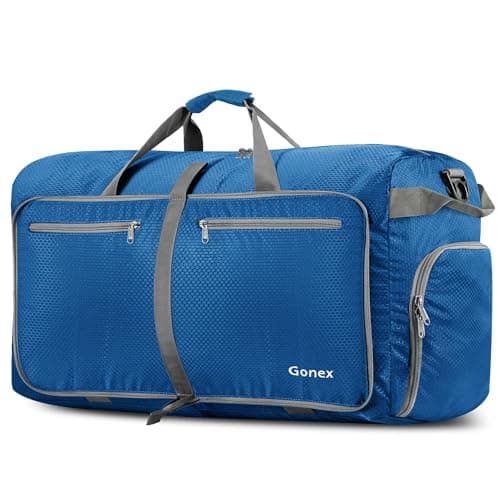
A side-access shoe compartment sounds like marketing and turns out to be the most-used feature on a weekend bag. Shoes are the dirtiest thing anyone packs and the most awkward shape; a dedicated end pocket solves both at once, and it doubles as the place wet swimwear goes on the way home. Herschel's Novel and the packable Gonex both have one.
A luggage-handle sleeve on the back matters when the duffel is a second bag rather than the only bag — it turns two bags into one thing to push through a terminal. An internal mesh lid pocket is where chargers stop vanishing. A laptop sleeve is worth paying for only if the duffel is genuinely the work bag; if they already carry a daypack or a briefcase, the sleeve is dead weight that eats packing space.
What isn't worth paying for: compression straps on a bag under 45 liters, and a built-in lock. Duffel zippers can be pried open by anyone with a pen, and no soft bag is a security device. Locks and trackers belong on checked luggage — see our luggage tracker roundup if that's the worry you're actually trying to solve.
What about wheeled duffels?
Wheeled duffels exist, and they're a genuine option for someone who wants duffel-style packing without the carrying. The honest accounting: wheels and a handle add several pounds of empty weight, eat internal volume, and typically cost far more than the same bag without them. If wheels are the priority rather than a bonus, a proper spinner is a better bag for the money — start with our carry-on roundup. Buy a wheeled duffel only when the destination has rough ground and the person can't carry a loaded bag.
Buying one as a gift
Duffels are one of the easier travel gifts to get right, because sizing is forgiving in a way luggage and clothing aren't. Three practical notes.
First, err smaller than you think. A 40-liter duffel looks modest on a product page and swallows a long weekend. The common mistake is buying a 70-liter bag for someone who takes three-day trips, and a too-big duffel mostly encourages a too-heavy one.
Second, match the finish to the person rather than to the spec sheet. Someone whose travel is client meetings and hotel lobbies will use a clean-looking weekender far more than a technical hauler in safety orange, and the reverse holds for someone whose weekends involve mud. Our business travelers gift list leans the first way; the adventure travelers list leans the second.
Third, a duffel is one of the few travel gifts that works as a bundle anchor. A weekender plus a set of packing cubes is a complete present with a story to it, and it costs less than a mid-range suitcase. If the budget is bigger and the recipient is the sort who notices materials, a leather weekender is the premium version of the same idea.
How we ranked these
Scored against our published rubric from published specifications, manufacturer documentation and aggregated owner feedback. We don't run a lab and we don't claim measurements we haven't taken. Carry system and fabric coating carry the most weight under usefulness and durability, because those two decide whether a duffel gets used on the second trip. Price per liter drives the value score, which is why the most expensive bag here doesn't win it — and why the cheapest doesn't either.
How to choose a travel duffel bag
1. Will it be carried, or only moved?
If the bag goes further than a car to a lobby, buy one with a stowable backpack harness. If it truly never does, you can skip the harness, save the weight and the money, and buy on looks instead.
2. Carry-on or checked?
Carry-on means 30 to 45 liters and a hard look at the depth measurement — many travel duffels are deeper than the printed nine-inch limit. Checked means 55 liters and up, where the extra volume costs nothing at the gate.
3. What's the weather where they go?
Rain and gravel mean a laminated or TPU-coated fabric. Cities, cars and trains mean an uncoated polyester bag is fine — and it will look better doing it.
4. Is it the main bag or the second bag?
A main bag needs structure, a real harness and good zippers. A second bag needs to weigh nothing and fold flat, and a packable duffel at the price of a takeout dinner is the right answer rather than a compromise.
5. Does it need to look like a gift?
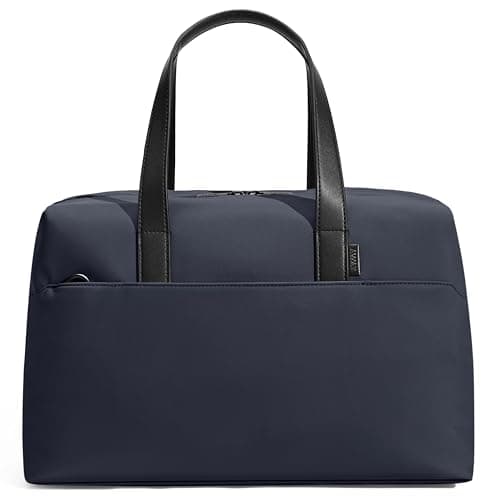
Technical duffels look like equipment. That's a feature for some people and a problem when the bag is being unwrapped in front of an audience. A weekender in a clean finish, or a nylon-and-leather carryall from a brand the recipient already knows, presents like a present.
6. What are you actually spending?
Packable spare duffels are the cheapest thing on this page by an order of magnitude. Good-looking weekenders land in the middle. Laminated technical duffels and design-led carryalls sit at the top, and a lifetime or all-mighty warranty is the thing that justifies the jump. We publish a live price on every pick rather than a number that goes stale — the buttons above show what each one costs today.