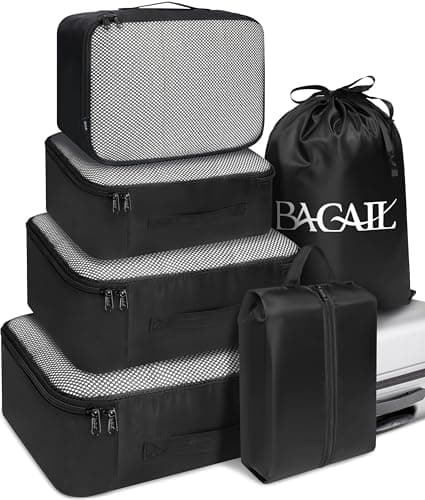
This is the gift that people are still using three years later. Six zippered fabric boxes in assorted sizes, mesh tops so you can see in, and a price that makes the decision easy. It doesn't compress, it isn't beautiful, and there's no warranty worth mentioning — and it still turns a suitcase from a pit into shelves, which is the whole job.
What a six-cube set actually organizes
The number is not arbitrary. Six is roughly the count at which one person's trip sorts cleanly into categories without any cube being pointless. In practice that means a large cube for tops, a second large for trousers and layers, a medium for a bulky sweater or a jacket, a slim one for underwear and socks, and two small ones for the things that otherwise migrate — chargers, swimwear, a laundry pile that grows across the week.
The payoff isn't at packing time. It's on day four, living out of the bag in a hotel room, when finding a clean shirt means pulling one cube instead of excavating a suitcase. And it's on the last morning, when repacking takes two minutes because everything already lives somewhere.
The thing they don't do
They don't save space. This gets said in every review and it still surprises people, so it's worth stating plainly: a folded shirt inside a regular packing cube occupies the same volume as a folded shirt loose in a suitcase. Cubes organize; they do not shrink.
What shrinks a load is a compression cube — a second zipper that squeezes the air out of the pile, at the cost of slightly more creasing. If the person you're buying for is regularly sitting on their suitcase to close it, or is trying to go carry-on only, buy compression instead. Our packing cubes vs compression bags guide walks through the difference properly, and the full packing cube roundup ranks the compression sets alongside these.
Mesh tops, and why they matter more than they look
The mesh panel on the top of each cube does two jobs. The obvious one is that you can see what's inside without unzipping, which is the difference between "the blue shirt is in the second cube" and opening all six.
The less obvious one is airflow. A cube of clothes worn in a hot climate and zipped into solid fabric for three days smells like exactly what it is. Mesh lets the contents breathe, which is the reason experienced travelers don't buy the fully-enclosed sets even when they're cheaper.
BAGAIL's mesh is functional rather than exceptional — Eagle Creek's is more genuinely see-through. On a set at this price, functional is the correct expectation.
Where the corners are cut
Being honest about a budget product means naming what the money didn't buy.
The zippers. They're the first thing to fail on any cheap cube set, and these are adequate rather than premium. They pull smoothly out of the packet; whether they still do after fifty trips is a different question, and it's the main argument for spending four times as much on a set with a lifetime warranty.
The fabric. Light polyester. It does the job and it will eventually fray at a seam under hard use. For someone who travels a few times a year that's a non-issue; for someone who lives on planes it's the reason to look at the warrantied options instead.
The presentation. These arrive looking like what they are — a practical multipack. As a standalone gift for someone close that's a little thin, which is why they work best as the structural component of a bigger present rather than the present itself.
Six or eight?
The eight-piece set exists and it is not automatically better. Eight cubes is more boxes than a weekend carry-on can swallow, and the surplus ends up in a drawer at home. Eight is right for a family sharing a large checked bag, for a couple packing into one case, or for someone doing a month on the road with genuinely more to sort.
For one person on normal trips, six is the set. Buying up "to be safe" is the most common way this gift lands slightly wrong.
Who should buy it
Anyone buying for a traveler who doesn't already use cubes — which is still most travelers. It's the single highest hit-rate practical gift on this site, because the problem it solves is universal and the solution is immediately obvious the first time it's used.
Skip it for the committed minimalist traveling with three shirts, where boxes inside an already-small bag are just more bags. Skip it for the person fighting a carry-on size limit, who wants compression. And skip it as a standalone gift for a partner or parent, where it's the right idea at the wrong scale — pair it with a clamshell travel backpack or a carry-on, which is the bag shape cubes were designed around.
How we assess
Scored against our published rubric — usefulness, portability, durability, value, giftability — from published specifications, manufacturer descriptions and aggregated owner feedback. We compile and reason rather than running a lab, and we say so on every page. Durability is scored down here deliberately, because that's where this set's price shows, and value is scored up for the same reason.