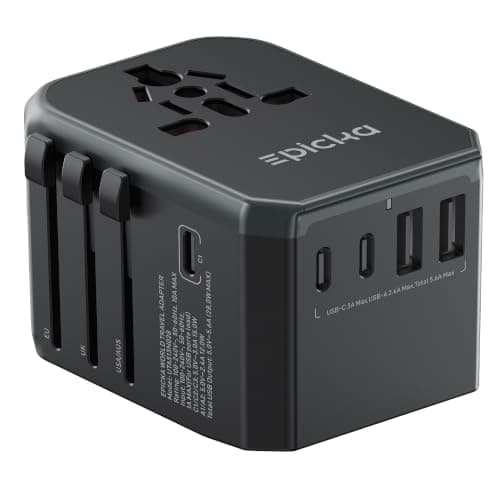
Buy the EPICKA Universal Travel Adapter. It covers both European plug shapes in one object, it carries its own USB-C and USB-A ports, and those ports — not the plug coverage — are the reason it is the right buy for a European trip. If the recipient is going to one country and one country only, a plain two-pin Type C adapter does the plug job for a few dollars. Almost nobody buys that, because what actually fails in a European hotel room is not plug shape. It is that there are two reachable sockets and the traveler arrived with five things that need charging.
Europe is two plugs, not one
The single most useful fact before buying anything: “a European adapter” is not one shape.
- The continent runs Type C, E and F. France uses Type E, Germany uses Type F (the grounded “Schuko”), Italy uses Type L, Switzerland uses Type J and Denmark uses Type K.
- The UK and Ireland run Type G — the chunky three-rectangular-pin plug — and it fits nothing else in Europe.
That sounds like five adapters. It is not, because of one quirk of the two-round-pin Type C plug, the “Europlug”: it is designed to go into far more sockets than its own. Per the published standards documentation, a Europlug fits all three CEE 7 sockets — unearthed, German/Schuko and Belgian/French — and also many non-CEE 7 sockets including the Swiss, Danish and Italian 10 A ones. So a single Type C plug on the end of an adapter covers the great majority of continental Europe on its own.
The practical rule. One adapter with a Type C output covers France, Germany, Spain, Italy, Switzerland, Denmark, the Netherlands and the rest of the continent. A trip that also includes London needs the Type G shape as well — which is exactly what a universal adapter gives you and a cheap single-shape one does not. If the itinerary is “Paris then London,” buy universal. If it is “two weeks in Spain,” you are buying the USB ports.
230 volts is the half that breaks things
Every country named above supplies 230 V. The United States supplies about 120 V. An adapter changes the shape of the pins and nothing else — it passes 230 V straight through to whatever is plugged into it.
This is survivable for almost all modern travel electronics, because laptop bricks, phone chargers, camera chargers and electric shavers are built with a switching power supply that accepts anything from 100 V to 240 V. Check the small print on the brick; if it says 100–240V, it is fine behind a plain adapter.
It is fatal for heating appliances. A US-market hair dryer, flat iron, curling wand or travel kettle is usually a single-voltage 120 V device, and 230 V through one of those is roughly four times the intended power in a heating element designed for one. That is the failure every adapter review buries in a footnote, and it is why every pick on this page carries the same warning. The full version of the argument, including when a true converter is worth buying and when it is not, is in our travel adapter vs voltage converter guide.
The five picks, side by side
| | Covers UK Type G? | USB | Extra AC outlets | Shape |
|---|
| EPICKA Universal | Yes — slide-out plugs | USB-C + USB-A | One pass-through | One block |
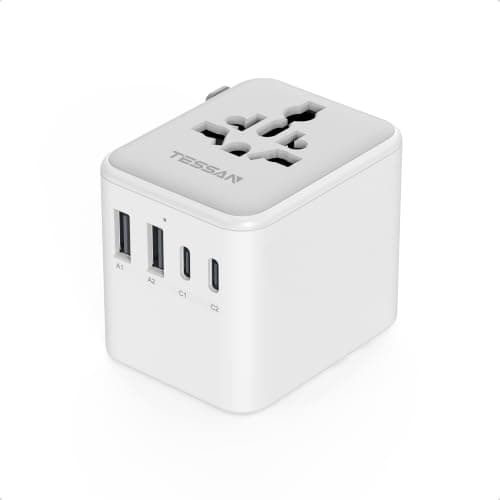
| TESSAN Universal | Yes | USB-C + USB-A | Multiple AC outlets | One larger block |
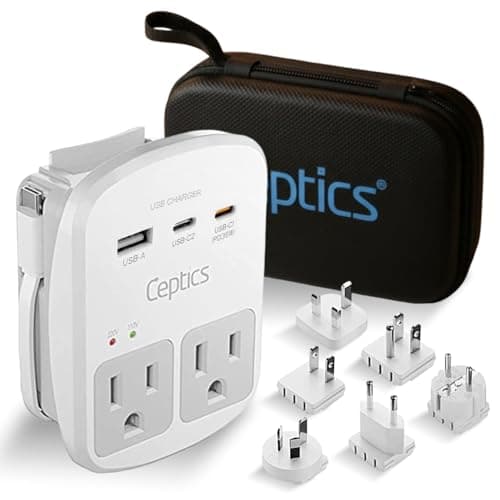
| Ceptics kit | Yes — separate plug in the set | Yes | Each plug takes one US plug | Pouch of individual plugs |
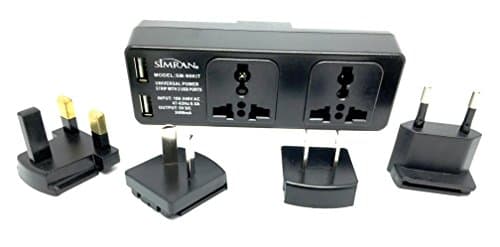
| Simran SM-90KIT | Yes — UK head included | 2 USB (no USB-C published) | 2 AC, universal sockets | Strip + four plug heads |
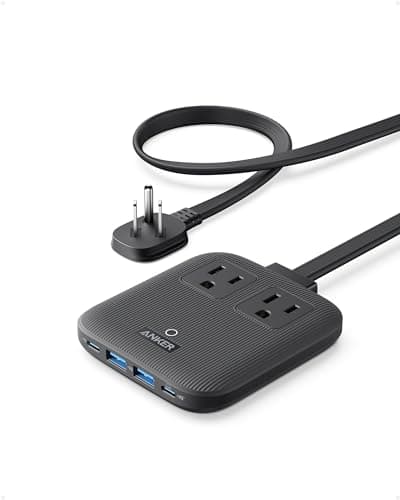
| Anker Nano 67W | No — needs an adapter in front, and is rated 100–240V for it | 2 USB-C + 2 USB-A | 2 AC | Flat slab, 5 ft flat cord |
Everything in that table comes from the manufacturers' own product pages or the current retail listings. Where a listing does not publish a figure — the Simran's USB wattage, for instance — we have left it out rather than estimate it.
The combination most people should actually buy
One universal adapter plus one multi-port charger, and the adapter is the cheap half.
Here is the arithmetic. A European hotel room, especially an older one, gives you one socket by the desk and one by the bed, often with a lamp already in it. The traveler has a phone, a watch, earbuds, a power bank and a laptop. Five devices, one outlet. No amount of plug-shape coverage fixes that — what fixes it is ports. The Anker Nano 67W is on this page for exactly that reason: it is rated 100–240 V input, so with a plain Type C adapter in front of it one European socket becomes two AC outlets and four USB ports.
Our EPICKA Universal Travel Adapter review goes through the top pick on its own, including the fuse and what the “150+ countries” claim actually covers.
If you would rather buy one object than two, the TESSAN is the single-item version of the same idea — more AC outlets and more ports in one block — and the Simran is the version built for a 230 V wall from the start, with universal sockets and four interchangeable plug heads. We rank the plug-and-port question in full on the travel power strip roundup, which is where the “one outlet, five devices” problem properly lives.
Where a universal adapter is the wrong gift
Three cases, stated plainly, because a gift that goes unused is worse than no gift.
They already own one. Anyone who has been to Europe twice owns an adapter. This is the single most duplicated travel gift there is. If you are not sure, buy the multi-port charger instead — almost nobody owns a good one.
They are going to one country for a weekend. A plain Type C adapter is a few dollars and fits in a coat pocket. We do not rank a specific one here, because the Amazon listings in that slot are largely transient unbranded sellers and we will not name a product we cannot expect to exist in three months. Buy whichever two-pack is currently well-reviewed, and spend the saved money on something else.
They are packing hair tools. Then the adapter is not the gift — a dual-voltage appliance is, or nothing. See the converter guide linked above.
Buying this as a gift
An adapter is a good gift for one specific person: someone with a trip already booked who has not travelled internationally before. It is a poor gift for a seasoned traveler, for the reason above. If the trip in question is a first one, our first international trip checklist is the companion piece, and the broader present-shaped version of this is gifts for someone going to Europe.
One presentation note. An adapter alone looks like a thing you bought at an airport. An adapter with a multi-port charger, or an adapter inside a tech organizer, reads as a kit somebody thought about. Same money, completely different gift.
How to choose a Europe adapter
Check whether the UK is on the itinerary
It is the only question that changes the answer. The continent is Type C/E/F and a Europlug covers nearly all of it; the UK and Ireland are Type G and share nothing with it. Both on one trip means universal.
Count the devices, then count the ports
Five devices and a two-port adapter is a queue. This is the spec that decides whether the thing gets used every night or once.
Read the brick, not the adapter
If the device's own power supply says 100–240V, a plain adapter is safe. If it names a single voltage, no adapter makes it safe at 230 V.
Prefer a fuse
A built-in fuse plus a spare — which the EPICKA publishes — is the cheapest insurance in this category. It is the component that fails instead of the laptop.
One block or a pouch of plugs
An all-in-one is simpler and bulkier; a kit of individual plugs is sturdier in the socket and easier to lose. Buy the block for one trip, the kit for someone who goes constantly.
What to spend
This is a $20–$40 category and spending more buys ports, not safety. Every price on this page is live and date-stamped; where we have no verified live price we show none rather than a stale number.