Buy a scale to leave yourself a margin, not to find out your exact weight. Every one of these devices reports a number to a decimal place, and every one of them is reporting it against a different reference than the scale at the check-in desk. The airline’s scale is the one with authority, it is calibrated on its own schedule, and arguing with it costs you the fee anyway. So the correct use of a luggage scale is not “am I at 50.0 pounds” — it is “am I comfortably under, at home, where repacking is free.” Everything else on this page follows from that.
Why this is a better gift than it sounds
On paper a luggage scale is an unromantic present. In practice it is one of the highest-hit-rate items on this site, for a specific reason: it prevents a bad experience that the recipient has probably already had. Almost everyone who checks bags has had the moment at the counter — unzipping a suitcase in public, moving shoes into a tote, hoping. A small object that makes that impossible is a genuinely thoughtful gift, and it costs less than a paperback.
It is also the rare travel gift with no fit, size, taste or compatibility question attached. There is no wrong color and no wrong size. That makes it the safest thing on the site to buy for someone whose preferences you do not know, which is why it appears in our travel gifts under $25 and stocking stuffers lists.
The honest limitation, stated plainly: it is a thin present on its own. Our recommendation is to pair it with something — a set of packing cubes is the natural partner, because the two objects do the same job from opposite ends (one organizes the bag, the other tells you when you have overfilled it).
How we picked
This is a category where the products are much more alike than the marketing suggests. Four criteria actually separated them.
- Does it publish a capacity? Most do: 110 lb / 50 kg is the category standard and is comfortably above any airline’s checked limit. One pick on this page publishes no capacity at all, and its card says so rather than guessing.
- How does it attach to the bag? A hook-and-strap design takes the weight of a packed suitcase across a webbing loop. A bare hook has to find a handle it fits. This matters more than any electronic specification, because it is where the measurement physically happens.
- Can you read it where you will use it? A bag gets weighed on a hotel-room floor at six in the morning, holding the scale at arm’s length. A backlight is the difference between reading the number and guessing at it.
- What happens to the power? The real failure mode in this category is not inaccuracy — it is a coin cell that died silently in a suitcase pocket eleven months ago. A rechargeable scale removes that failure entirely, at a price.
We compile published specifications, manufacturer descriptions and retailer listings. We do not have a set of calibration weights and we do not claim to have measured any of these, which is exactly why this page argues for leaving a margin instead of ranking the scales by an accuracy figure none of us can verify.
Hanging, handle, or neither
There are really only two designs, and the difference decides how pleasant the thing is to use.
Hanging scales— every pick on this page — have a hook or a strap. You clip it to the suitcase handle, lift the whole bag clear of the floor by the scale’s own grip, wait for the reading to settle, and put it down. The lift is the catch: with a heavy checked bag you are deadlifting 40 to 50 pounds on a plastic handle for three or four seconds, which is awkward for anyone with a wrist, shoulder or back problem. A wide rubberized grip helps more than it sounds like it should.
Platform or floor scales exist, and we have not ranked one, for an honest reason: they are the size of a bathroom scale and the whole point of this object is that it lives inside the suitcase it weighs. If lifting is a genuine problem for the recipient, a bathroom scale at home does the job for free — stand on it holding the bag, subtract your own weight. It is less precise and it requires nothing new in the bag.
What to actually do with the number
This is the part most listings skip, and it is the part that saves the fee.
Leave a margin of a few pounds. Your scale and the airline’s will not agree exactly, and you do not get to choose which one is right. Treat the limit as being lower than it is and the disagreement stops mattering.
Weigh it packed, with the things you forget. Toiletries in, shoes in, the jacket you were going to carry but will probably pack, the souvenir space you have optimistically left. A scale is only useful against the bag that is actually going to the airport.
Then weigh it again before the flight home. This is the single most useful habit here and the one almost nobody has. The outbound bag was packed carefully at home; the return bag was packed in twenty minutes and has gifts in it. The return leg is where overweight fees actually happen, which is why one of our picks is a two-pack and why the scale needs to live in the suitcase rather than in a kitchen drawer.
Know which limit you are weighing against. Checked allowances differ by airline, route and fare, and carry-on weight limits — widely ignored by American travelers — are enforced on many international and budget carriers. Our carry-on size rules guide covers why the published figure is the one to check rather than the one you remember.
A note on fees, and why there are no dollar figures here
You will find pages in this category that tell you precisely what an overweight bag costs. We are not going to, because the number is wrong as soon as it is written: airlines change baggage pricing constantly, it varies by route, cabin, fare class, loyalty tier and whether you paid online or at the desk, and a figure from last year quoted as current is worse than no figure. What is reliably true is the shape of it — an overweight charge is a flat penalty large enough that a cheap scale pays for itself the first time it prevents one, and often by a wide multiple. Check your own carrier’s published table for the actual number.
Which one for which recipient
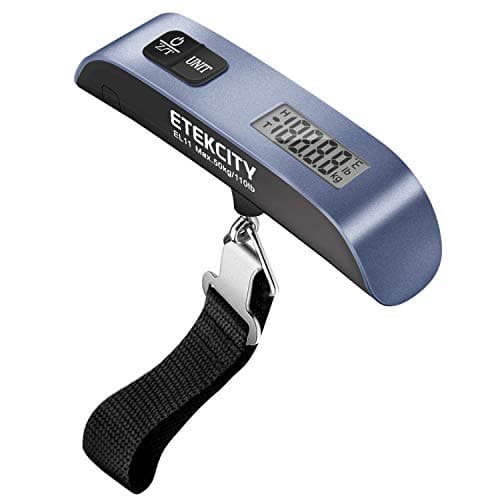
You want one safe answer. The Etekcity. It publishes its capacity, it is tiny enough to live in a suitcase pocket permanently, the battery is included, and it costs little enough that it can be part of a gift rather than all of it. It is the default for a reason.
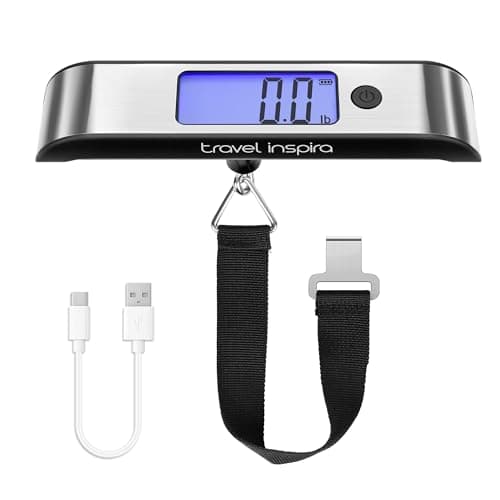
The recipient would never check a battery. The rechargeable travel inspira, and this is a more thoughtful pick than it looks. A steel body and USB-C charging mean it shares a cable with everything else they own and cannot be defeated by a dead coin cell on the one morning it is needed.
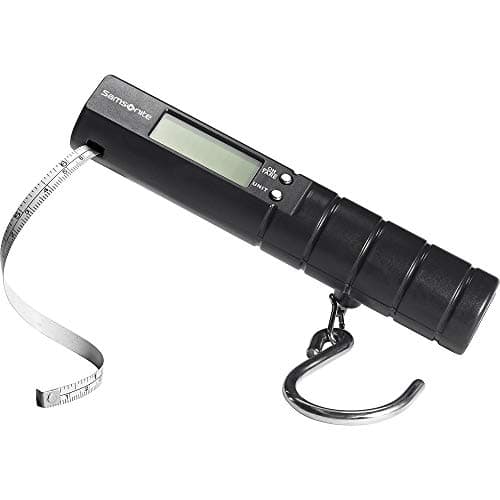
The scale is the whole gift. The Samsonite. A luggage brand on the box is what makes a measuring device read as a present, and it will match luggage a lot of recipients already own. Its listing publishes almost no specifications, which we have said on its card — buy it for what it is, which is the giftable one.
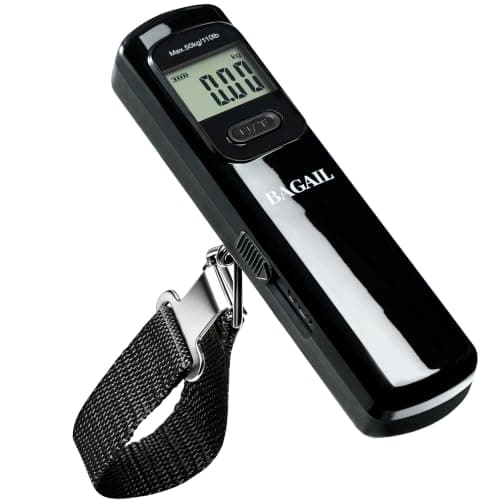
You are building a bundle. The BAGAIL. Cheapest here with a large display and proper straps, and the same brand as the packing cubes that win our cubes roundup, so a cubes-plus- scale gift looks deliberate rather than assembled.
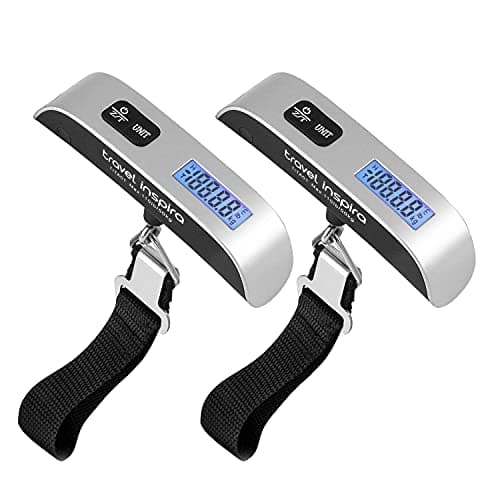
It is for a couple, or you took the return-leg point seriously. The two-pack. One lives in the suitcase, one stays at home, or one each for two people who travel separately.
110 lb is the number to look for
It is the category standard and it is well clear of any checked allowance, so capacity is not really a differentiator — it is a box to tick. What you are checking is that the listing publishes it at all. A scale that does not state its capacity may well be fine; it just means you are buying on brand rather than on specification, and you should know which one you are doing.
The strap matters more than the electronics
Every scale here reads to a tenth of a pound and none of that precision survives a wobbly lift. What does change the experience is the physical connection: a webbing strap with a hook spreads the load and fits any handle shape, while a bare metal hook has to find a loop it suits. If the recipient has a hard-shell spinner with a recessed handle, the strap design is the safer gift.
Backlight, because of when you will use it
Nobody weighs a bag at midday in good light. It happens at dawn in a hotel room with the curtains shut, or in a hallway, holding the thing up at eye level. Two picks here publish a backlit display and it is the feature we would not give up.
Rechargeable versus coin cell
A coin cell in a device used four times a year lasts a long time — and it dies without warning, in a suitcase, discovered on the morning of a flight. That is the whole argument for the rechargeable pick, and it is a real one. The counter-argument is just as real: a coin cell can be replaced in two minutes from a corner shop, while a flat rechargeable scale needs a cable and an hour you may not have. For a frequent flyer we would take the rechargeable; for someone who flies twice a year the coin cell is genuinely the better engineering.
Store it in the bag, not in a drawer
The one piece of advice that decides whether this gift gets used: it belongs in the suitcase, permanently, in the same pocket as the documents and the spare luggage tag. A scale in a kitchen drawer weighs the outbound bag and is a thousand miles away for the leg where it was actually needed.