Ask one question before you look at a single notebook: do they already write things down? If the answer is yes, a good journal is among the most personal travel gifts there is. If the answer is no, no notebook on earth will change that, and a beautiful blank book becomes a small reproach on a shelf. This page only works for the first group, and we would rather lose the sale than pretend otherwise.
Why a paper notebook still belongs in a bag
It works with no battery, no signal and no roaming plan. It is legal to use during taxi, take-off and landing when devices are stowed. It takes a customs form, a ticket stub, a hotel address written down by someone who does not speak your language, and a sketch. And the thing people actually report years later is that they reread it — which is more than most of us can say about a camera roll.
It is also the rare travel gift with no compatibility problem. No charger, no plug shape, no phone ecosystem, no size to guess. Compare that to almost everything on our travel gadgets roundup, where half the buying advice is about which devices someone already owns.
The one spec that separates the two picks
Numbered pages and a built-in index. That is the whole difference in practical terms, and it is bigger than it sounds.
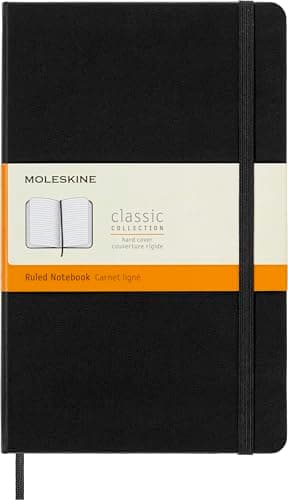
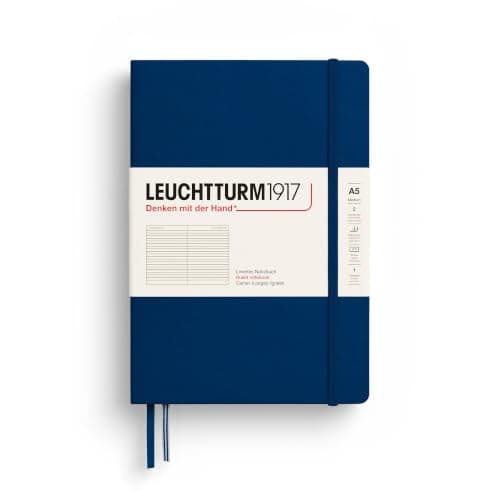
A journal without them is a diary: entries in order, findable only by flipping. A journal with them is a searchable record — write the page number next to "Lisbon, day 3" or "the restaurant in the back street" in the index at the front, and a year later you can find it in seconds. For someone who travels repeatedly and refers back to their notes, this turns a keepsake into a tool. The LEUCHTTURM1917 has both. The Moleskine Classic has neither.
What the Moleskine has instead is recognition. It reads as a travel journal on sight, it needs no explanation as a gift, and it carries an association with travel writing that a technically better notebook does not. If the gift needs to land the moment it is unwrapped, that is a real argument and not a soft one.
Paper, and the pen problem nobody mentions
The most common way a journal gift goes wrong is ink. Thin paper feathers — the line spreads into the fibers and goes fuzzy — and ghosts, where writing shows through to the reverse side. On thin stock, a fountain pen or a heavy marker can make one side of every sheet unusable, which halves a notebook without warning.
The LEUCHTTURM's paper handles ink better than the Moleskine's, which is the practical reason to choose it for anyone who uses a fountain pen or draws with markers. If they write with a ballpoint or a fine gel pen, the difference stops mattering and you can buy on preference. That is the sort of trade-off we try to state plainly rather than leave to a spec table — the same principle behind our published method.
Binding, pocket and closure: the three details that get used daily
Lay-flat binding. A notebook that will not stay open needs a hand to hold it down, and on an airplane tray table you do not have a spare hand. Both picks lay reasonably flat; this is the feature people notice on day one and stop noticing forever after, which is the sign of a good one.
The back pocket. The expandable gusset at the rear is where boarding passes, ticket stubs, museum tickets and receipts live. This is the single most travel-specific feature on either notebook, and it is why a general-purpose hardcover beats a purpose-marketed "travel journal" with printed prompts.
The elastic closure. It keeps the cover shut and the loose contents in when the notebook is jammed into a side pocket. A journal without one sheds its collected paper into the bottom of a bag within a week.
Size: A5 or pocket
A5 — roughly the size of a paperback — is the right default. There is room for a proper entry and a sketch, and it still slides into a daypack. Pocket-size notebooks are better for notes on the move and worse for anything longer than a few lines, and they fill up fast enough that a long trip needs two. If notes on the move are actually the point — a back pocket rather than a bag — that is a different purchase, and we rank it separately in the best pocket notebooks for travel.
The hardcover question resolves the same way for travel as it does at home: hardcovers survive a bag, softcovers survive a pocket. For a gift, hardcover, every time — it is the version that still looks like a gift after a month of being packed.
Why only two picks
Because the category is genuinely two decisions wide. Once you have chosen between a record-keeping notebook and a recognizable one, every remaining difference is cover color and ruling — dotted, lined, plain, squared — which is preference rather than quality. Padding this page to eight notebooks would mean ranking cover art, and we do not do that.
The honest alternative for a non-writer is not a different journal, it is a different category of keepsake: an instant camera that produces prints, or a scratch map that turns a travel history into an object on a wall. Both are covered on unique travel gifts.
What we left out, and why
Prompted journals with fill-in-the-blank pages. They work for the first three days of a trip and then become homework. The blank page is intimidating for about a minute; a printed prompt you do not want to answer is annoying for the entire trip.
Five-year "one line a day" journals. A lovely format, and a commitment device rather than a travel notebook. Giving one to someone who has never journaled is setting a target they did not choose.
Leather-bound refillable blank books. Beautiful, heavy, and precious enough that people save them for a trip worthy of them, which never quite arrives. If you want the leather-and-milestone gift, buy it from the luxury travel accessories page instead, where that is the point.
Notebooks with built-in pen loops as the deciding feature. A clip-on loop costs almost nothing and can be added to either pick.
How to give a journal well
Two things make the difference. Include a decent pen — a journal with no pen at hand is a journal that does not get started, and the pen is the cheapest half of the gift. Which pen matters more than it sounds, because ink type decides whether the entries survive a spilled drink — our travel journaling pen roundup ranks that decision. And write something on the first page: where you hope they take it, or simply the date. It removes the blank-first-page problem, and it is the reason this particular gift gets kept.
For a milestone trip, pair it with something that records the same trip differently — an instant camera for prints, or a map for the wall. Our personalized travel gifts guide covers the engraving-and-initials route if you want the gift to carry their name without turning into a novelty. And if the person already journals seriously, our gifts for journal lovers list builds the full kit around the notebook — the travel pen, the pocket book, the weatherproof option.
The one question this page does not settle is the brand argument every journal shortlist ends on. We gave it a page of its own: LEUCHTTURM1917 vs Moleskine works through numbered pages, paper and ink, and which of the two is the better gift rather than the better notebook. If the recipient has never kept a journal before, send them how to start a travel journal with it.