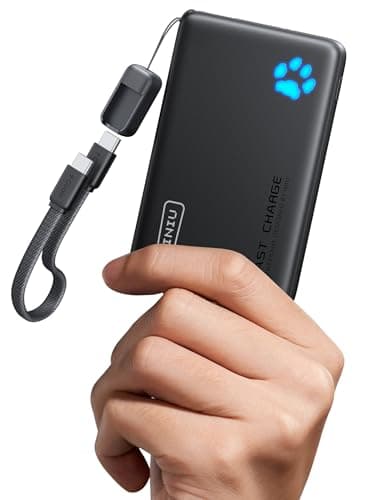
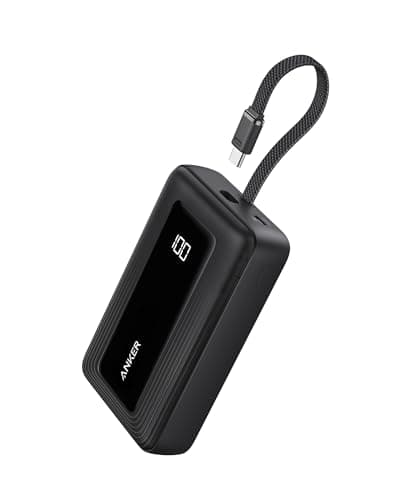
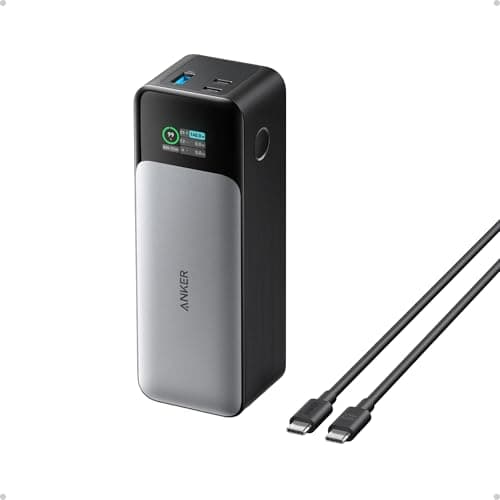
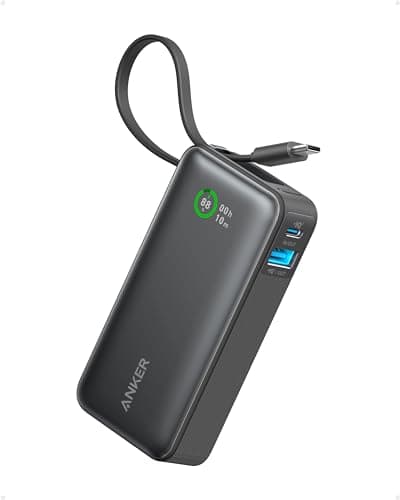
Buy the one with the connector attached to the body. The most common power-bank failure has nothing to do with capacity — it is a fully charged bank and a cable in the other bag. A model with a fold-out plug or an integrated cable removes that failure entirely, and that single design choice matters more day to day than any specification on the box.
The three numbers, in the order they actually matter
1. Does it have a cable attached? Not a spec, but the first question. Integrated-connector banks get used; cable-dependent banks get left behind at the exact moment they're needed. If you're buying for someone disorganized, stop reading here and buy an integrated one. The other half of that fix is giving the cable a fixed home — a travel tech organizer is what stops it being in the other bag in the first place.
2. Wattage, not capacity, decides what it can charge. This is the most misunderstood part of the category. Capacity (mAh) is the size of the tank; wattage (W) is the size of the hose. A huge low-wattage bank will trickle into a laptop for hours and barely move the percentage. Roughly: 20W is fast phone charging, 45W meaningfully charges a tablet or small laptop, 100W and above genuinely charges a laptop at speed.
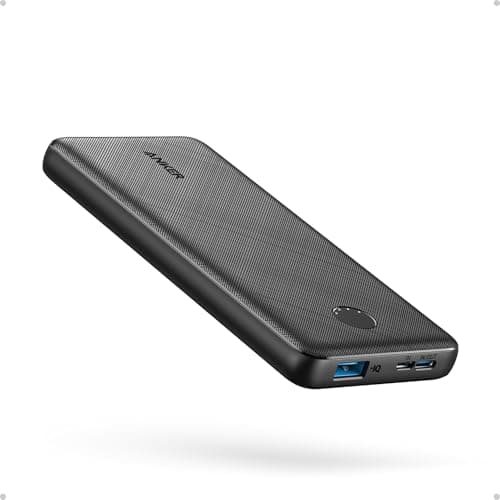
3. Capacity, matched to the trip rather than to ambition. 10,000mAh is about two phone recharges and is right for almost everyone — small enough to carry, big enough to matter. 20,000mAh covers a delayed travel day, two devices, or a couple who share. Beyond that you're carrying a brick to solve a problem most people don't have.
The airline rules, which are stricter than people assume
- Power banks must travel in the cabin, never in checked baggage. A firm rule, not a preference — a lithium fire in the hold cannot be reached. A bank packed in a checked bag is a bag that may be pulled.
- There are capacity limits. Airlines cap lithium batteries by watt-hours (Wh), not mAh. Most consumer banks up to around 20,000mAh sit comfortably inside the standard limit; larger units may need airline approval, and bigger ones again are prohibited.
- Portable power stations are not power banks. The camping-style units with AC outlets are far above cabin limits and are road-only gear. We cover those in gifts for van lifers.
Rules vary by carrier and change, so check the specific airline before a trip rather than trusting a general figure. We go through this properly in can you take a power bank on a plane.
Magnetic banks: genuinely useful, with one condition
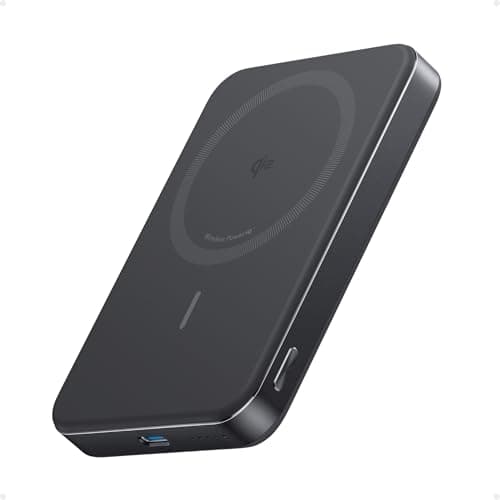
Qi2 magnetic banks snap onto the back of a compatible phone and charge without a cable at all, which is the least-friction version of this product. The condition is that the magnet needs a compatible phone or a magnetic case to grip — on a bare Android phone it's just a heavy bank with a flat back.
The honest trade beyond that: wireless charging is slower and generates more heat than plugging in, so you lose efficiency for convenience. For someone charging while walking around a city that's a good trade. For someone topping up in a plane seat, a cable is simply better.
What we didn't rank
Solar power banks. The panel on a pocket-sized bank is far too small to recharge it meaningfully — a full day of direct sun typically yields a fraction of a charge. They market well and perform badly. Anyone genuinely off-grid needs a proper folding solar panel, not a bank with a panel glued to it.
Very high capacity units. Beyond about 25,000mAh you run into both airline limits and the simple fact that the weight stops being worth it for most travelers.
Banks with built-in wall plugs. A reasonable idea, but the combined units tend to be bulky and compromise on both functions. A good universal adapter plus a separate bank is the better pairing.
How we ranked these
The rubric weights how reliably something gets used above headline specifications, which is why integrated-connector models lead and the highest-capacity option doesn't. We compile published specifications, confirm each pick is currently purchasable, pull live prices, and score against our published rubric. We do not run a lab and don't claim charge-cycle testing we haven't done — what we can do is read the wattage figures honestly and be clear about what each one will and won't charge.
How to choose a travel power bank
1. What do they need to charge?
Phone only: 10,000mAh and 20W+ is plenty. Phone and tablet: 45W. Laptop: high wattage and high capacity, and expect a heavy object.
2. Will they remember a cable?
If there's any doubt, buy an integrated-connector or magnetic model. It is the single highest-impact decision in this category.
3. What phone do they have?
Magnetic banks need a compatible phone or a magnetic case, and a built-in USB-C plug is useless to someone on an older Lightning iPhone. Thirty seconds of checking prevents a returned gift.
4. How long are the gaps between outlets?
A commuter needs a top-up; a long-haul flyer with a connection needs a full recharge; a festival or hiking trip needs several. Match capacity to the longest realistic gap, not the average one.
5. Check it's cabin-legal
Power banks go in carry-on only, and airlines cap capacity by watt-hours. Standard consumer sizes are fine; anything unusually large needs checking with the airline first.