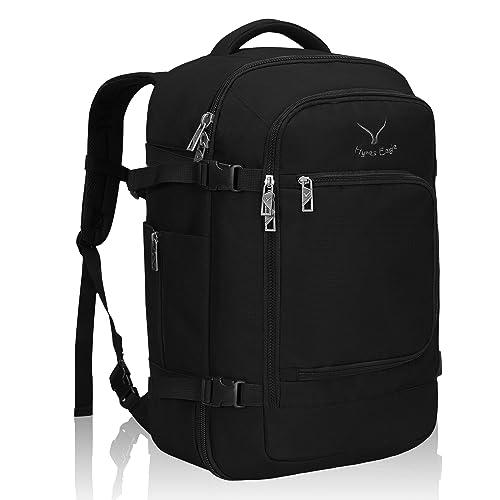
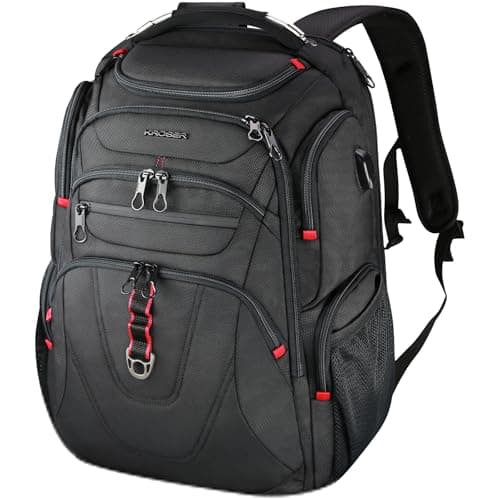
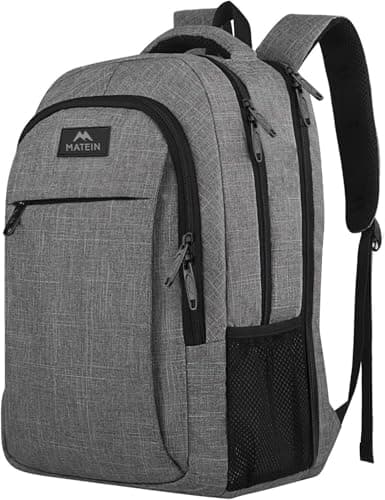
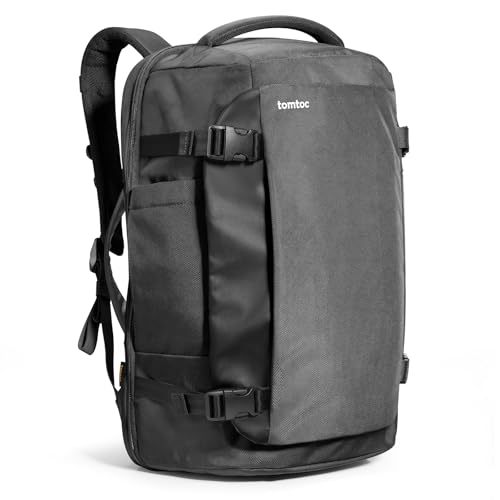
The tomtoc Travel Backpack 40L is the pick under $100, because it is the only bag in this band that commits to being a real flight-approved cabin case rather than a very large daypack — 40 liters, and a laptop compartment big enough for a 17.3 inch machine. The budget pick is the MATEIN, which is the cheapest thing here and still does the lay-flat airport trick. Every price below is read live from our price layer and stamped with an as-of date in the table — the under-$100 claim describes those prices on that date.
Why $100 is a real line in travel backpacks
Price-band pages are often arbitrary. This one is not, because of where the market actually sits. Below a hundred dollars there is a crowded field of soft-sided packs. Above it, the next serious travel backpack we rank is the Osprey Fairview 40 at around a hundred and fifty, then the Farpoint 40, then the Cotopaxi Allpa. There is essentially nothing in between — the gap between roughly eighty dollars and a hundred and fifty is empty.
That gap exists because of one component. Above the line, packs are built around an internal frame and a load-transferring hip belt. Below it, they are not. Everything else — the fabric, the zippers, the pockets, the laptop sleeve — scales smoothly with price. The suspension does not; it is a thing a bag either has or does not, and it is the reason the price doubles.
What you actually give up under $100
Being specific matters here, because the answer is not “everything,” and the usual version of this page implies that it is.
- Weight transfer.A proper hip belt puts most of a loaded pack’s weight on the hips, where the body carries it well. Not one of the four picks here is sold on its suspension — their listings lead on capacity, laptop fit and the lay-flat opening, while the Ospreys above this band lead on the frame and the belt, because that is precisely what the extra money buys. Loaded and carried for half an hour, you feel the difference in your shoulders, not in your opinion of the bag.
- Warranty and repair. The premium packs make a lifetime or long-term guarantee a headline feature. Nothing in this band publishes a comparable one. These are bags you replace rather than repair, and at these prices that is a reasonable trade — but it is a trade.
- Fabric and hardware ceiling. Water-resistant, not waterproof. Decent zippers, not the oversized weather-sealed ones. Fine for airports and hotels; not what you would take up a mountain in the rain.
- Fit adjustment. Premium packs come in torso lengths or adjust to them. These come in one size and you hope. For a shorter or longer than average torso, that is a real argument for spending more — we go through it in the carry-on backpack guide.
What you do not give up
More than people expect, and this is why the band is worth shopping rather than skipping.
- Capacity. Two of the four picks here are full 40L cabin bags. Capacity is cheap; you are not paying for liters.
- The lay-flat TSA opening. The feature that most improves an actual airport morning — a laptop compartment that folds flat so it goes through the scanner in the bag — is standard right down to the cheapest pick here.
- Laptop protection. All four carry a padded compartment. One of them takes a 17.3 inch machine, which is larger than many premium travel packs manage.
- Being replaceable. Underrated. A bag that costs less than a night in a hotel can be checked, abused, left somewhere, or handed to a teenager, and none of that is a disaster.
The mistake this band is famous for: two different bags
This is the part worth reading before you pick anything. The sub-$100 shelf contains two products that photograph almost identically and do completely different jobs.
The big laptop daypack. The MATEIN and the KROSER are this. They are built around a large laptop compartment and a commute, with travel features added. They are excellent at being the bag someone uses every day and takes on a plane four times a year. They are not 40-liter one-bag travel packs, and a week of clothes does not go in one.
The 40L cabin clamshell. The tomtoc and the Hynes Eagle are this. They open flat like a suitcase, hold a week of clothes, and are sized to the cabin allowance. They make poor daily commuters — oversized and shapeless when half empty — and excellent single bags for a trip.
Buying the wrong one of those two is the most common failure in this price band, and it has nothing to do with quality. Decide which job the bag has before you compare anything else. If the honest answer is “both,” the daypack-plus is the safer buy: an oversized commuter is annoying, while a 40L bag used as a daily carry is faintly ridiculous.
How long will they carry it loaded?
This is the one question the missing hip belt turns into a decision rather than a detail. Set it against the trip:
- Under about twenty minutes at a stretch — terminal to gate, cab to hotel, platform to train. The suspension is irrelevant. Buy in this band and spend the savings on the trip.
- An hour or more, repeatedly — a hostel hop, walking a European city with everything on your back, a bus-and-walk itinerary. Spend the extra. This is what the framed packs exist for and the shoulders of the person carrying it will know within one afternoon.
- Anything load-bearing and off-pavement. Not this band, and arguably not a travel backpack at all — that is a hiking pack, and a different category.
The full picture across every price, including the framed packs above this line, is in our travel backpack roundup.
How we built this band
Four packs in our catalog carried a live price under $100 when this page was written, and all four are here. The nearest pack above the line is about twenty dollars clear of it and the one after that is twice the band, so the picks are not sitting on the edge waiting for a price move to make this page wrong. We considered a $50 band and did not build it: three packs qualify, they sit within twelve dollars of each other, and the page would have nothing to reason about.
Prices move. The band describes the prices in the table on the date stamped beside them, and if a pick crosses the line we say so on the page rather than quietly leaving it ranked. Every figure renders from our live price layer — our product records contain no price field at all — and where there is no verified live price we show a check-price link rather than a number that might be wrong.
How we ranked these
Scored on the same five-point rubric as everything else on this site — usefulness, portability, durability, value and giftability — from published specifications, manufacturer documentation and aggregated owner feedback, not from lab tests we did not run. The method is on how we choose. Within the band, ranking is weighted toward bags that do the travel job rather than the commute job, since the query is about travel.
1. Decide which of the two bags you are buying
A 30-ish liter laptop daypack and a 40L cabin clamshell are not competitors. One is for a person who commutes and occasionally flies; the other is for a person who flies with one bag. Settle this first and half the shortlist disappears.
2. Measure the laptop, not the person
Laptop compartments in this band run from 15.6 to 17.3 inches, and a 16 inch machine will not go into a 15.6 inch sleeve no matter how soft the bag looks. It is the one spec here with a hard pass or fail.
3. Check the airline before you trust “carry-on approved”
A 40L bag is at the top of most cabin allowances and over some budget carriers’ personal-item limits entirely. Packed soft it usually squeezes into a sizer; packed hard it sometimes does not. Our carry-on size rules guide has the current numbers.
4. Assume no hip belt, and plan the trip around it
If a pack in this band has a waist strap at all, treat it as a stabilizer rather than a load carrier. The realistic comfortable limit is what the shoulders will take, which for most people is a lot less than 40 liters of densely packed clothing.
5. Lay-flat opening is the feature to insist on
It costs nothing extra at this price and it is the difference between unpacking the bag at security and putting it on the belt as it is. All four picks here have it, and we would not rank one that did not.
6. Treat it as a consumable
Three to five years is a fair expectation at this price, not a decade. That is not a complaint — it is the honest accounting. If the person wants one bag for the next ten years of travel, the money is better spent above this band.
What to spend
Qualitatively: the two laptop daypacks sit in impulse-gift territory, the Hynes Eagle is barely above them for twice the capacity, and the tomtoc is the considered end of the band. Live prices in the table above; we do not quote figures in prose because they move.