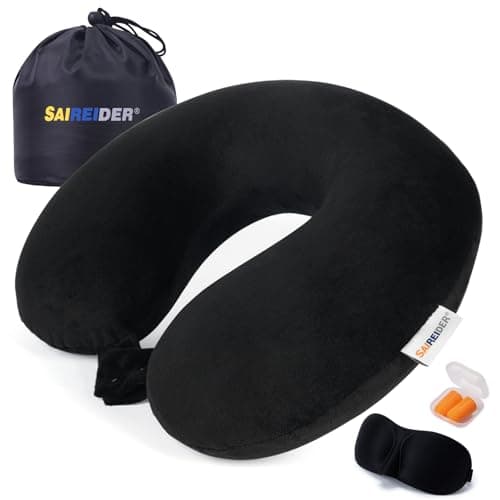
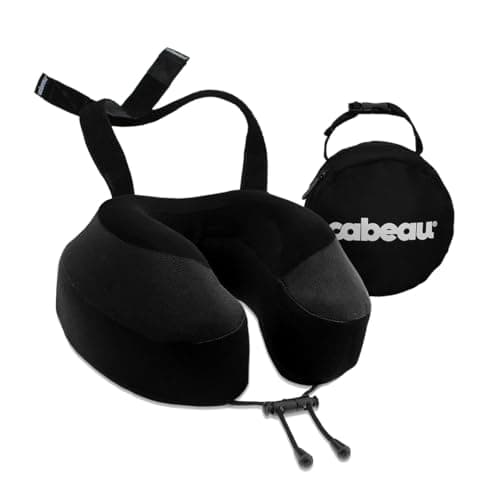
The Cabeau Evolution S3 is the pick under $50, and it is for the flyer who genuinely tries to sleep on planes — a raised back panel that holds the head up instead of just filling the gap, memory foam, and a strap that clips it to the seat so it does not slide off mid-nap. The budget pick is the SAIREIDER memory foam set: a pillow, an eye mask, earplugs and a storage bag for about what a plain pillow costs, which makes it the right answer for somebody who flies twice a year. Every price here is read live from our price layer with an as-of date in the table — the $50 band describes those prices on that date.
Under $50 you are buying a shape, not a tier
This is the thing that makes the price band interesting rather than depressing. In most travel-gear categories a budget cap means accepting a worse version of the same object. Neck pillows do not work that way: above and below $50 you find the same handful of competing shapes, and the expensive ones are not better at the job, they are better at a different job — usually packing smaller or looking nicer.
So the question under $50 is not “what am I giving up?” It is the same question as at any price: which way does their head fall?
- Head back and sideways. The classic plane-sleep failure: the head rolls off the seat back, the neck extends, and the sleeper jolts awake every twenty minutes. This needs a horseshoe with a structured back — a firm panel behind the neck so the head has somewhere to rest that is not thin air.
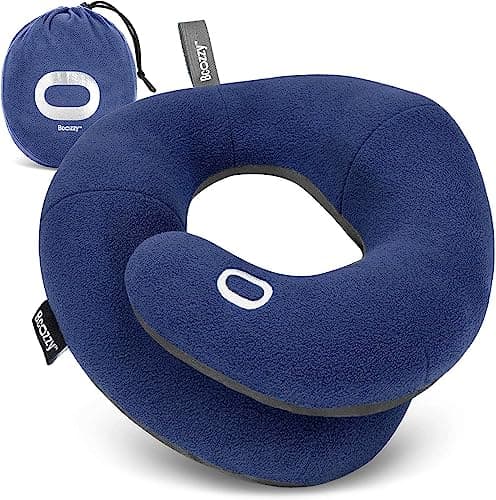
- Head forward, chin to chest. A completely different failure and the one most pillows ignore. The head drops forward because nothing is holding the chin, and a standard horseshoe does nothing about it. This needs overlapping ends that can be adjusted to support the chin itself.
- They are not really a plane sleeper at all. Two flights a year, short hops, no established sleep routine on board. Here the pillow is one of several small problems (light, noise, a dry cabin), and a kit beats a specialist object.
Those three answers are the three picks on this page, in that order. If you know which of the three descriptions fits the recipient, you already know what to buy — and that is a far more useful filter than price.
How we built the band
Three rules, so this page cannot drift into a claim it is not entitled to.
- A pick only appears if our live price layer shows it under $50. No product record on this site carries a price field at all — the numbers in the comparison table are read at render time and stamped with the date they were collected. If one crosses the line, the number shown will say so rather than the page quietly lying.
- Three qualifying picks minimum, or no page. Three qualify, which is the floor and the reason this is the $50 band rather than the $25 band — under $25 only one neck pillow in our registry qualifies, so that page does not exist.
- Pillows just over the line are prose, never picks. Two are worth naming because plenty of buyers should spend the extra. The Trtl Pillow is the scarf design: it packs flatter than anything here and suits a carry-on-only traveler who cannot give up the space. The Ostrichpillow Go is the one to buy when the gift has to look like a gift. Neither is on this page because neither is under $50.
Beyond price we rank on support geometry, whether the cover comes off and goes in the wash, packed bulk, and whether the listing publishes the specifications at all. We compile published listing specifications and manufacturer descriptions and score every pick against our published rubric. We have not run a sleep study and we publish no measurements of our own.
Which pillow for which sleeper
The frequent flyer who sleeps on planes. The Cabeau Evolution S3. The raised back panel is the specific feature that earns the top spot: it means the head has structure behind it rather than falling into the gap between the seat and the shoulder, which is the mechanism behind the twenty-minute wake-up. The cover unzips for the wash, which most rivals do not offer, and the seat strap solves the other recurring complaint — a pillow that ends up on the floor. We examined it in full in our Cabeau Evolution S3 review.
Anyone whose head falls forward.The BCOZZY. This is the pillow for the chin-to-chest sleeper, and it is the one most buyers have never considered because the problem is less talked about than the head-roll. The overlapping ends can be positioned to hold the chin, which is mechanically different from everything else here, and it comes in a kids’ size as well as an adult one — which matters if you are buying for a family rather than a person. It is also our pick for a car, for reasons we set out in the car pillow roundup: a car headrest already supports the back of the head, so the chin is the only thing left failing.
The occasional flyer, and the safest gift here. The SAIREIDER memory foam set — our budget pick. Honest framing: the pillow inside it is not as good as the Cabeau, and it does not need to be. For somebody who flies twice a year, the realistic obstacles to sleeping on a plane are light, noise and a pillow, and this box contains an answer to all three for roughly the cost of a pillow alone. It is adjustable to three sizes and machine washable. If you do not know how the recipient sleeps, this is the lowest-risk purchase on the page.
What this band cannot do for you
It cannot pack genuinely small. This is the real trade at this price, and the reason the band has a ceiling. Memory foam pillows compress but they do not disappear, and all three picks here are an object you carry. The designs that solve bulk — the scarf and the inflatable wrap — start above $50, and if the recipient travels carry-on-only and complains about space, the extra money is genuinely buying something. Our memory foam vs inflatable comparison is the page that settles that trade.
It cannot fix a window-seat side sleeper. Side sleeping on a plane is a harder problem than either of the failures above, because it needs support between the shoulder and the ear rather than around the neck. We treat it separately in best travel pillow for side sleepers, and the honest answer there is not always a neck pillow at all.
It cannot be the whole sleep kit on its own. A pillow with a lit cabin and engine noise still leaves two of three problems unsolved. A proper sleep mask is the cheapest big improvement anybody makes to plane sleep, and it costs less than any pillow here.
Buying it as a gift
Neck pillows are a strange gift category: hugely popular, frequently wrong, and almost always bought on shape-blindness. The failure mode is buying the generic horseshoe for somebody whose head falls forward, where it does nothing at all — and the recipient concludes that travel pillows do not work rather than that this one does not work for them.
So the single most valuable thing you can do before spending anything is ask one question, or remember one observation: when they fall asleep in a car or on a sofa, does their head go back or forward? Back, buy the Cabeau. Forward, buy the BCOZZY. No idea at all, buy the set — which also has the advantage of unwrapping like a kit rather than like a single object.
At this budget it also bundles well. A pillow plus a sleep mask is the complete plane-sleep gift for well under fifty dollars together, and it is a markedly better present than either alone. For more at this money see travel gifts under $50, and for the whole category, including the designs above this band, the full travel pillow roundup is the page.
Ask which way the head falls, then buy
Head back and sideways: a horseshoe with a structured back panel. Head forward, chin to chest: overlapping ends that can support the chin. That single observation matters far more than price, and it is the question almost no buyer asks.
Under $50 is a choice of shape, not a lesser tier
The same shapes compete above and below this line. What the extra money buys is packed size and appearance, not support — which is why this band is a legitimate place to shop rather than a compromise.
Insist on a removable, washable cover
A pillow that touches a face on every flight and cannot be washed has a short honest lifespan. A cover that unzips is the difference between two years of use and one.
A seat strap solves a real problem
The second most common complaint after poor support is a pillow that slides off during the nap. A clip or strap to the seat back fixes it, and it costs nothing.
Accept the bulk, or spend more
Nothing in this band packs genuinely flat. If the recipient travels carry-on-only and guards every litre, the scarf and inflatable designs above $50 are buying something real.
Bundle the mask, not a second pillow
Plane sleep fails on light, noise and support. A pillow fixes one. A sleep mask is the cheapest fix for another and costs less than any pillow here, which makes it the best possible companion purchase.