Skip to content
Jet & Jot

03 — Buying Guides

Do you need compression socks on a flight?

Under four hours in the air, almost certainly not. Over four hours with a risk factor on the list below, they are one of the few cheap things worth doing. Here is where the line actually sits.

By Stephen V.Updated How we choose
#ad

We earn a commission when you buy through our Amazon links, at no extra cost to you. It never changes the pick, and we say plainly when the cheaper option is the better buy. How this works.

Under four hours: no. For a flight longer than four hours, the CDC Yellow Book's position is that graduated compression stockings “appear to reduce asymptomatic DVT in travelers and are generally well tolerated” — so they are worth wearing, and worth wearing most if you carry one of the risk factors listed below. We are a gift site, not a medical one, so this page does two things only: it reports what the published sources actually say, and it tells you what to buy if the answer turns out to be yes. For anything specific to a person, the answer comes from their clinician and not from us.

Where the four-hour line comes from

The CDC Yellow Book's page on travel-associated deep vein thrombosis and pulmonary embolism is explicit about the threshold most of the research uses. It records that “>4 hours” is “most often used” as the definition of long-distance air travel, and states plainly that “for flights <4 hours, the risk of symptomatic VTE is negligible.” It also notes that the underlying studies defined long-distance travel across a range — from more than 3 hours to more than 10.

That one sentence does most of the work on this page. A two-hour hop does not need compression socks, and the enormous volume of internet advice implying otherwise is selling something. Swollen ankles after a short flight are uncomfortable and are not the same thing as clot risk.

Above four hours, the picture changes, and the recommendation that gets quoted most is more specific than “wear socks.” The same CDC page records that the American College of Chest Physicians recommends “properly fitted below-the-knee GCS that provide 15–30 mmHg of pressure” for at-risk travelers on journeys exceeding six hours. Three details in there matter: below the knee, properly fitted, and a pressure range whose bottom end is the ordinary over-the-counter travel grade.

The risk factors are the real answer

The most useful figure on the CDC's page is not about duration at all. It records that “75–99% of people who developed travel-associated VTE had ≥1 preexisting risk factors.”

In other words: the flight is rarely the whole story. It is a contributing factor layered onto something that was already there. The risk factors the page lists include active cancer, estrogen use, recent hospitalization or surgery, limited mobility, obesity, age over 40, pregnancy, a previous VTE, thrombophilia, and a family history of VTE.

It also records one factor nobody expects: height. People shorter than 1.6 m (5 ft 3 in) and people taller than 1.9 m (6 ft 3 in) were at increased risk — presumably because an economy seat fits neither of them, in opposite directions.

So the practical test is two questions, not one. Is the flight longer than four hours? And does the traveler carry anything on that list? Two yes answers is where compression socks move from “nice” to “sensible,” and it is also the point at which the honest advice is to raise it with a clinician rather than with a gift guide — the CDC's own framing is that decisions about drug prophylaxis for high-risk long-distance travelers “should be made on an individual basis.”

The things that are free and matter as much

Compression socks are one item on a list of preventive measures, and the rest of the list costs nothing. The CDC page names frequent ambulation, calf exercises, an aisle seat assignment, and hydration.

That ordering is worth noticing, because it is the opposite of how the internet sells this. Getting up and walking the aisle every couple of hours, flexing the calves in the seat, and booking the aisle so that getting up is socially possible are the interventions a passenger controls completely. A $15 pair of socks is an addition to those, not a substitute for them. Our how to sleep on a plane guide has the awkward practical version of this: the aisle seat is worse for sleeping and better for everything else.

What to buy when the answer is yes

Four picks, ranked on this page, and the choice between them is mostly about how often they will be worn.

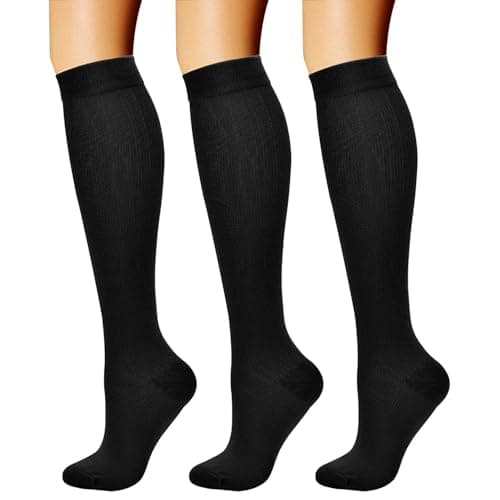
A first pair, or a family on one flight: the CHARMKING three-pack. The standard over-the-counter travel grade, at a price that means a household can all have a pair for one long-haul leg. It is also the right answer when you genuinely do not know whether the recipient will like wearing them.

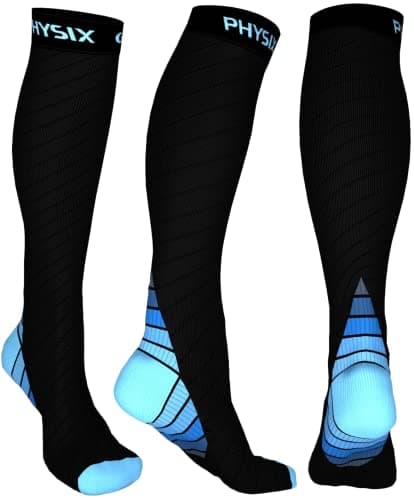
One good pair for repeat use: the Physix Gear socks. This is the pair for somebody who has decided they are doing this on every long flight and wants a sock that holds its compression through repeated washing.

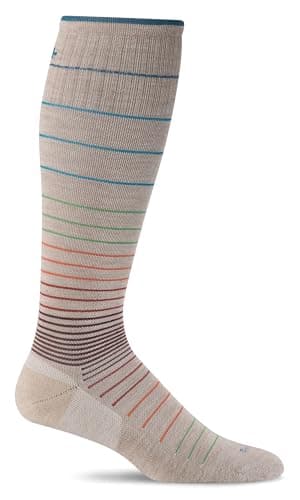
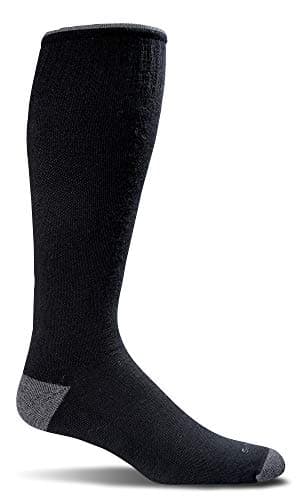
Long-haul comfort, if they have used compression before: the Sockwell Circulator and Elevation. Merino rather than nylon, which matters over fourteen hours in a dry cabin more than the spec sheet suggests. These are the pair for somebody who already owns cheap compression socks and finds them unpleasant after hour six.

The grades, the fit measurement and the gift-sizing problem are covered properly on best compression socks for flying, which is the ranked version of this category. One point from it bears repeating here, because it is where compression socks most often go wrong as a gift: “properly fitted” is in the ACCP wording for a reason, and a compression sock that is too large does less than nothing while a compression sock that is too small is genuinely unpleasant. Sizing in this category runs off calf circumference and shoe size together, so for a gift, a gift receipt is part of the present.

Three honest limits on everything above

We are not a medical site and this is not medical advice. Everything on this page is a report of what the CDC Yellow Book publishes, linked in Sources so you can read it yourself. Anybody with a clotting history, a pregnancy, recent surgery, a cancer diagnosis or a prescribed medication should be asking their own clinician, who can weigh the actual case.

The evidence is about asymptomatic DVT. The CDC's wording is careful — stockings “appear to reduce asymptomatic DVT.” That is a real finding and it is not the same claim as preventing a pulmonary embolism, and we are not going to upgrade it.

A sock is not a seat. Limited mobility is on the risk list, and nothing you can buy changes the fact that a long flight in a cramped seat involves sitting still. If there is a lever worth pulling for a high-risk traveler on a very long flight, it is the aisle, the exit row or the upgrade — not the sock.

If you are buying this as a gift

Compression socks are a good gift for exactly one person: somebody with a long flight booked who has mentioned swollen feet or stiff legs. They are a bad gift for anybody who has not raised it, because the subtext reads as a comment about their health. Put them inside a bigger present rather than giving them alone — a pair with a sleep mask and a travel blanket is a long-haul kit, while a pair on their own is a hint.

The exception is professional use, where they are entirely unremarkable and genuinely welcome: nurses, flight crew and anybody on their feet for twelve hours wear compression for work rather than for travel. See gifts for travel nurses and gifts for flight attendants.
The short answer

Quick picks

#GiftBest forScorePrice
01
Physix Gear Physix Gear Compression Socks
Physix Gear Compression Socks

The unsexy gift that saves swollen ankles on a long-haul — practical care in a box.

Anyone facing long flights or long days on their feet
8.4
$19.78Amazon
02
Sockwell Sockwell Women's Circulator Compression Sock
Sockwell Women's Circulator Compression Sock

Merino instead of nylon — the compression sock someone will actually keep on for fourteen hours.

Long-haul flights where comfort decides whether they get worn
8.4
$32.95Amazon
03
Sockwell Sockwell Men's Elevation Firm Compression Socks
Sockwell Men's Elevation Firm Compression Socks

The firm-compression men's option, in merino, for someone who already knows they want the tighter grade.

Long-haul flyers who have used compression before
8.2
$32.95Amazon
04
CHARMKING CHARMKING Compression Socks, 3 Pairs
CHARMKING Compression Socks, 3 Pairs

Three pairs for the price of an airport sandwich — the sensible way to find out whether someone likes compression.

A first try, or a family on the same long flight
8.0
$9.99Amazon

#ad · Live prices from the Amazon Product API, as of October 21, 2026. Where we have no verified live price, we show none — we would rather leave a gap than print a number that has gone stale.

In detail

The picks, in full

01
Physix Gear Physix Gear Compression Socks

Anyone facing long flights or long days on their feet

Physix Gear Compression Socks

20–30 mmHgGraduated compressionBreathable knitMultiple sizes
8.4/10

The unsexy gift that saves swollen ankles on a long-haul — practical care in a box.

Usefulness
9
Portability
10
Durability
8
Value
9
Giftability
6

Good

  • Graduated compression genuinely reduces the post-flight ankle swell
  • Also helps nurses, teachers and anyone on their feet all day
  • A thoughtful, health-minded gift that gets used

Trade-offs

  • Not a glamorous unwrap
  • Getting the size and tightness right matters

Skip it if…

…you want a wow gift. This is genuinely useful and appreciated after the fact, but it won't light up the room when opened.

$19.78View on Amazon

Price as of October 21, 2026. Prices change — Amazon's is the one that counts.

#ad · we may earn a commission from this link to Physix Gear Compression Socks

02
Sockwell Sockwell Women's Circulator Compression Sock

Long-haul flights where comfort decides whether they get worn

Sockwell Women's Circulator Compression Sock

Moderate graduated compressionMerino wool blendKnee-highSized by shoe size
8.4/10

Merino instead of nylon — the compression sock someone will actually keep on for fourteen hours.

Usefulness
9
Portability
10
Durability
8
Value
7
Giftability
8

Good

  • Merino manages temperature and odor in a way nylon compression socks simply do not
  • Patterned rather than medical-looking, which decides whether they get used
  • Graduated knit is firmest at the ankle, which is the design point of a flight sock

Trade-offs

  • Several times the price of a nylon multi-pack
  • Wool needs a gentler wash than a synthetic sock

Skip it if…

…you're buying a first pair to find out whether they like compression at all. Buy the cheap multi-pack for that and upgrade if it sticks.

$32.95View on Amazon

Price as of October 21, 2026. Prices change — Amazon's is the one that counts.

#ad · we may earn a commission from this link to Sockwell Women's Circulator Compression Sock

03
Sockwell Sockwell Men's Elevation Firm Compression Socks

Long-haul flyers who have used compression before

Sockwell Men's Elevation Firm Compression Socks

Firm graduated compressionMerino wool blendKnee-highMen's sizing
8.2/10

The firm-compression men's option, in merino, for someone who already knows they want the tighter grade.

Usefulness
9
Portability
10
Durability
8
Value
7
Giftability
7

Good

  • Firm grade for someone whose ankles swell badly on ultra-long-haul
  • Merino blend keeps them wearable through a full travel day
  • Plain enough to wear under a suit without comment

Trade-offs

  • Firm compression is genuinely hard to pull on — that surprises first-timers
  • Premium price per pair

Skip it if…

…this is their first pair. Firm grade on a beginner usually ends with the socks in a drawer; start moderate.

$32.95View on Amazon

Price as of October 21, 2026. Prices change — Amazon's is the one that counts.

#ad · we may earn a commission from this link to Sockwell Men's Elevation Firm Compression Socks

04
CHARMKING CHARMKING Compression Socks, 3 Pairs

A first try, or a family on the same long flight

CHARMKING Compression Socks, 3 Pairs

15–20 mmHg3 pairs per packKnee-highMultiple size options
8.0/10

Three pairs for the price of an airport sandwich — the sensible way to find out whether someone likes compression.

Usefulness
8
Portability
10
Durability
6
Value
10
Giftability
6

Good

  • 15–20 mmHg is the grade most flight advice points at, and it is stated on the pack
  • Three pairs means a trip's worth without laundry
  • Cheap enough to buy for two people traveling together

Trade-offs

  • Synthetic knit gets warm on a long flight
  • Sizing runs tight; the size chart is not optional reading

Skip it if…

…the recipient has a medical reason for compression. Prescribed grades and fitting are a clinician's job, not a gift guide's.

$9.99View on Amazon

$17.9944% off

Price as of October 21, 2026. Prices change — Amazon's is the one that counts.

#ad · we may earn a commission from this link to CHARMKING Compression Socks, 3 Pairs

How we chose

We don't run a testing lab — and we say so

Every ranking site in this category implies a test bench. We don't have one. We compile the published specs (real dimensions, weight, capacity, TSA and cabin-size compliance), do the arithmetic a gift buyer actually cares about, pull live prices so nothing is stale, and score each pick against a published rubric. The scores are judgments from documented research — not measurements we took. Where a fact came from a manufacturer or a retailer, we name and link them in Sources.

Questions

Frequently asked

Do you need compression socks on a flight?
Not on a short one. The CDC Yellow Book states that “for flights <4 hours, the risk of symptomatic VTE is negligible,” and that more than 4 hours is the threshold most often used to define long-distance air travel. Above that, it reports that graduated compression stockings appear to reduce asymptomatic DVT in travelers and are generally well tolerated.
How long does a flight have to be before compression socks are worth it?
Four hours is the line the research most often uses. For at-risk travelers on journeys over six hours, the CDC page records the American College of Chest Physicians recommending properly fitted below-the-knee stockings providing 15–30 mmHg.
Who is most at risk of a blood clot on a flight?
Someone who already has a risk factor — the CDC records that 75–99% of people who developed travel-associated VTE had at least one. The listed factors include active cancer, estrogen use, recent hospitalization or surgery, limited mobility, obesity, age over 40, pregnancy, prior VTE, thrombophilia and family history. Height is also noted: under 5 ft 3 in or over 6 ft 3 in.
What strength compression socks should I wear on a plane?
The CDC page records the ACCP recommending 15–30 mmHg, below-the-knee and properly fitted, for at-risk travelers on journeys over six hours. 15–20 mmHg is the standard over-the-counter travel grade; anything firmer is a conversation for a clinician.
What else prevents blood clots on a long flight?
The CDC names frequent ambulation, calf exercises, an aisle seat assignment and hydration alongside stockings. All four are free, and they are the measures a passenger controls completely — socks are an addition to them, not a replacement.
Can compression socks be harmful?
The CDC describes graduated compression stockings as generally well tolerated. The practical risks are fit rather than compression: too large and they do nothing, too small and they are uncomfortable, and anybody with circulatory problems, diabetes or neuropathy should ask their clinician before wearing compression at all.

Keep reading

Receipts

Sources

We don't run a testing lab, and we don't pretend to. Product facts come from manufacturer spec sheets and retailer listings, which we name and link. Where we couldn't verify something, we say so on the page rather than quietly leaving it out. Read our full method.