Skip to content
Jet & Jot

02 — Best Travel Gear

The Best Travel Games

Nobody is defeated by a bad game on a trip. They are defeated by a tray table, a missing piece, or a rulebook nobody wants to read at 30,000 feet.

By Stephen V.Updated How we choose
#ad

We earn a commission when you buy through our Amazon links, at no extra cost to you. It never changes the pick, and we say plainly when the cheaper option is the better buy. How this works.

Our pick

Best overall

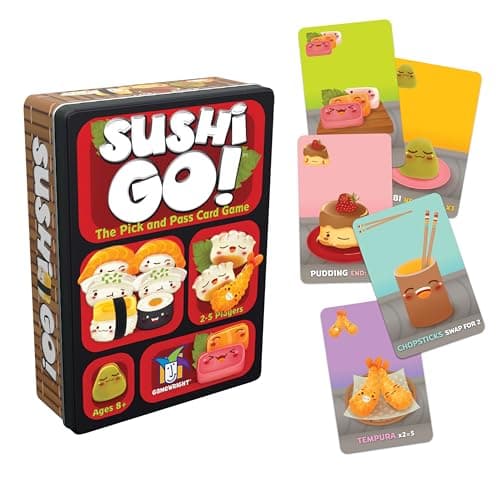
Sushi Go!

108 cards in a box the size of a phone, two to five players, taught in two minutes and finished in fifteen — the travel game with the fewest excuses.

$11.99View on Amazon

Price as of October 22, 2026. Prices change — Amazon's is the one that counts.

#ad · we may earn a commission from this link to Sushi Go!

Why it wins, and who should skip it ↓

Buy for the surface, not for the game. Every recommendation list in this category ranks games the way a hobby shop would — by how clever they are. That is the wrong axis. A travel game is played on an economy tray table that tilts when the seat in front reclines, on a knee in a moving car, on a hostel bunk, or on a picnic table in wind. Decide which of those it has to survive and the shortlist writes itself. Everything else is a preference.

The surface decides the game

There are four travel surfaces, and they are genuinely different problems.

An airplane tray table is a little bigger than a sheet of letter paper, a drink takes a quarter of it, and it slopes the moment somebody in front reclines. It supports one shared deck and one small spread per player. It does not support anything that needs to be laid out in a grid, and it does not support dice.

A carhas no surface at all. Anything played here has to work in the hands, or in the air, and it cannot require reading — a proportion of passengers get carsick looking down at cards, and the driver is a player who cannot look at anything. This is the narrowest constraint in the category and it is why almost nothing on a conventional “best board games” list belongs in a car.

A hotel room, rental kitchen or cabin table is a real table. Anything works, which is why the games people remember from trips are almost always the ones played here. If the trip is a week in one place, buy for this surface and ignore the rest.

A campsite bench or a beach adds wind, which specifically kills cards and specifically favors tiles and pieces with mass. It is the one situation where the heaviest pick on this page is the correct one.

Match the pick to the surface and you are most of the way there. The rest of this page is the four other things that decide whether a game survives contact with a trip.

The player count is set by the trip, not by the box

This is the most common way gift buyers get this category wrong. The box says “2–5 players” and the buyer reads that as a range of situations the game covers. It is not. Most games have one count they are actually built for, and the ends of the printed range are compromises.

Sushi Go! supports two and is a much better game at four, because drafting is about what you hand to the person next to you. The Crew is published for three to five with a variant for two, and that variant is a different, smaller experience. Hive Pocket is two players with no variant at all. SKYJO genuinely does work from two to eight, which is rare and is most of the reason it is on this page.

So count the actual trip. A couple needs a two-player game and will resent a party game. A family of four needs something that scales down when one child loses interest. A group of six adults in a rental house needs a game that does not collapse at six. Buying “a good game” without doing that count is how a box ends up unopened — which is the same mistake we describe in travel gifts to avoid, applied to a different shelf.

Loose pieces are a countdown

At home, losing a piece is annoying. On a trip it is terminal, because the game lives in a bag that gets emptied in five different rooms, and because the floor of a rental car is where small objects go to die.

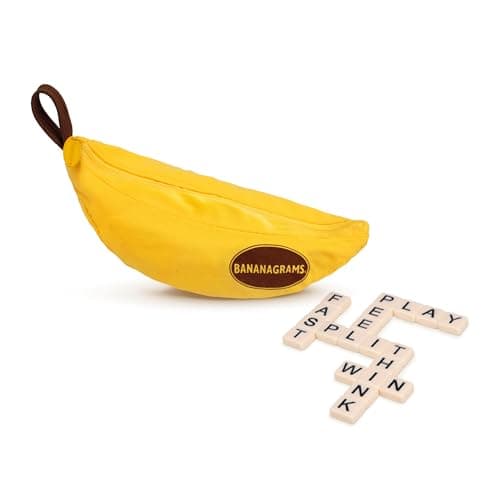
The number to look at is not quality, it is count and consequence. Bananagrams carries 144 tiles in a soft pouch with an open top; it also survives losing a few, because the tile distribution is redundant and nobody notices one missing E. Hive Pocket carries 26 pieces and survives losing none — every piece is a distinct chess-like unit, and a missing beetle is a dead game. Rory’s Story Cubes is nine dice, which is the smallest count here and also the most mobile: a die on a tilted tray table is gone.

Cards are the safe format, and that is most of why five of the seven picks here are card games. A card can be bent, sat on, spilled on and still played. It does not roll under a seat, and a deck stays a deck because it is one object rather than fifty.

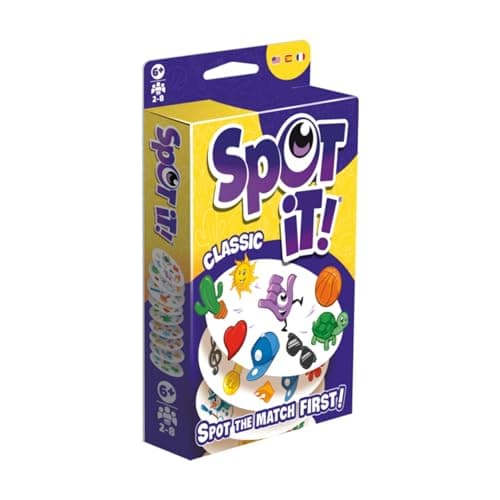
Packaging follows from this, and it is worth checking before you buy. The 2024 refresh of Spot It! moved the pocket edition out of the metal tin the game was famous for into a paper blister — same 55 cards, no protection. Rory’s Story Cubes is sold both in a magnetic box and in a blister, and for travel the box is not a nicety, it is the entire reason to pick that edition. A zipped organizer pouch solves this for anything that arrives naked, and is a genuinely good thing to wrap alongside a game.

Rules you can teach in the boarding queue

The constraint nobody writes down: on a trip, the person who owns the game has to teach it, out loud, to people who are tired, in a place with background noise, without a table to demonstrate on. If the teach takes longer than ten minutes, it does not happen.

This is why a game’s complexity matters less than the shape of its rules. Spot It! is one sentence long — any two cards share exactly one symbol — and can be taught without speaking. SKYJO inverts the usual goal (fewest points wins) and that single flip is the whole lesson. Sushi Go! is take one card and pass the rest, with the scoring explained as you go. All three are teachable to a stranger.

The Crew is the honest exception on this page, and it is ranked second anyway. It assumes the table already knows how trick-taking works, and if nobody has played hearts or spades, the first twenty minutes is a card lesson before the rules even start. That is a fair price for the best game here — but it is a price, and the person you are buying for needs to be someone who will pay it.

Reading and language are the real accessibility spec

Three of these games have no text in play at all: Hive Pocket, Spot It! and Rory’s Story Cubes. That is not a minor feature. It means they work between a grandparent and a six-year-old, between people who share no language, and in a moving vehicle where reading makes people ill.

At the other end, Bananagrams is not just English-dependent, it is English-competence-dependent, and it quietly humiliates non-native speakers at a table of native ones. It is a brilliant game and a bad choice for a mixed international group. SKYJO splits the difference by printing its rules in five languages, which is a small thing that tells you the publisher thought about who was playing.

If the gift is for somebody heading abroad to live rather than to sightsee — a semester, a posting, a long stint — a text-free game is worth far more than a clever one, for exactly this reason. The same logic runs through gifts for study abroad students.

Noise, turn length and the person in 22C

Two practical things that only matter in transit.

Noise. A game that requires shouting, buzzing or slapping the table is unplayable on a plane and unwelcome in a hostel common room. Nothing on this page is a shouting game, and that is deliberate. The Crew is actively quiet — its central mechanic restricts players to a single signaled card instead of talking — which makes it one of very few genuinely good games for a night flight.

Turn length.Travel is made of interruptions: the trolley, the seatbelt sign, the gate change. A game with fifteen-second turns and a fifteen-minute round can be abandoned and picked up. A game with a forty-five-minute arc cannot. That is the one real strike against playing SKYJO to a full 100 points in an airport, and the reason Sushi Go!’s three quick rounds beat it there.

Airport security: there is no rule to worry about

TSA’s What Can I Bring? database runs to hundreds of entries and contains nothing for playing cards, dice or board games, because none of them are restricted items. Cards, tiles, dice and paper travel in carry-on or checked bags without a second thought.

There is one practical wrinkle, and it is about density rather than legality. A tightly packed block of tiles reads oddly on an X-ray, and AFAR has published an account of one of its own staff members running into repeated trouble bringing Bananagrams through security. That is a bag check, not a confiscation — but if you are the kind of traveler who budgets zero minutes for the checkpoint, a pouch of 144 wooden-feeling tiles is the one item here that might cost you two. The liquids and battery rules in our TSA liquids guide and the power bank rules are the ones actually worth reading before a flight.

Are “travel editions” worth buying?

Usually not, and it is worth saying plainly because the search term “travel game” surfaces a lot of them. A travel edition of a big-box game is typically the same game with smaller pieces, a cardboard mat instead of a board, and a price that has not come down much. Smaller pieces are worse on a tray table and worse in a car — the whole problem is that things move.

The games that travel well were designed small in the first place. Every pick on this page is a full game in its normal retail form, not a shrunken version of something else. Hive Pocket is the one apparent exception and it proves the rule: the pocket version is the same game with slightly smaller pieces plus two expansions in a travel bag, which is why serious players buy that edition at home too.

The magnetic travel chess and backgammon sets are a separate case. They genuinely solve the sliding problem, and if the recipient already loves one specific classic game, a magnetic set of it is a better present than anything here. We have not ranked one because the category is almost entirely unbranded listings that come and go, and we will not name a product we cannot expect to still exist in three months.

Buying a game as a gift

A game is the only gift on this site that the recipient cannot use alone. That changes the decision in three ways.

First, you are buying for a group, not a person. Picture the actual table: how many, what ages, who will be tired, who does not play games. The best game for the recipient is frequently not the best game for the people they travel with, and the game that gets played is the one everybody at the table agreed to.

Second, somebody has to propose it. A game needs a champion — the person who gets it out of the bag and talks three others into it. If the recipient is not that person, buy a two-player game they can start with one other human, or buy something else entirely.

Third, the whole category is cheap, so use that. Most of this page costs less than a restaurant lunch. That makes a game a poor standalone present for an adult and an excellent second item: in a stocking, beside a travel journal, or as the thing that makes a bigger gift feel considered rather than transactional. We work through that arithmetic in how much to spend on a travel gift. For a family, two games at different player counts is a better twenty-five dollars than one game at twenty-five, which is why gifts for families who travel treats them as a pair.

One last practical note. Three of these games need score tracking and only SKYJO includes a pad, so a pen is part of the gift whether you planned it or not — and the pen in a checked bag is not always the pen that survives the flight, which is a rabbit hole we went down in the best pens for travel journaling.

How we ranked these

Scored against our published rubric from publishers’ own specifications, retailer contents listings and aggregated owner feedback. We do not run a lab and we do not claim measurements we have not taken; where a figure comes from a publisher or a retailer we say which one below.

Usefulness is weighted toward the number of real travel situations a game covers rather than how good it is at its best one — a game that only works at a dining table with four adults is a narrower product than one that works at a gate with two. Portability counts the packed footprint and the consequence of losing a piece, not just weight. Durability is about format and packaging: cards in a box beat cards in a blister, and solid tiles beat both. Value rewards the cheap picks honestly, which is why the seven-dollar filler scores a perfect ten there and still finishes fifth. Giftability is the honest penalty: a storytelling toy for six-year-olds is an excellent object and a thin present for an adult, and the scores say so.
The short answer

Quick picks

#GiftBest forScorePrice
01
Gamewright Sushi Go!
Sushi Go!

108 cards in a box the size of a phone, two to five players, taught in two minutes and finished in fifteen — the travel game with the fewest excuses.

Almost any trip, almost any group of two to five
8.4
$11.99Amazon
02
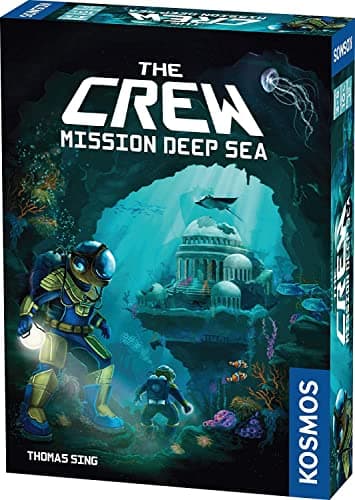
Thames & Kosmos The Crew: Mission Deep Sea
The Crew: Mission Deep Sea

A cooperative trick-taking campaign in a deck-sized box: the one game here that a group of adults will still be talking about on day four.

Three to five adults who want a real game, not a time-filler
8.2
$12.49Amazon
03
Gen42 Games Hive Pocket
Hive Pocket

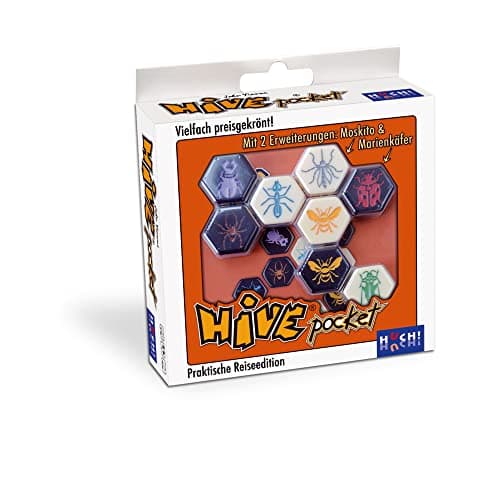
Two players, no board, no text and no luck — the pieces build the board as you play, so it works on a tray table, a bed or a rock.

A couple, a parent and a teenager, or anyone playing the same opponent all week
8.0
$28.88Amazon
04
Bananagrams Bananagrams Classic
Bananagrams Classic

The famous one, and still the best word game to pack — as long as you understand that it needs a table, not a tray.

Hotel rooms, rental kitchens, cabins and campsite picnic tables
7.8
$11.99Amazon
05
Zygomatic Spot It! Classic (Pocket Eco Edition)
Spot It! Classic (Pocket Eco Edition)

Fifty-five cards, no reading, no turn order and barely any rules — the one game that genuinely works with a six-year-old and a grandparent in the same round.

Mixed ages, mixed languages, and the ninety seconds before boarding
7.6
$6.59Amazon
06
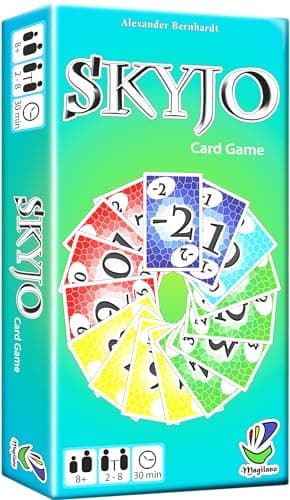
magilano SKYJO
SKYJO

The one box that genuinely covers two players and eight, taught in three minutes, with a score pad already in it.

A big mixed group — families, in-laws, a table of friends of very different ages
7.4
Check price →
07
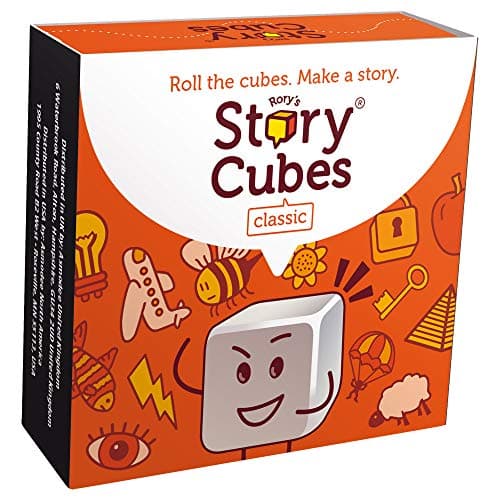
Zygomatic Rory's Story Cubes Classic (Box)
Rory's Story Cubes Classic (Box)

Nine picture dice in a magnetic box: no reading, no winning, and the only thing here that works for a child in a moving car.

Car journeys, young kids, and anyone who gets motion sick reading
7.2
$14.99Amazon

#ad · Live prices from the Amazon Product API, as of October 22, 2026. Where we have no verified live price, we show none — we would rather leave a gap than print a number that has gone stale.

In detail

The picks, in full

01
Gamewright Sushi Go!

Almost any trip, almost any group of two to five

Sushi Go!

2-5 players, ages 8+108 cards, no board15-minute play time4 x 5.6 x 1.5 in box
8.4/10

108 cards in a box the size of a phone, two to five players, taught in two minutes and finished in fifteen — the travel game with the fewest excuses.

Usefulness
9
Portability
9
Durability
7
Value
9
Giftability
8

Good

  • Gamewright publishes the box as 4 by 5.63 by 1.5 inches — the smallest real footprint on this page, small enough that it disappears into a jacket pocket rather than negotiating for bag space
  • It is a pick-and-pass drafting game, so everybody chooses at the same time instead of waiting three turns for their go: the single most valuable property a game can have on a plane
  • The whole rule set is take one card, pass the rest, plus a scoring page — it can be taught across an aisle to somebody who does not play games
  • Cards only. Nothing rolls, nothing tips, and nothing is lost forever when the seat-back pocket eats it: a bent card does not end the game

Trade-offs

  • Each player builds a spread of face-up cards in front of them, and five players' worth of spreads needs a real table rather than two tray tables
  • Gamewright's contents list is 108 cards and the rules — there is no score pad, so somebody has to have a pen and paper for the three-round total
  • Ages 8+ is honest: the scoring combinations (sashimi sets, wasabi multipliers) are arithmetic, and a six-year-old will need a helper
  • Two-player drafting is thin. It works, but passing a hand back and forth between two people is a much smaller game than it is with four

Skip it if…

…the recipient travels as a couple and plays only with each other. Sushi Go! supports two, but it comes alive at four — for a pair, a dedicated two-player game is a far better present.

$11.99View on Amazon

Price as of October 22, 2026. Prices change — Amazon's is the one that counts.

#ad · we may earn a commission from this link to Sushi Go!

02
Thames & Kosmos The Crew: Mission Deep Sea

Three to five adults who want a real game, not a time-filler

The Crew: Mission Deep Sea

3-5 players (2-player variant)Ages 10+, about 20 minutesCards only, no boardNumbered mission campaign
8.2/10

A cooperative trick-taking campaign in a deck-sized box: the one game here that a group of adults will still be talking about on day four.

Usefulness
9
Portability
9
Durability
7
Value
9
Giftability
7

Good

  • Cooperative, so nobody is knocked out and nobody spends the flight losing — the group either completes the mission or retries it, which is a completely different social experience from a competitive card game
  • The campaign structure is the travel feature: missions are numbered and get harder, so the box picks up exactly where the last hotel-room session stopped instead of resetting
  • Communication is deliberately restricted to one signaled card per player, which means the game is genuinely quiet — a real consideration in seat 22B at 11pm
  • Cards and a mission log, nothing else. It is a deck-sized box, and at the price it is the most game per ounce on this page

Trade-offs

  • The Kosmos box is published for 3 to 5 players with a variant for two, and that two-player variant is a compromise rather than the real game
  • Trick-taking is assumed knowledge. If the group has never played hearts, spades or euchre, the first twenty minutes is a card-game lesson before the actual rules start
  • Ages 10+ and it means it — this is the most explanation-heavy pick here, and the wrong thing to hand to a restless eight-year-old
  • Published mission counts differ between retailer listings, so treat the exact length of the campaign as unverified until the box is open

Skip it if…

…the trip is a couple's trip. Two people can play it, but you are buying the variant rather than the game — Hive Pocket is the better two-player gift at a similar price.

$12.49View on Amazon

Price as of October 22, 2026. Prices change — Amazon's is the one that counts.

#ad · we may earn a commission from this link to The Crew: Mission Deep Sea

03
Gen42 Games Hive Pocket

A couple, a parent and a teenager, or anyone playing the same opponent all week

Hive Pocket

2 players, ages 9+26 pieces, 25 mm acrossNo board — pieces form itSoft travel bag
8.0/10

Two players, no board, no text and no luck — the pieces build the board as you play, so it works on a tray table, a bed or a rock.

Usefulness
8
Portability
8
Durability
9
Value
6
Giftability
9

Good

  • Gen42 is explicit that there is no board: the pieces are added to the playing area and become the board, which is why it plays on surfaces that would defeat anything with a fold-out map
  • Zero text and zero language dependency — it crosses a language barrier the way chess does, and it can be taught by demonstration in a few minutes
  • The Pocket edition includes the Mosquito and Ladybug expansions in the box, so the version that fits in a bag is also the version experienced players actually want
  • Solid pieces 25 mm across and 10 mm deep have real mass. They do not slide off a tilted tray table or blow off a campsite bench the way cards do

Trade-offs

  • Strictly two players. There is no variant, no team mode and no way to include a third person except as a spectator
  • Twenty-six loose pieces in a drawstring bag is a real loss risk, and unlike a bent card a missing beetle ends the game permanently
  • No luck at all, which sounds like a virtue and is a problem for a couple — the stronger player wins every single time, and that gets old by the second evening
  • The most expensive pick here by a wide margin, and the live listing is a third-party one with limited stock at the time of writing

Skip it if…

…there will be three or more people playing. A two-player abstract is a brilliant gift for one pairing and useless to a family of four — buy SKYJO or Sushi Go! instead.

$28.88View on Amazon

$35.0017% off

Price as of October 22, 2026. Prices change — Amazon's is the one that counts.

#ad · we may earn a commission from this link to Hive Pocket

04
Bananagrams Bananagrams Classic

Hotel rooms, rental kitchens, cabins and campsite picnic tables

Bananagrams Classic

144 letter tilesFabric banana pouchNo board, no pencilEveryone plays at once
7.8/10

The famous one, and still the best word game to pack — as long as you understand that it needs a table, not a tray.

Usefulness
7
Portability
7
Durability
8
Value
9
Giftability
8

Good

  • The pouch is the design. A soft fabric case squashes into the gap between a packing cube and a shoe in a way no rigid box can, and it weighs almost nothing
  • The published contents are a pouch, 144 tiles and an instruction sheet — there is no board to unfold, no pencil to find and no score pad to lose
  • Everybody plays simultaneously and the round ends when somebody uses their last tile, so there is no downtime and no turn order to police
  • Near-universal name recognition, which matters for a gift: the recipient knows what it is the moment the wrapping comes off, and knows it is good

Trade-offs

  • It needs the most table space of anything here by a wide margin — every player grows a crossword grid, and the seat in front reclining will wreck it
  • 144 small tiles is the highest loss risk on the page, and the pouch is open at the top once the drawstring is loose
  • Purely English and purely literate: it punishes non-native speakers and anyone who finds spelling stressful, which makes it a poor choice for a mixed international group
  • AFAR reports one of its own staffers repeatedly running into trouble bringing Bananagrams through airport security — a pouch of 144 dense tiles is exactly what draws a bag check

Skip it if…

…the travel in question is mostly flying. This is a game for the place you arrive at, not the seat you get there in — on a tray table it simply does not fit.

$11.99View on Amazon

$15.9925% off

Price as of October 22, 2026. Prices change — Amazon's is the one that counts.

#ad · we may earn a commission from this link to Bananagrams Classic

05
Zygomatic Spot It! Classic (Pocket Eco Edition)

Mixed ages, mixed languages, and the ninety seconds before boarding

Spot It! Classic (Pocket Eco Edition)

2-8 players, ages 6+55 cards, 5 mini-gamesNo reading requiredRounds last seconds
7.6/10

Fifty-five cards, no reading, no turn order and barely any rules — the one game that genuinely works with a six-year-old and a grandparent in the same round.

Usefulness
7
Portability
10
Durability
5
Value
10
Giftability
6

Good

  • Any two cards in the deck share exactly one symbol, and that single fact is the entire rule set — it can be explained without words to somebody who does not speak yours
  • Asmodee publishes it as 2 to 8 players, ages 6+, at under fifteen minutes, and the five included mini-games let you re-pitch it when a child gets bored of the first one
  • A round takes seconds rather than minutes, which is the only format that fits a taxi queue, a delayed gate or the last descent before landing
  • The cheapest pick here by a distance, which makes it the obvious thing to add to a larger gift rather than agonize over

Trade-offs

  • The 2024 refresh moved this edition out of the metal tin the game was famous for — contents are 55 cards and a rulebook in a paper blister, so loose cards will bend in a backpack
  • If the tin matters, Asmodee still sells the Eco Sleeve edition with one included at roughly double the price; buy that one for a bag that gets thrown around
  • It is a pure reflex game, so it is genuinely unfair across ages and eyesight — an adult who wants to think will be bored in one round
  • Round after round of the same 55 cards gets familiar fast; this is a filler, not an evening

Skip it if…

…the recipient wants a game with decisions in it. Spot It! is a test of pattern-spotting speed, and for an adult who plays board games it is a warm-up rather than a gift.

$6.59View on Amazon

Price as of October 22, 2026. Prices change — Amazon's is the one that counts.

#ad · we may earn a commission from this link to Spot It! Classic (Pocket Eco Edition)

06
magilano SKYJO

A big mixed group — families, in-laws, a table of friends of very different ages

SKYJO

2-8 players, ages 8+150 cards + score padRules in 5 languages15-45 minutes
7.4/10

The one box that genuinely covers two players and eight, taught in three minutes, with a score pad already in it.

Usefulness
8
Portability
9
Durability
6
Value
8
Giftability
6

Good

  • Two to eight players out of one box is the widest span on this page, which is the thing that matters when the group is a family plus whoever else is at the table
  • It ships with a score pad and rules in English, Spanish, French, German and Italian — the only pick here that solves scoring and language inside the box
  • The goal is to finish with the fewest points, and that inverted objective is the whole teach: three minutes, and a table of eight is playing
  • Luck-heavy in the way that keeps a mixed-ability table together — a child can beat an adult, which is exactly what you want on night three of a family trip

Trade-offs

  • Every player lays out a twelve-card grid in front of them, so eight players need a dining table; this is not a tray-table game and it is not a car game
  • It is mostly luck. A player who wants decisions to matter will find a full game to 100 points frustrating rather than tense
  • Published play time runs 15 to 45 minutes, and the long end of that is a real commitment when the alternative is a 15-minute round of something else
  • The cards take heavy shuffling every round and the stock is ordinary — expect them to look tired after a couple of trips

Skip it if…

…they want a game where skill decides the winner. SKYJO is a social leveler by design, which is a feature for a family table and a flaw for two competitive adults.

Check price on Amazon →

No buyable offer at the last price check (October 22, 2026). We show nothing rather than a stale number.

#ad · we may earn a commission from this link to SKYJO

07
Zygomatic Rory's Story Cubes Classic (Box)

Car journeys, young kids, and anyone who gets motion sick reading

Rory's Story Cubes Classic (Box)

9 dice, 54 imagesAges 6+, 1 or more playersMagnetic boxNo reading required
7.2/10

Nine picture dice in a magnetic box: no reading, no winning, and the only thing here that works for a child in a moving car.

Usefulness
6
Portability
10
Durability
8
Value
7
Giftability
5

Good

  • No reading and no text at all, which makes it the one pick here that works in a car — nobody has to look down at cards while the road moves
  • The magnetic box is the reason to buy this edition rather than the blister version: it keeps nine loose dice together, and nine loose dice are otherwise a disaster in a vehicle
  • Playable solo, which nothing else on this page is. A six-year-old can roll and narrate alone for a surprisingly long stretch
  • There is no winning and no losing, so there is no meltdown — a genuinely underrated property in a gift aimed at a family with small children

Trade-offs

  • Nine dice will go under the seats the first time somebody rolls them on a moving surface. Roll them into the box lid or a bag, not onto a tray table
  • It is a prompt generator rather than a game: there is no objective, no scoring and nothing to win, and a competitive player will lose interest immediately
  • It needs an adult willing to play along enthusiastically. Handed to a child alone in the back seat, it lasts about four minutes
  • The 54 images become familiar quickly for adults, which is why the many themed sets exist — the classic set on its own is a children's purchase

Skip it if…

…the recipient is an adult who plays games. This is a storytelling toy for children and for the families with them, and it is not a gift for a grown-up who wanted something to play.

$14.99View on Amazon

Price as of October 22, 2026. Prices change — Amazon's is the one that counts.

#ad · we may earn a commission from this link to Rory's Story Cubes Classic (Box)

How to choose a travel game

1. Where will it actually be played?

Answer this first and answer it honestly. A tray table means cards and one small spread per player. A car means no surface, no reading and no loose dice outside a lid. A hotel or cabin table means anything goes. Wind means tiles rather than cards. Most bad travel-game purchases are a good game bought for the wrong surface.

2. How many people, really?

Count the trip, not the box. Two people need a game designed for two, not a four-player game with a two-player variant. A family that fluctuates between three and six needs something that genuinely scales — which is a much shorter list than the printed ranges suggest.

3. What is the youngest and oldest person at the table?

A single age gap decides more than any other factor. Ages 6+ with no reading is a different product from ages 10+ with arithmetic scoring. If the table spans a six-year-old and a grandparent, buy the text-free reflex game and buy a second game for the adults after bedtime.

4. Can it be taught in ten minutes, standing up?

If not, it will be taught once, at home, and then not travel. One-sentence rules and inverted-goal rules are the two shapes that survive a tired table. Anything that assumes prior knowledge — trick-taking especially — needs a group that already has it.

5. What happens when a piece goes missing?

Ask the consequence question, not the count question. Losing a letter tile out of 144 is survivable; losing one of 26 unique pieces is not. Cards are the most forgiving format there is, and a rigid or magnetic box is worth more on a trip than it looks worth in a shop.

6. Does it need a pen?

Several of the best travel games track points across rounds and do not include a score pad. That is a two-dollar problem if you notice it and an evening-ruining one if you notice it at a campsite. Check the contents list, and put a pen in the box.

What you should spend

This is the cheapest category on the site, and the honest advice is to spend the money on breadth rather than on one impressive box. The bottom tier — a single small card game — is genuinely good and genuinely disposable, and it is the right thing to slip into a stocking. The middle band buys a proper game with a campaign or a real decision space, and it is where this category is at its best value by a distance. The top of the page is a two-player classic that costs several times a card game and earns it only if the recipient will play the same opponent repeatedly. We publish a live price on every pick rather than a number that goes stale — the buttons above show what each one costs today.

How we chose

We don't run a testing lab — and we say so

Every ranking site in this category implies a test bench. We don't have one. We compile the published specs (real dimensions, weight, capacity, TSA and cabin-size compliance), do the arithmetic a gift buyer actually cares about, pull live prices so nothing is stale, and score each pick against a published rubric. The scores are judgments from documented research — not measurements we took. Where a fact came from a manufacturer or a retailer, we name and link them in Sources.

Questions

Frequently asked

What is the best travel game?
For most trips and most groups, Sushi Go! — 108 cards in a box Gamewright publishes at 4 by 5.63 by 1.5 inches, two to five players, taught in about two minutes and over in fifteen. It is a drafting game, which means everybody chooses simultaneously instead of waiting for their turn, and that is the single most useful property a game can have in transit. If the group is three to five adults who already play card games, The Crew: Mission Deep Sea is the better game. If it is exactly two people, buy Hive Pocket instead.
What is the best travel game for two people?
Hive Pocket. It is designed for two with no variant and no compromise, it has no board — the pieces build the playing area as you place them, per Gen42’s own description — and it contains no text, so it travels across languages. The pieces are 25 mm across and heavy enough not to slide off a tilted surface. The one warning: there is no luck in it at all, so if one of the two is clearly stronger, they will win every game, and that dynamic sours a week faster than people expect. A couple who wants a closer contest is better served by a card game with some chance in it.
What travel games work on an airplane tray table?
Card games with a small personal spread, and nothing else. Sushi Go! and The Crew both work with a shared deck and a modest area per player. Spot It! works because a round needs one card face up. What does not work: anything needing a grid in front of every player (SKYJO’s twelve-card layout, Bananagrams’ growing crossword) and anything with dice, because a tray table slopes the moment the seat in front reclines. If you only take one game on a flight, take a card game with simultaneous turns.
Can you take board games, cards and dice on a plane?
Yes. TSA’s What Can I Bring? list has no entry for playing cards, dice or board games at all, which is what you would expect for items that are simply not restricted — they go in carry-on or checked bags freely. The only practical issue is density: a tightly packed mass of tiles can look unusual on an X-ray and earn a bag check. AFAR has published an account of a staff member having repeated trouble bringing Bananagrams through security for exactly that reason. It is an inconvenience, not a prohibition.
What are the best travel games for kids?
For a mixed-age table, Spot It! Classic: Asmodee publishes it at ages 6+ for two to eight players, it needs no reading, and a round is over in seconds, so a child who loses interest has not derailed anything. For a car specifically, Rory’s Story Cubes in the magnetic box — nine picture dice, no reading, no winner, and nothing to melt down about. For an eight-year-old and up who can handle scoring, Sushi Go! is the one that adults also enjoy, which matters more than it sounds.
What is a good game to play in the car?
Almost nothing on a conventional games list works in a car, because there is no surface, because reading in a moving vehicle makes a proportion of passengers ill, and because the driver is a player who cannot look at anything. That leaves games played in the hands or out loud. Rory’s Story Cubes is the pick here: roll the dice into the box lid rather than onto a seat, and the game is spoken from that point on. Card games belong to the hotel room at the end of the drive, not to the drive.
Are travel editions of board games worth it?
Usually not. A travel edition is often the same game with smaller pieces and a cardboard mat, and smaller pieces are worse on a sloping tray table and worse on a car seat — the entire problem is that things move. The games that travel well were designed small to begin with, and every pick on this page is a full retail game rather than a shrunken one. Hive Pocket is the useful exception: the pocket edition adds two expansions and a travel bag, so it is what many players buy at home as well.
Is a game a good gift for a traveler?
It is a very good second gift and a weak standalone one for an adult. Nobody can play a game alone, so you are really buying for the group they travel with — count that table before you choose, and make sure the recipient is the sort of person who will get the box out and talk three others into it. The category is cheap enough that the right move is usually two games at different player counts, or one game alongside something larger. For a family trip in particular, a filler for the gate and a real game for the evening is a better pairing than one expensive box.

Keep reading

Receipts

Sources

We don't run a testing lab, and we don't pretend to. Product facts come from manufacturer spec sheets and retailer listings, which we name and link. Where we couldn't verify something, we say so on the page rather than quietly leaving it out. Read our full method.