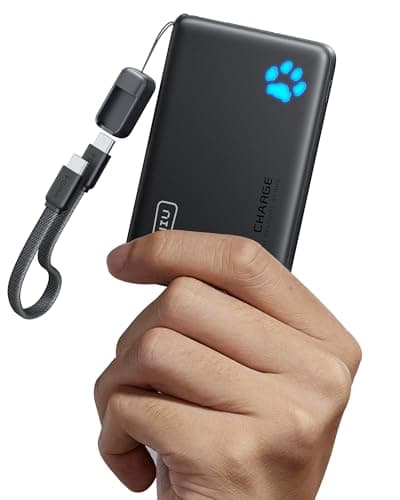
The INIU 45W 10,000mAh is the pick under $50, and it is for the traveler who wants one bank that charges a phone fast and can also put a useful amount into a small laptop or a tablet — wattage that used to cost twice this. The budget pick is the Anker 10,000mAh PowerCore: the cheapest thing here that does the core job properly, and the safest can’t-go-wrong gift in the category. Every price below is read live from our price layer and stamped with an as-of date — the $50 band describes those prices on that date, not forever.
Capacity is no longer the interesting question
Power bank listings still shout about milliamp-hours because it is the easiest number to make big. Under $50 it has stopped mattering, for two reasons.
The first is that 10,000mAh is the practical sweet spot and it is cheap. That is roughly two full phone charges, in an object that fits a jacket pocket and weighs about as much as a phone and a half. Going to 20,000mAh doubles the capacity and roughly doubles the weight and bulk, which is a real cost on a trip where everything is carried. Most travelers who buy the bigger one end up wishing they had the smaller one, and the people who genuinely need 20,000mAh know exactly why.
The second is that the airline limit is not close. Every bank on this page is far below the watt-hour threshold where airline rules start to bite, so there is nothing to think about at this capacity — the only hard rule is that a power bank travels in the cabin, never in a checked bag. We set out the detail, including how to convert mAh to watt-hours, in can you take a power bank on a plane, and it is worth reading before buying anything larger than this band contains.
With capacity settled, what actually differs under $50 is the cable situation — and that is a question about the recipient rather than the product. Three answers exist, all of them on this page.
- They carry cables and do not lose them. Buy the plain bank with the best ports and wattage for the money. Nothing else is worth paying for.
- They leave the cable at home, every time. Buy the one with the cable physically attached. This is the single most useful feature in the category and it is only a few dollars.
- They have a recent iPhone and hate cables entirely. Buy the magnetic one. It snaps on and charges with nothing plugged in, which is slower and much more pleasant.
How we built the band
Three rules, so the page stays honest as prices move.
- A pick only appears if the live price layer shows it under $50. No product record on this site has a price field at all — every number in the comparison table is read at render time from the price layer and stamped with the date it was collected. If something crosses the line, the displayed number says so.
- At least three qualifying picks, or no page. Five qualify here, which is comfortably a shortlist. That is also why this is the $50 band: at $25 there are not three travel-grade banks with a live price, so we did not build that page.
- Anything over the line is prose, not a pick. One bank we rate highly sits above this band and is worth naming: the Anker 737 at 24,000mAh, which is the one to buy if the real job is charging a laptop on a long haul. It is not on this page because it is not under $50.
Beyond price, the ranking criteria are output wattage, port count and mix, whether a cable is integrated, and pocketability — and we weight published specifications over marketing adjectives. We compile listing specifications and manufacturer documentation, score each pick against our published rubric, and publish no measurements of our own, because we have no lab and do not pretend to.
Which bank for which traveler
The best value, and the default recommendation. The INIU 45W. The reason it tops the band is the wattage: 45W out of a 10,000mAh bank is enough to put a meaningful charge into a tablet or a small laptop rather than just trickling a phone, and at this money that used to be impossible. For a digital nomad or anyone who works on a plane, it is the pick.
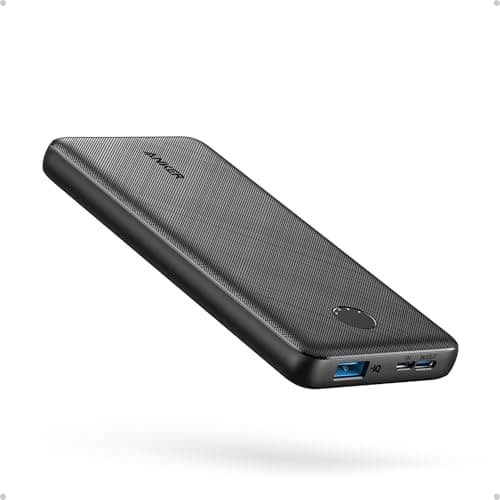
The safe gift for anybody at all.The Anker 10,000mAh PowerCore — our budget pick. Pocket-size, roughly two phone charges, USB-C in and out, and a brand with a reputation that means the recipient will trust it. This is the power bank to buy when you do not know what phone they have, how they travel or what they already own. It is the single most can’t-go-wrong tech gift on this site.
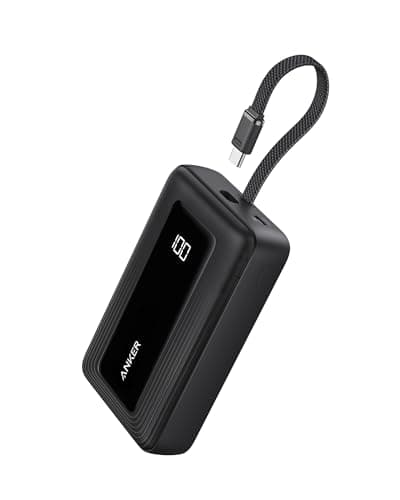
Long travel days, or more than one device. The Anker Zolo 20,000mAh with a built-in cable. Double the capacity and the cable attached, which is an unusual combination under $50. The trade is weight and bulk — this is a bag item, not a pocket item. Buy it for a delayed-travel-day person: airport, train, taxi, hotel, phone plus headphones plus a watch.
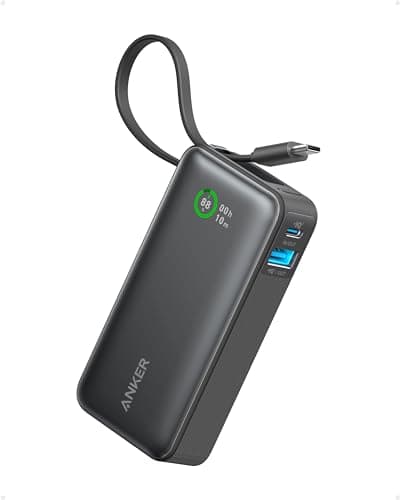
The person who always forgets the cable. The Anker Nano with a built-in USB-C cable. The whole pitch is one sentence: there is no cable to forget, because it is attached. It also keeps extra USB-C and USB-A ports for somebody else’s phone. If you have ever watched the recipient borrow a cable in an airport, this is the gift. We reviewed it on its own in our Anker Nano power bank review.
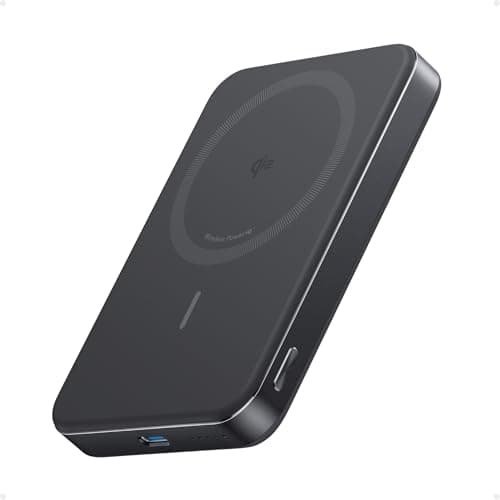
A recent iPhone owner who hates cables. The Anker MagGo with Qi2 magnetic charging. It snaps onto the back of a compatible iPhone and charges wirelessly, with a fold-out stand so the phone becomes a screen on a tray table. Wireless charging is slower and less efficient than a cable — we are not going to pretend otherwise — and it is nonetheless the one people reach for, because the friction is zero. It is the pick in this band for an iPhone household.
What to check before you buy
What phone they have, if you are buying for the cable. A built-in USB-C cable is the right call for every modern Android phone and every recent iPhone. Magnetic charging only works on iPhones with the magnet array. If you do not know, buy the plain bank.
Whether they need output wattage or just capacity. A phone does not benefit from 45W. A tablet or a thin laptop does, a lot. If the recipient never charges anything bigger than a phone, the cheaper bank is genuinely the better buy and the extra wattage is money spent on a spec they will not use.
Where it will live. A 10,000mAh bank fits a jacket pocket and will be carried daily. A 20,000mAh bank lives in a bag, and a bag item that is not in the bag on the day is worth nothing. Our tech organizer roundup is the other half of this problem — a power bank nobody can find in a backpack is a power bank that is flat.
It flies in the cabin. Always. Not in a checked bag, not in a bag you plan to gate-check. This is the one rule in the category that is not a preference.
Buying it as a gift
Power banks are one of the most reliable travel gifts there is, for a slightly unflattering reason: almost everybody needs one, most people own a bad one, and nobody replaces a bad one until it fails at an airport. A good bank from a brand the recipient recognizes is a straightforward upgrade to something they use weekly.
The bundle that works is a bank plus a cable organizer, because the two failures are a flat battery and a bag with no cable in it. Under fifty dollars that is a complete fix, and it reads as thought rather than as supplies. For more at this budget see travel gifts under $50, and for the whole category — including the bigger banks and the laptop-capable ones — the full power bank roundup is the page.
10,000mAh is the number, not the biggest number
Two phone charges in a pocket-sized object. Doubling capacity roughly doubles the weight and bulk, and the weight is carried every day for a benefit used occasionally. Buy bigger only if the real job is a laptop.
Decide the cable question first
It is the only thing that genuinely differs under $50. Built-in cable for the person who forgets cables, magnetic for a recent iPhone, plain and high-wattage for everyone who manages their own cables.
Wattage matters for tablets, not phones
45W out of a small bank is transformative for a tablet or a thin laptop and irrelevant to a phone. Do not pay for output the recipient has nothing to plug into.
Read the price with its stamped date
The band here describes live prices on the date shown in the comparison table. We never print a number we have not just read, and where we have no verified price we show a check-price link instead.
It travels in the cabin, every time
Lithium batteries are not permitted in checked baggage. Every bank in this band is far below the watt-hour threshold where airline approval becomes a question, so the only rule that applies is keeping it with you.
Buy the organizer at the same time
A power bank that cannot be found in a backpack is a flat power bank. A small tech pouch turns it from a thing in a bag into a thing you can reach, which is most of what makes it get used.